• No. 285 – The African Consciousness

    The more I read and study Africa’s history, the more I realize I don’t know. Part of that feels overwhelming. More of it is encouraging. The little I’ve scratched shows so much richness, and there is so much more to uncover.

    The more I talk with Black folks in Africa and the diaspora, the more I see how little most of us were given. We know a lot of ancient and biblical history from our sacred texts and a lot of Western history from school. We know a bit of African history, mostly from the slave trade and colonial rule forward, with a little before.

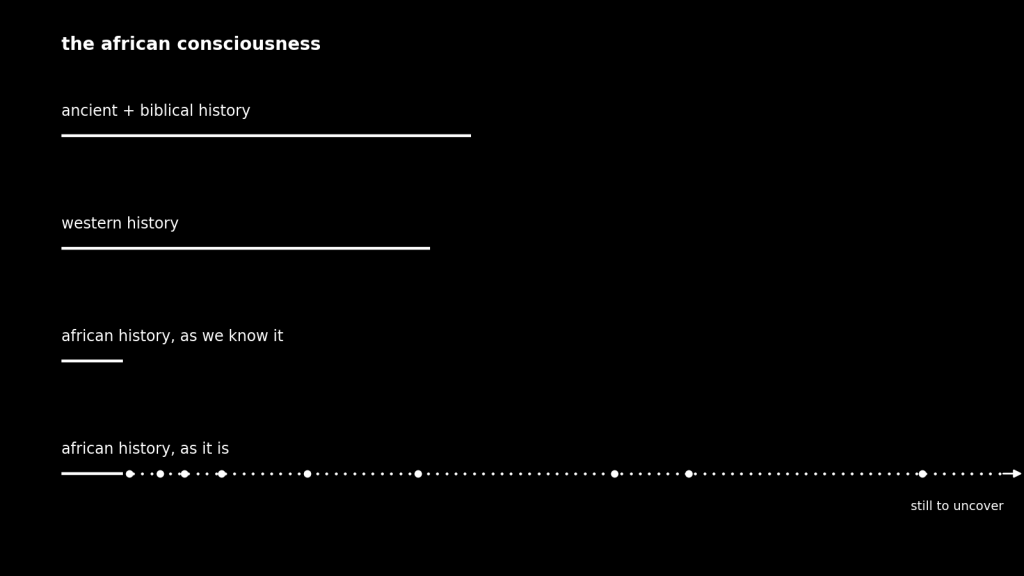
    I sketched it as a chart, “the african consciousness.”

    Chart titled the african consciousness: ancient and biblical history and Western history drawn as long lines, African history as known drawn as a short stub, with a to-scale timeline below running back 300,000 years.

    The top lines are illustrative. Only the bottom timeline is to scale: the solid stub is roughly the last 500 years, Kemet goes back about 5,000, Nabta Playa about 7,000, and the human story in Africa about 300,000. At that scale the dotted line runs hundreds of screens past the edge.

    A review of five US high school world history textbooks found 57 to 62 percent of the content was about Europe. In a 2022 Pew survey, only 23 percent of Black Americans who know some Black history said they learned most of it in K-12 school. 43 percent said family and friends.

    I believe the implications of this gap are social, political, and economic.

  • “As yet I am as strong this day as I was in the day that Moses sent me: as my strength was then, even so is my strength now, for war, both to go out, and to come in.” – Caleb at 85 years old

    “I fight every day, morning, day and night. It has become part of me now. I enjoy fighting.” – Aliko Dangote at 69 years old

    The sermon this past Sunday was on courageous creativity, and the pastor used Caleb to illustrate the concept. I have read the passage in Joshua 14 plenty of times, and appreciated Caleb’s vigor in his advanced age. But I missed a whole detail about the scale of his ambition.

    Here is some context on Caleb. At 40 years old, he was one of twelve men Moses sent to scout Canaan. Ten of the scouts come back afraid. They saw giants. Caleb and Joshua come back ready to take the Promised Land. They saw good land and opportunity. Unfortunately, they were outnumbered by the negative voices. As a result, the people of Israel spend forty years in the wilderness waiting for that generation of folks to die out.

    Fast forward 45 years, and the Israelites have entered the Promised Land. Caleb is now 85. He comes to Joshua and says he is as strong now as the day he was sent out, and he wants what he was promised – the Hill country where the giants lived.

    I missed that detail until this past Sunday. Caleb does not ask for a reward he could take with no effort. He asks for the high ground, where the fortified cities are and where the giant Anak people have a clear view of any attack heading their way. At eighty-five Caleb requests all the smoke. 

    My mind went straight to an interview I watched last week. Aliko Dangote, 69, talking about how he has trained himself to fight.

    Dangote started trading in 1977. In 2026, Dangote took one of his companies public in the largest IPO Africa has seen. Like Caleb, Dangote keeps choosing the mountain. He did not build a regular refinery. He built the largest single-train refinery on earth, at a cost of around twenty billion dollars, 50% bigger than anything before it. He lost five years just getting access to the land, three and a half on one parcel and a year and a half on another, blocked by people he describes as the mafia in the oil business. Midway through a decade of trying to get the project to completion, the naira fell from 156 to the dollar to over 1,900. No port or road in the country could land equipment weighing three thousand tons a piece, so he built the port and the roads. Hills everywhere.

    Asked about the line between thinking big and thinking too big, Dangote said “if you think big you grow big, and if you think small you do not grow at all.” That is a man at 69 pushing himself to think bigger while his age mates are slowing down. Clearly, Caleb and Dangote share ambition in spades. Beyond that, I appreciate the absence of cynicism after experiencing such lengthy delays. 

    Caleb had forty years to turn bitter. He was right about the opportunity in the land, he said so, he was overruled, and he paid for his people’s fear with four decades of his own life. By every reasonable account he should have shown up at 85 asking for ease. Instead he arrives with his appetite intact.

    Dangote had 10 years of blocked land, a currency that lost more than ninety percent of its value, and aggressive rentseekers. He got the refinery done and is now gearing up to build two more, investing $16B in just one of them.

    I am 14 years into a journey that will take several more decades to complete. I have had a taste of the delay and it’s not sweet. What encourages me here is that Caleb and Dangote did not let the waiting shrink what they were willing to go after. 

    Give me this mountain.


    A postscript.

    I am helping three friends I know and trust find their next role in the Washington, DC area. If you are hiring, or you know someone who is, and one of these sounds like your team, please send me a message, and I will make the introduction.

    • Creative director and video producer (13+ years). A multimedia storyteller who founded and runs a creative studio: 80+ clients, 1,000+ videos, 40+ campaigns, and original series with 10M+ impressions and 56% engagement growth. Has led creative teams of up to 60 and mentored more than 20 emerging creatives. Fluent across the full Adobe suite, Final Cut, and CapCut. Best fit: creative producer, content strategist, brand or social content, or video producer. DC / Northern Virginia.
    • Biotech professional transitioning into product and project management. M.S. Biotechnology candidate at Johns Hopkins University (Bioinformatics), with hands-on regulatory affairs experience supporting IND, NDA, and BLA submissions, early-stage venture operations, and 10+ years of event production and operations experience. Translates complex ideas into roadmaps, workflows, experiences, and executable plans, with working knowledge of Python and SQL. Target roles: Associate Product Manager, Project Manager, Product Operations, Program Manager, or Regulatory Project Manager across biotech, life sciences, healthcare, and technology. Based in DC; open to VA and remote opportunities.
    • Brand and messaging strategist and storyteller with 15+ years experience. A communications leader who has directed brand and story for institutions, nonprofits, and media, including a documentary that raised $1M, and founded a subscription writing business that had paying customers in its first month. Currently a graduate student in the humanities in DC. Best fit: brand strategy, messaging, content, or communications. DC area.
  • When I was a kid, maybe 9 or 10, we got our first computer. I could not stop exploring it. I would stay up way past my bedtime downloading games over a dial-up connection, hoping they would finish by morning. I tried to figure out Excel, bought and failed at learning AutoCAD all in efforts to design cars, and found new ways to get myself in trouble. I told people I wanted to be a computer engineer. I did not fully know what that meant. I just knew I wanted to build things.

    I went in a different direction, but never lost the desire to push my bounds technologically. I’ll never forget glitching the servers at my first job while trying to find a better way for my team to collaborate. I have been thinking about AI since 2018 or so, but did not have the technical chops to do much with the tools I came across, until ChatGPT came out. The past several years, I have kept up with as many platforms as possible to experiment and see what comes up. The past two months have felt different. I am not a technical person, yet I am now very active on GitHub. The range of products have helped me commit thousands of lines of code, stand up over a dozen GitHub repositories, and run experiments late into the night. Part of me feels like I’m 10 again waking up to see what finished running overnight. The creative part of my brain and the technical possibilities of this moment are speaking the same language, and it is opening things up for me.

    The second thing sitting with me is Anthropic’s announcement of a $100m investment in building out its partner network. I immediately thought of David Steward and the $20B business he built with World Wide Technology, integrating technologies like Microsoft, Cisco, and NVIDIA into enterprises. An entrepreneur who has maintained their child’s eye of the world, while keeping their ear to the streets will build a business multiples the size of WWT. The gap between what the research labs and hyperscalers are releasing and what enterprises are actually capturing in returns is the gap in which that entrepreneur will create a generational business. There is a risk worth naming. At some point, AI may do much of the integration work itself. But there is a window right now.

    Third, my mind goes to Andre M. Perry’s latest research on Black-owned businesses. The number of Black-owned employer firms eclipsed 200k for the first time, providing nearly 2M jobs and $70B in salaries. Who is helping them find creative ways to reimagine their business with AI in their tech stack? Hopefully, the entrepreneur I mentioned earlier comes from, and starts with, this community. There are nearly 6M employer firms in the US. I would love to see 100%+ jumps in the number of Black-owned employer firms in the coming years, through acquisitions or starting from the bottom. It feels like the tech tools available at the moment are sufficient to help make that happen. An improved set of policy tools would set that on an exponential curve.

    Lastly, I reflect on all this and think about the 10-year old kids in Gaza, Sudan, Lebanon, now Iran, and elsewhere who are up late at night worrying about whether they make it to tomorrow. My heart breaks for them, and I think on James 4: “What causes quarrels and what causes fights among you? Is it not this, that your passions are at war within you? You desire and do not have, so you murder. You covet and cannot obtain, so you fight and quarrel. You do not have, because you do not ask. You ask and do not receive, because you ask wrongly, to spend it on your passions.” May God have mercy and guide us to tame our passions and seek peace.

  • No. 282 – On Double-Mindedness

    You could have all the merit, excellence, and intellect in the world. If you don’t have wisdom, you’re likely to find a way to hustle backwards. This has been the lot of the United States at key points in our country’s nearly 250 year history, particularly when it comes to cultivating all that its people bring to the table. Rather, the country has continued to waver at key points in our history where we could have exercised wisdom and done the hard work to root racial disparities out of our system.

    James 1:5-8 outlines the bad effects of this wavering.

    If any of you lacks wisdom, let him ask God, who gives generously to all without reproach, and it will be given him. But let him ask in faith, with no doubting, for the one who doubts is like a wave of the sea that is driven and tossed by the wind. For that person must not suppose that he will receive anything from the Lord; he is a double-minded man, unstable in all his ways.

    The stakes are high. We are entering an exponentially complex time with artificial intelligence maturing into the largest platform shift anyone alive has witnessed. In parallel, through the energy transition, we are attempting to usher in the first technology shift in history that likely will not reap a return in our lifetimes. Both of these shifts are happening at a time when our society appears frayed and the institutions this country relies on don’t look as strong as we’ve held them to be. What we face doesn’t leave room for MEI virtue signaling or surface-level $100M commitments that don’t materialize.

    Sit with the counterfactual that had the country pushed itself, between 1990-2019, to ensure Black folks got the same sort of shots as our White counterparts in the fundamentals – education, jobs, healthcare – we could be looking at $23 trillion in additional GDP.

    I wrote about my dad’s push that if better is possible, good is not enough. I often hear business leaders known for being uncompromising in pushing the bounds in investing, technology, and more, compromise on the pursuit of the ideals of our country saying, “Capitalism is not perfect, but it is the best system we have.” If one of their direct reports followed similar logic in bringing a deal to them, I doubt they would be happy. Similarly, we shouldn’t be happy with the extent to which we have underperformed.

    This is what comes to mind when I see a proclaimation that MEI (Merit, Excellence, and Intellect) would replace DEI as company policy. The people implementing and cheering on these sort of policies, or challenging DEI programs at the Supreme Court are incredibly smart. What seems to be missing is wisdom.

    I met an incredible man a few years ago who works with a prominent family in the UAE. He made a fascinating observation in contrasting Middle Eastern values with those of the US, highlighting that the US was extremely technically skilled. The CEO of the company that has its new MEI policy graduated from MIT with a 5.0, for example. The man went on to state that for all the technical skill that the UAE may not have, it has wisdom, which has enabled it to maximize the resources it does have. Meanwhile, those looking to supposedly flex their commitment to meritocracy stand up strawmen to knock down rather than actually do the right thing and hire the best people.

    This country made a similar decision in bringing Reconstruction to an end. Rather than apply pressure against the racialized infrastructure of the South, a handshake deal pulled Union troops out of the South in exchange for Southern Democrats ending their filibuster of Rutherford B. Hayes legally becoming president and ushered in Jim Crow laws. It took nearly 60 years to reverse the separate but equal precedent set by the Supreme Court in 1896. It was nearly another 20 years before the Civil Rights Act put Jim Crow laws to their end. Unofficial policies like redlining continued to carry forward the spirit of those laws, contributing to McKinsey’s findings that it would take 110-320 years for Black folks to reach parity with White folks at the current rate of change in eliminating structural racial discrimination and the spirit of Jim Crow.

    So, what are we supposed to do with a multi-century deficit and $23 trillion in lost economic activity? I submit that we need to focus our efforts on getting wisdom and exercising it to unlock efforts that shift the trajectory of this country towards one that maximizes what its people bring to the table in efforts to maximize outcomes for everyone. That looks like being aggresive in unearthing the best people for opportunities wherever they may be. That looks like investing boldly in communities that have been boxed out from tapping into their potential for generations. That looks like pulling the plug on complexes that extract rents from the least of these. But it all starts with seeking wisdom. And then it’s about putting that wisdom into practice.

    If we can root out the wavering on eliminating structural disparities in our country and push ourselves to move with wisdom, the times ahead could be really special. But we’ve really got to be about more than merit, excellence, and intellect. We’ve got to tap into wisdom that helps us unlock the full potential of all God’s children. That’s the kind of thing that would push future generations forward.

  • Several years ago, noted artificial intelligence leader Andrew Ng predicted that AI would be like electricity. It would be fundamental to all facets of our lives, but we wouldn’t really notice it running in the background.

    An interesting thing about electricity is that it would not have the impact it does on our lives without copper. The metal conducts electricity beautifully and is the core component of the wires that bring power to our homes from the grid, our rooftop solar panels, generators, or wherever else we’re getting electricity.

    What’s funny about Ng’s prediction is that is that AI too would not have the impact it is increasingly having on our lives without copper. AI requires enormous amount of data to do the things we ask it to do poan significant amount of energy to do the things we ask it to do. The numbers are wild:

    • On average, a ChatGPT query needs nearly 10 times as much electricity to process as a Google search.
    • A single ChatGPT query requires 2.9 watt-hours of electricity, compared with 0.3 watt-hours for a Google search, according to the International Energy Agency. Consider that about 40kW are used in a day by a 3,000 square foot home.
    • A traditional server rack in a data center typically needs between 10-15kW of power. Compare this to the 40-60kW of power needed for AI-ready racks – 4-6x more power and cooling usage.
    • The average size of data center facilities globally has reached 412,000 square feet, a nearly 5x increase since 2010.
    • Globally, over 7,000 data centers are either operational or at various stages of development, double the 3,600 in 2015.
    • Data centers have the capacity to consume a combined 508 TWh of electricity annually if operated continuously, more than the total annual electricity production of Italy or Australia.
    • Between 2022 and 2030, the demand for power will rise roughly 2.4%. Roughly 1 percent points of that will be tied to data centers. That kind of demand increase apparently has not been seen since the early 2000s.
    • Utility companies are being asked to increase the size of their generation fleets by 10-30% to accommodate the growing energy demands. US utilities will need to invest around $50 billion in new generation capacity just to support data centers alone.

    Growing Demand for Copper

    That new investment in generation capacity has me very curious to see what happens to copper demand over the coming decades if AI truly does become like electricity in our lives, not to mention the other big thing driving demand – the energy transition. Currently, Goldman Sachs says that data centers in the US only require about 100,000 metric tons of copper on an annual basis. That is less than 10% of how much copper China uses across all applications per month. I don’t see how that projection makes sense considering the growth figures I outlined above. It seems to me $50B in new generation capacity, just in the US, will require quite a bit more copper. The data back me up:

    • It is estimated that it takes close to 65,000 tonnes of copper per every GW of applied power. The potential incremental copper demand just from the US could range between 0.5-1.5% of global copper demand.
    • Global copper demand is projected to increase by 20% by 2035, reaching 30 million mt/year, driven by electric vehicle production, electricity transmission grid expansion, and renewable power generation.
    • The demand for copper in power transmission and distribution networks is projected to rise to 1.8 million mt by 2035, up from the current 100,000 mt/year.

    Challenges in Copper Production

    Right now, projections for copper supply to meet demand say that things are pretty balanced. Look out over the next several years and you’re looking at copper production needing to double. But there’s a problem. Mining companies pulled back on their investment in copper production many years back for a number of reasons. Investors want to see dividends. Communities reject the development of projects. Companies view the political environment as unstable. The list goes on, and the journey to make up for the underinvestment in projects is a very long one.

    • Global development and expansion capital for primary copper mines peaked at $26.13 billion in 2013.
    • Capital spend on copper projects is estimated to have been only $14.42 billion in 2022.
    • There was an estimated 0.1% reduction year over year in development capital expenditure for copper projects in 2022.
    • The copper market is projected to have a deficit of 54,000 mt for 2024.
    • Total development capex is likely to hover under $8 billion for the time being.
    • New primary copper mines starting up between 2019 and 2022 had an average lead time of 23 years from discovery to commercial production. The time to conduct feasibility studies averaged nearly 6.6 years. Bankable projects averaged two years before construction began. The time between the start of construction and commercial copper production averaged 3.2 years.

    The Tension and Potential Solutions

    There’s a real tension here as it feels like a perfect storm of rising demand and lagging supply. I have so many questions about the role innovation plays all along the mining lifecycle, what the future looks like for the future of our data center demand.

    Prospecting and evalution – What role does AI play in accelerating that work. Wilson, I have questions!

    Development – How do you ensure you’ve really got buy-in from the community in developing the mine? Are there opportunities to more deeply understand the world view of the community and craft a vision for a potential mining operation within that context? Could you more tangibly ensure incentives are aligned? What does it look like for a community to have a real ownership stake in an operation, beyond a new school and job prospects? Perhaps considerations like these prevent large mines from being shutdown? In the same breath, perhaps you get faster clarity on whether there’s alignment to continue development, so you can move on.

    Extraction – What additional technologies are out there that build on the shift to underground mining, in efforts to reduce the environmental impact of the mine?

    Closing/Reclamation – How do we leverage those same considerations in the development phase to craft a vision with the community on what happens to the mine once it is closed? How do we build a vision that goes beyond extraction?

    Data centers – While they are getting more efficient, that efficiency likely leads to boosted workflows and more data centers. The latest version of the hottest chip in the market uses three times more power than its predecessor, and customers show no sign of slowing down on their orders. We have data centers today that can fit eight 767s parked nose-to-tail. How much further are we going on expanding the footprint of these? How creative can we get in building out future data centers? What lessons can we learn from nature in coming up with those new designs?

    Conclusion

    For AI to become electricity, it will need a significant amount of electricity. Providing that electricity will require a significant amount of copper. Our copper production is already slipping into a deficit in an environment where capital expenditures , but copper has been on the back burner when it comes to investment. It will take significant investment to catch up. Those new copper mines that come online need to come online quicker. They and the new data centers that come online will need to be built with more excellence – better for the environment and more efficient. The challenge is real, as is the opportunity for innovation to help alleviate the pressure. I’m excited to learn about the people and organizations driving those innovations.

    Sources:

    O’Keeffe, Dunigan, Grant Dougans, David Crawford, Aaron Denman, Anne Hoecker, Jue Wang, Matthew Crupi, and Jim Wininger. “How to Feed AI’s Hunger for Power.” Bain & Company, www.bain.com/insights/how-to-feed-ais-hunger-for-power/.

    Crooks, Ed. “The Energy Transition Sparks New Interest in Copper Mining.” Wood Mackenzie, 9 Feb. 2024, www.woodmac.com/news/opinion/the-energy-transition-sparks-new-interest-in-copper-mining/.

    Mills, Richard. “Biggest Copper Mines Produced 20% Less Copper in 2023.” Ahead of the Herd, 6 Apr. 2024, aheadoftheherd.com/biggest-copper-mines-produced-20-less-copper-in-2023-richard-mills/.

    Energy Perspectives 2024. Equinor ASA, 2024, www.equinor.com/en/sustainability/energy-perspectives.html.

    Kalinic, Stjepan. “Vale To Boost Copper, Nickel Production With $3.3B Investment – Vale (NYSE:VALE).” Benzinga, 21 June 2024, www.benzinga.com/news/large-cap/24/06/33359723/vale-to-boost-copper-nickel-production-with-3-3b-investment.

    “Views from the Floor – The Copper Bottleneck: What’s the Impact on AI and Net Zero?” Man Institute | Man Group, 26 Mar. 2024, www.man.com/maninstitute/views-from-the-floor-the-copper-bottleneck-whats-the-impact-on-ai-and-net-zero.

    “Global Copper Demand to Rise 20% by 2035 to 30 Million Mt/Year: Nornickel.” S&P Global Commodity Insights, 10 Oct. 2023, www.spglobal.com/commodityinsights/en/market-insights/latest-news/metals/101339-global-copper-demand-to-rise-20-by-2035-to-30-million-mtyear-nornickel.

    “AI Is Already Wreaking Havoc on Global Power Systems.” Bloomberg.com, 28 May 2024, www.bloomberg.com/news/features/2024-05-28/artificial-intelligence-is-already-wreaking-havoc-on-global-power-systems.

    Li, Ying. “Copper Miners Enjoy High Profits, but Development Capital Expenditure Lag.” S&P Global Market Intelligence, 26 Apr. 2023, www.spglobal.com/marketintelligence/en/news-insights/research/copper-miners-enjoy-high-profits-but-development-capital-expenditure-lag.

    Berman, Gregory. “Hedge Funds’ Bullish Copper Bets Run Into China’s Slowdown.” MINING.COM, 22 May 2024, www.mining.com/hedge-funds-bullish-copper-bets-run-into-chinas-slowdown/.

    “AI Is Poised to Drive 160% Increase in Data Center Power Demand.” Goldman Sachs, 14 May 2024, www.goldmansachs.com/insights/pages/ai-is-poised-to-drive-160-percent-increase-in-data-center-power-demand.html.

    Owen, Will. “Copper Must Scale up Production Within Sustainable Limits.” Global Mining Review, 24 Apr. 2024, www.globalminingreview.com/mining/24042024/copper-must-scale-up-production-within-sustainable-limits/.

    The Markets: Copper Hits All-Time Highs. Goldman Sachs, 17 May 2024, www.goldmansachs.com/insights/podcasts/episodes/17-may-2024-the-markets-copper-hits-all-time-highs.html.

  • My father is the most influential person in my life. If you have met him, you know that he is a force of nature. I grew up watching him make something from nothing. For example, he took raw peanuts and cashews and a 5AM newspaper route and turned them into 40-year friendships with his customers, a nearly 30-year old church, a top knotch education for all his kids, and more. As I result, his words have a ton of weight with me. The maxims he has shared with me since I was young continually roll around in my head.

    • I may not have much to pass down to you, but you have the Som-Pimpong name
    • Show me your friends and I’ll show you your character
    • Always find a way to be helpful
    • Learn to play all the instruments
    • Get a good career so that you’re not beholden to anyone

    I could write an entire piece on each of these. The one I will dwell on in this piece came up after I brought home my last set of grades from Davidson. I landed the plane of my college career with a series of Bs and Cs, and a cumulative 2.23 GPA. His immediate response was disappointment: “What happened? You were an Obama.” Man, that hurt. I went to my room feeling like I had a dagger stuck in my chest. I’m grateful we were able to have a beautiful, healing conversation a few years ago about that moment.

    Later in the day as we were driving somewhere I can’t quite remember, my father shared where his disappointment came from: “If better is possible, good is not enough.” I recognized this phrase from the Upward Bound program he had taught math classes at for decades, and at which I had been on the residential life staff for most of my college summers. I couldn’t really hear what he was saying in the moment as I was still trying to get the dagger out of my chest.

    I’m currently working through some challenges and his encouragement to not settle for good enough came up for me last night. That reminder then made me think about Jeff Bezos’ last shareholder letter, in which he talks about the price required of those aspiring to live a distinct life:

    We all know that distinctiveness – originality – is valuable. We are all taught to “be yourself.” What I’m really asking you to do is to embrace and be realistic about how much energy it takes to maintain that distinctiveness. The world wants you to be typical – in a thousand ways, it pulls at you. Don’t let it happen.

    You have to pay a price for your distinctiveness, and it’s worth it. The fairy tale version of “be yourself” is that all the pain stops as soon as you allow your distinctiveness to shine. That version is misleading. Being yourself is worth it, but don’t expect it to be easy or free. You’ll have to put energy into it continuously.

    There was a gift in what my dad shared that I believe marries well with Bezos’ statement. My dad saw greatness in me and called me up to that standard. In order to avoid the gravity of the world, you have to chase greatness. That requires a different sort of energy than settling for good enough. Amisho Lewis says, “Life is a slam dunk if you’re living with low goals.” Settling for good will leave you more exposed to the strength of the world’s desire to bring you down to normalcy.

    Don’t be confused. I’m not referring to a perfectionism that prevents you from moving forward, executing, shipping, whatever it is you’re on this earth to do. When you get to good enough, ship it. What I am saying is to not be content there. Get the feedback and iterate to continue your pursuit of better.

    What exactly is the better that I am pursuing? I have long held my ambition to shape a world in which Black people are doing well socially, politically, and economically. That is a huge ambition that is bigger than me. Yet, I pursue it. How? My faith guides me. My name, Tometi, draws from Psalm 1:3 and Jeremiah 17:8. My name calls me up to be a tree planted by rivers of water. There is a requirement of me to live with intention. I am to be careful about the counsel I keep. I am to meditate on God’s word day and night. All this is rooted in a trust in God to order my steps. That positions me to have the resilience and strength to resist the world’s pulls to bring my ambition lower, to get me to settle for good enough.

    I am dependent on my faith to fill me with the fuel I need to press on towards my calling. My ambition is to shape a world in which Black folks are doing well socially, politically, and economically. My wife, daughters, and the generations that follow require that I remain true to my ambition and exert the energy to bring that ambition to reality.

  • Playing the game on the field can help you launch a new business, raise a fund, get an idea funded, and more. The same game could leave us writing off our investments, shutting down our business, or even putting pensions at risk. I got the term from Bill Gurley who outlines in this piece the importance of recognizing the signs of a bubble and thinking critically in navigating herd behavior. Why exactly can it be dangerous to play the game on the field? And what do we do about that? Cultivating our intuition and rooting ourselves in data come to mind as two ways to navigate the danger. I’ll work my thoughts out in this piece and see where that takes us.

    The Risks in the Field

    In a recent podcast, QED Investors co-founder Frank Rottman talked about his frustration over the course of the past couple years at the price investors were paying to invest in startups that hadn’t really built anything. Yet, at the end of the day he had to give in to the game that was being played on the field.

    Why is this dangerous? Playing the wrong game potentially leads to all sorts of bad effects. It puts the pensions of teachers, firefighters, and nurses at risk as LPs assessed high-performing Black-led funds more harshly than their White-led counterparts, subsequently missing out on investment opportunities. Employees face layoffs because company leadership got distracted by shiny objects and lost discipline. Venture capital firms are not able to raise their next fund because their portfolios have too many companies that aren’t a business. Startups cannot raise money at the price they used to be able to because they built a solution looking for a problem. Playing the wrong game can be dangerous.

    A Case of Shifting the Field of Play

    You don’t have to play the game on the field. Greg Alexander, founder of Collective 54 tells a great story in his book, The Boutique, that models another option, shifting the field of play. The owner of a bookkeeping business developed a new outlook on life after beating cancer and wanted to sell his company. In other words, he decided he was playing the wrong game. He could have taken the logical path, played the game on the field, and sold to a large bookkeeping business.

    Rather than going this route, the investment bankers he hired noticed that a lot of his customers were registered investment advisors. Interviews with these firms revealed the strategic importance of handling their clients’ bookkeeping. This revelation enabled the bankers to position the bookkeeping business for a bidding war and successful sale, enabling the owner to ride off into the sunset.

    It’s hard to prove the counterfactual here, but I imagine if he had gone through a process selling to a larger bookkeeping firm, he would not have been perceived as nearly as strategic and likely would have received a lower multiple. What helped make this happen? The owner responded to the shift in his mental state and got wise counsel around him, the investment bankers. Those investment bankers rooted themselves in data.

    Those two principles, cultivating intuition and rooting in data, set the stage for key things that I believe help to determine whether we’re playing the right game, and to shift the field of play if we determine we’re not playing the right game.

    Cultivating Intuition

    At some level, it seems to make sense to play the game on the field. That feels like the safe thing to do. The reality is that we can design safety for ourselves. That comes from cultivating our intuition. There is an internal and external component to that.

    On the external front, scripture tells us that in the multitude of counsel there is safety. It is critical to have a real strong team to help you check your decisionmaking. I started learning this at Davidson College where my ambition and ego met Davidson’s academic rigor, and I took a good licking. In a conversation with Paul Brunson, I shared how I have been curating a circle of people to tell me the truth about myself and my thinking ever since I took that licking.

    On the internal front, there are some key questions to ask to determine whether we have the systems in place maintain mental strength. Am I praying? Am I meditating? Am I sleeping? Am I exercising?

    These two components are what I have found critical in keeping me from caving to anxiety or making rash decisions. When I do make mistakes, it usually tracks to my slipping in checking in with my community or maintaining my wellness disciplines.

    Rooting in Data

    Years ago, Chenae Edwards, introduced me to Steven Covey’s concept of “keeping the main thing, the main thing.” I love the work I have gotten to do at Deloitte, spanning customer strategy and innovation, because of the intentionality in starting from the needs of the end user, or the customer. In my context, they are the main thing.

    Instead of making decisions based on charisma or a seemingly good idea, do we know what keeps our end user up at night? Do we know what their journey is accessing their healthcare benefits? Do we know what prevents them from keeping one of their chemical plants running smoothly? I have to constantly exercise the humility required to listen to and observe my target customer, then commit to focus on serving them. That humility and focus serves as a powerful anchor when shiny objects appear that could distract me from the main thing.

    Playing the right game requires a commitment to cultivating my intuition and rooting my decisions in data. This looks like keeping wise counsel around me, maintaining my wellness. It also looks like using data to keep the main thing the main thing. The danger of playing the wrong game lies in distraction, our ultimate goes, and the people we are supposed to be serving. Here’s to building the disciplines that will keep us mindful of the game we’re playing, and provide us the strength to shift the field of play when we need to.

  • No. 278 – On The Mining Industry’s Workforce Challenge

    Over the past decade, the US mining industry has seen a significant decline in its talent pipeline. In particular, declining enrollments in mining schools signals waning interest in the industry. That is completely out of line with the Biden administration’s industrial policy to boost the US’ domestic supply chain of critical and strategic minerals like lithium. What do we do about that?

    There has been a concerted effort to boost the presence of the Black community in the technology industry. While those efforts have yielded some benefit, it seems our definition of “technology” has been a bit narrow with a heavy focus on digital technology.

    The reality is that technology is a broad term, defined as “the practical application of knowledge in a specific area.” This encompasses innovations across all sorts of industries, mining included. I believe there is real opportunity to flip that.

    The Levers of Change: Capital, Resources, and Talent

    BloombergNEF’s recently launched research ranks the potential for countries to maximize their potential to build a strong lithium-ion battery supply chain based on three levers: capital, materials, and human resources.

    On the capital front, the US lags behind Canada and China, investing 1.1% of its GDP across our battery supply chain, below the global average of 1.7%. This will likely look different in the coming years as more and more of US industrial policy attract capital. This is while we are in race to secure our access to the natural resources needed for the energy transition, much of which is outside of the United States. As a result, the US is on a quest to boost our collaborations with resource-rich nations, though our regulatory environment proves challenging in moving at speed.

    Arguably the most crucial lever, however, is our human resources. Nothing moves without people — at least for now. The United States has the talent capable of driving innovations and capitalizing on the R&D the country produces. We just don’t have a large enough portion of the country’s talent choosing to work in the mining industry. The number of empty mining roles in 2023, were 50% more than a decade ago. In the manufacturing industry, they were 150% more. That’s wild.

    Expanding the Demographics of the Mining Industry

    The data I cited at the beginning of this piece on the challenge our mining schools have attracting students is quite concerning. It begs the question, what needs to be in place to attract the workforce necessary for this transition. One area that has my eye is the mining industry media landscape. Companies like Aspermont are likely enjoying very nice businesses with leading brands like Mining Journal and Mining Magazine and the event businesses built around them. That said, I could see a real opportunity to leverage some of those profits to build new brands targeting younger readers who may not be thinking anything about the new electric haul trucks BHP and Rio Tinto are testing, but are the top biker boys in DC, Baltimore, Philadelphia, or elsewhere.

    I spent a bit good bit of time looking through Bureau of Labor Statistics data to see if I could lay eyes on a breakdown of the demographics of the mining industry, but was unsuccesful. If the coal mining industry serves as an OK proxy, the presence of the Black community in the industry is paltry. Much like there has been a concerted push to get Black folks into the digital technology industry, I believe there’s opportunity to do similarly further down the “technology stack.”
  • Michael Norman, one of the most talented 400m sprinters in the world, has the potential to be one of the greats but struggles with patience. By patience, I mean disciplined inward focus, not. My Nigerian brothers and sisters would frame it as “facing your front.” Norman and his coach, Quincy Watts, have pointed to his lack of patience as a key blocker from Norman fully realizing his potential. In this training video, we see his coach Quincy Watts reminding Norman to cultivate that patience and how that will enable him to make it through the prelims of the Olympics and be ready to get after it in the final, rather than gassing himself chasing folks throughout. Norman’s struggle serves as a microcosm of a broader issue I aim to explore – the quest for racial parity. His journey to fully face his front reflects a broader call to action for Black folks.

    Watts’ comments about patience came back to mind when I saw McKinsey’s recent report on the quality of the Black experience in varied types of communities across the United States. When I saw the report, I remembered Watts’ comments about patience. They found that Black folks could take between 110-320 years to reach parity with White folks at the current pace of change. They do highlight that we have made progress over the past decade but White folks have seen their outcomes improve as well at or above the level of Black folks, across all categories. The authors then float two approaches to accelerating progress. One approach was to make targeted investments in specific communities that bring a holistic strategy for elevating the lived experience in the community. The other was to make thematic investments in areas like nationwide public early childhood care.

    Source: McKinsey & Co

    The reason Michael Norman’s video comes to mind is that I believe a good amount of his struggle with patience comes from his operating in relation to others rather than himself. This causes him to press to catch them, which leads him to run out of gas in the big moments. If he masters running his race, the sky is the limit for what he could do. Just as Norman needs to find a way to consistently run his own race, the task is the same for the Black community to double down on cultivating our inherent strengths in efforts to build a beautiful future, rather than chasing parity. Parity feels like a low goal to have to wait centuries to realize.

    Are we really chasing parity with White folks? I would argue that is the wrong race to be running. It leads us to a place of important but uninspired solutions to flip the situation – reliance on legacy philanthropic institutions, an ineffective Congress, and corporations that say one thing yet do the other. I don’t see how these institutions get us to accelerate the closing of that gap. I should also mention that we are assuming the gap can’t widen. The fallout of Reconstruction’s failure was a 100-year journey to reclaim rights rescinded on a handshake deal in exchange for a presidency. What’s to say we couldn’t find ourselves in a similar place trying to rely on institutions that contain echoes of that history in their DNA?

    Maximizing what we have within us – our talents, insights, creativity, resources, and more – seems to be the more worthwhile path. In Let’s Trade Keys, I’ve written that the Black community on a global scale is operating with one hand tied behind our backs and have been doing so for centuries since the emergence of the Black American, Caribbean, British, and the list goes on. These barriers prevent us from fully renewing our minds by trading keys, sharing information, collaborating, building institutions, and more.

    Some would say, “I am American.” Africans have nothing to do with me. My ancestors helped build this country and I am focused on reaping the benefits of that labor. To that, I’d say well and good. But, if McKinsey’s analysis is right, how exactly do we plan on reaping those benefits? I’m open to ideas, but the ones outlined by McKinsey don’t appear to get us there. What if we linked arms across borders in efforts to shift the game being played?

    It seems worth a shot to run our own race, focused on maximizing our potential to build a future not yet conceived. I believe this will enable us to unlock outcomes we could not imagine and serve as a macro benefit to the world. That requires a patience that comes from confidence in what is within us as a community.

  • Welcome to my reflection where I share my thoughts on the literature that shapes my perspectives, the ideas that provoke my contemplation, and the discoveries fueling my curiosity. In sharing these reflections, I hope to spark meaningful conversations, invite differing viewpoints, and find new collaborators. Join me as I recount the books I’ve consumed, the thoughts they’ve seeded, the questions I’m asking, and the dialogues I hope will ensue.

    What am I reading?

    I’m reading Orientalism by Edward Said and The Autobiography by Khalaf Ahmad al Habtoor. I’m early in Orientalism and approaching the end of My Autobiography, but they are melding nicely. Edward Said argues in it that the Western academic view of the East is linked to its imperialist roots. The book is dense, but I’m eager to work through it.

    In The Autobiography, Khalaf Ahmad al Habtoor comments on the destructive paternalistic view of the Middle East, especially in the lead up to and fallout from the wars in Iraq and Afghanistan. His story is fascinating. He grew up in a palm frond house and worked his way into being one of the primary developers who transformed Dubai into the skyline we know today.

    The recurring thought I have had while reading these books is that nothing happens in a vacuum. People are cumulative, so you’ve got to examine your thinking and influences for proper perspective. Otherwise, you hurt yourself and others. This is amplified in today’s geopolitical matters.

    If you are looking for book recommendations, take a look at my Goodreads profile.

    What’s on my mind?

    “The Lord said to Moses, ‘Why are you crying to me?’ Tell the people of Israel to move forward.” Exodus 14:15

    This verse stood out to me while reviewing last week’s sermon. The preceding ones tell the story of the Israelites complaining to Moses while caught between the Red Sea and the Egyptian army. They start crying to God and making the case for staying in Egypt. They faced death or re-enslavement. Moses tells them not to fear, stand firm and watch God work. The next thing they know, they’re crossing the Red Sea on dry ground between two walls of water.

    Verse 15 was a reminder that I know what steps I need to take in all areas of my life. My job is to move forward. This week, I caught up with a friend starting a new firm, and the quick traction he’s getting after taking the step served as a clear example of what can happen when you move forward, despite rationalization.

    A comment Damien Dwin made in his conversation with Dhani Jones is related to the Israelites’ journey. He framed his return to the DMV as rooted in the belief that “we have to claim our inheritance” in building Lafayette Square, his latest investment firm. That thought has been in my head as I build wealth for my family and shape a world where Black folks globally succeed socially, politically, and economically – a bet that broader society does better when we do well. My journey has not been easy and transitioning from labor to capital holds more challenges. Yet, I have an obligation to get it done.

    The backlash to DEI comes to mind here. We are seeing echoes of the fallout from the 1860s/70s Reconstruction era. The $100M commitments from Fortune 500 companies are being rebranded to avoid lawsuits. Black history curricula around the country are on the chopping block. The leader role seems to be moving to the backburner.

    What should we do about that? Another comment Damien made that stuck with me is, “Don’t try to out-Blackstone, Blackstone. Don’t try to out white boy, white boys.” He points out that innovation is critical for people not firmly embedded in today’s institutions. Black people have been doing this for generations, and Jay-Z captured the impact, “We are the culture. Nothing moves without us.” The unfortunate reality is that this impact doesn’t show on our balance sheets, affecting our lived experience and muting out potential impact on broader society. How do we address this in a world where DEI is a whipping boy, reparations are unlikely, and the wealth gap between Black and White folks persists?

    What am I exploring?

    I’ve written about my ambition to buy and build companies in foundational global economy industries and provide ownership opportunities for underrepresented individuals. I’m focused on the mining industry as the US implements industrial policy to secure domestic supply of critical minerals. I’m interested in environmental services firms working on assessments, permitting, and community engagement.

    My thinking is as follows:

    • Demand for critical and strategic minerals will increase as we shift to artificial intelligence and continue the energy transition.
    • The security of North America’s supply will continue to grow in importance as geopolitical challenges increase.
    • Securing domestic mining permits in North America is increasingly challenging near communities. Projects that gain community buy-in and permits work with top environmental assessment and government relations providers.
    • The industry is fragmented with 26K firms across the country and high M&A activity. In Q1, there were 140 acquisitions of architecture, engineering, and construction firms.

    I have a mix of regulatory and lobbying work at local, state, and federal levels, and innovation experience. I can offer a unique perspective to building a platform in the industry. I want to connect with experienced industry executives. If that’s you or someone you know, let’s connect.

    Build Your Universe

    I was in college, my godmother told me that who I knew had a greater impact than what I know. Since I was a child, I’ve been an investigator and naturally gravitate to increasing my knowledge. I read encyclopedias and old National Geographic magazines. My favorite book was The Way Things Work by David Macaulay. I daydreamed about being a spy.

    What I’ve learned in the 15 years since college is that who you know can significantly increase what you know. The information, book recommendations, feedback, and more I’ve received from investing time into relationships has transformed my life.

    Making relationships fruitful is an investment. The evolutionary psychologist Robin Dunbar posits that people maintain stable friendships with around 150 people, including family and non-family members. Within this 150, there are concentric circles of increasing friendship intensity:

    • 50 good friends
    • 15 close friends
    • 5 best friends
    • 1.5 intimates (He has interesting observations on the differences between men and women in maintaining intimate friendships)

    The innermost layer of 1.5 is [the most intimate]; clearly that has to do with your romantic relationships. The next layer of five is your shoulders-to-cry-on friendships. They are the ones who will drop everything to support us when our world falls apart. The 15 layer includes the previous five, and your core social partners. They are our main social companions, so they provide the context for having fun times. They also provide the main circle for exchange of child care. We trust them enough to leave our children with them. The next layer up, at 50, is your big-weekend-barbecue people. And the 150 layer is your weddings and funerals group who would come to your once-in-a-lifetime event.

    Dunbar’s additional observation is that people don’t automatically stay in each circle. A certain frequency of engagement is necessary to keep someone in a particular circle. For example, you are more likely to see your best friends/nuclear family weekly or daily. It takes about 200 hours over a few months to move a stranger to being a friend.

    I recently learned about Dunbar’s number in his conversation with Patrick O’Shaughnessy. But I’ve been thinking about relationship building for years. I heard my godmother’s advice but didn’t pay much mind as I felt unworthy of knowing interesting people. Later, my friend Robert insisted I invest time in building them. Ten years later, his insistence continues to blow my mind.

    Over time, I’ve built a system to be intentional about maintaining a sizeable network. I’ve noticed many talented people not knowing the next step in cultivating their relationships. They don’t know what I call Build Your Universe. If that’s you, I’ve set up a WhatsApp group for dynamic individuals to compare notes on building relationships. I’ll share my best practices. You can join the WhatsApp group here.

  • The quest of the Inner Ring will break your hearts unless you break it. But if you break it, a surprising result will follow. If in your working hours you make the work your end, you will presently find yourself all unawares inside the only circle in your profession that really matters. You will be one of the sound craftsmen, and other sound craftsmen will know it. This group of craftsmen will by no means coincide with the Inner Ring or the Important People or the People in the Know. It will not shape that professional policy or work up that professional influence which fights for the profession as a whole against the public: nor will it lead to those periodic scandals and crises which the Inner Ring produces. But it will do those things which that profession exists to do and will in the long run be responsible for all the respect which that profession in fact enjoys and which the speeches and advertisements cannot maintain.

    The Inner Ring – C.S. Lewis

    Countries around the world are looking to foster innovation within their borders as global cooperation and great power competition remake the globalized world that has dominated the past several decades. As countries embark on this journey, the ones that do well in heeding C.S. Lewis’ counsel will be the ones that succeed in cultivating truly innovative economies over the next several decades. I’ll explain why in this piece and make a case for North Carolina’s Triad region to be one of those innovation hubs.

    Tech Hub Competition

    The examples of countries in this competition are several. Canada is reimagining its incentives for attracting foreign technology talent. The UK is enacting policies to make itself attractive to the crypto industry. India is replacing its brand as one of outsourcing destination with one of innovation collaborator. The United States is pulling on several levers to reassert its global technology leadership, primarily through the Inflation Reduction and CHIPS and Science Acts.

    One of the levers the U.S. is pulling is the Economic Development Administration’s Tech Hubs Program. It is focused on catalyzing the diffusion of technology innovation hubs from Silicon Valley to the rest of the country. With $10 billion allocated to it over the next five years, the program is focused on “ensuring that the industries of the future—and their good jobs—start, grow, and remain in the United States.” Last week, the program announced the opening of its application for the first phase of its initiative, through which regional consortiums from around the country will compete to be one of the 20 designated Tech Hubs in the country. Phase two of the initiative is for those 20 Hubs to compete to be one of the five that receive millions of dollars in funding to implement their vision.

    As you can imagine, these incentives have the potential impact of focusing prospective applications on beating their competition. In some ways that is a good thing. Constraints have a powerful way of catalyzing productivity. At the same time, innovation is infinite. It is not zero-sum. How do you prevent the missing the infinite opportunities as competitors chase this funding and the United States seeks to reassert its hegemony?

    This is where C.S. Lewis’ counsel comes into play. Focus. “Face your front” as my Nigerian friends say. All the players here face some relation to the Inner Ring. The United States seeks to prevent itself from not being firmly at the center of the Ring. Regional consortiums across the country face the potential of finding their way into the Inner Ring alongside Silicon Valley. A hyper-focus on trying to gain or not lose the Inner Ring may keep you from noticing the opportunities that could lead to exponential results rather than winning hand-to-hand combat at an incremental pace.

    “But Kwame, what’s going to keep these players focused on getting results rather than chasing shiny objects, if not for competition?” Perhaps a better way for me to make my case is to ask whether the competition we’re in is a fight or a race? Are we duking it out to name a winner at the end of the day? Or are we in a race to catch the infinite?

    Innovation in the Triad Region

    With that question, I’ll shift my attention to North Carolina’s Triad region. I would love to see the area secure funding to accelerate its development into one of the country’s core innovation hubs. The region has quality technical talent, existing collaborative infrastructure, and an ideal location.

    NC A&T produces high quality technical talent. Corporations see the talent and are making moves to align themselves with the school. Merck recently launched a partnership to develop a biotech R&D center. Wolfspeed also partnered with A&T to develop a R&D center as the company prepares to build the world’s largest silicon carbide chip plant in nearby Chatham County. With that kind of activity, I was shocked to learn that the school currently receives less than 3% of the research and development funding in the state’s budget. For comparison, 87% of federal, state, nonprofit, and business R&D funding that comes into the state goes to UNC-Chapel Hill, NC State, and Duke. NC A&T is out-kicking its coverage and I would love to see what it could do with more funding.

    Further, UNC Greensboro and NC A&T have been building a culture of collaboration for years now. Over the past 20 years, the two schools have been developing the $400M Gateway Research Park research and development campuses in the Triad with the aim of catalyzing at least $50M in annual economic benefit in the area. The park currently supports ventures spanning nanoscience, materials testing, and contract research. The two universities have tech transfer capabilities that enable them to commercialize discoveries that come out of the various labs.

    Geographically, the Triad is smack dab in the middle of North Carolina, giving you easy access to a range of cool things to do. Asheville and Kitty Hawk are easy weekend trips to make. Charlotte is not too far away if you want to catch an NFL or NBA game, or a NASCAR race. Downtown Greensboro has a wonderful sense of place to it with a mix of good food, creative arts and vibrant commerce. Nearby Winston-Salem has loads of character and High Point is rapidly becoming a destination beyond furniture deals.

    There is a real opportunity for the Triad to be a key player in driving innovation across the technologies we benefit from today. Albemarle Corporation is developing one of the largest lithium mining operations in the country a couple hours drive from the region in Kings Mountain. The Triad has strong roots in textiles and denim, industries whose supply chains have long ago moved to other parts of the world. There is no reason why the region could not drive a reimagining of supply chain and manufacturing technology as reshoring continues to take place in different parts of the country. The state produces some of the best peanuts in the country (particularly if you’re eating some roasted by my dad’s Pimpong’s Unique brand). There’s no reason new applications for peanuts in food cannot be developed in the state to help alleviate hunger issues in the U.S. and beyond. The opportunities are infinite.

    The risk of missing the infinite in chasing the Inner Ring is evident in NCInnovation, a relatively small nonprofit that looks like it will be taking the mantle to raise North Carolina’s stature as an innovation leader in the country. When you open up NCInnovation’s website, you see immediate reference to where the state falls short when it comes to innovation. The state currently ranks 20th in innovation compared to other states, though it is second in terms of the amount of R&D dollars that the state attracts. The organization has raised $23M to fix this and has been selected as the flagship for the state on this front. There is a proposed one-time $1.4B appropriation in the state’s budget bill to endow NCInnovation. We’ll see if the entire allocation makes it all the way to the Governor’s desk for signature.

    My concern is that NCInnovation may be approaching its work from the worldview that this is a zero-sum game they are playing. Yes, there are real risks of losing talent and companies to other parts of the country. It is important to be aware of those. Yet, as long as there are people and capital in the state, you can cultivate a culture of innovation to build the future. Innovation is not a zero-sum game, unless you make it so. If you do, you likely create blindspots that position you to beat yourself. Here’s to my home state not making that mistake.

  • Last month, the unemployment rate for black folks hit 6%. This is well clear of the record low 4% that got a lot of coverage back in April on how the gap was closing between black and white folks. I have seen a headline floating around that 90% (267,000) of the 300,000 unemployment claims that were filed in the United States this past Spring were filed by a black person. What comes up for you when you read that? I have questions about the math there after staring at the BLS report for an hour. Please help me if you’ve done some analysis on this.

    I will say that the unemployment rate is one more data point validating that black folks have to shift the game we’re playing on the field. At every turn over the past three years, we have heard statistics talking about how black people are at the highest risk for succumbing to one thing or another. How do we shift that? One thing that I clearly think we need to do is find ways to increase the intensity in which we help one another, and expand the breadth of where we help one another. In this instance, I am squarely focused on what happens on the economic front.

    The tropes about black people not supporting each other’s businesses has to be laid to rest. That has not always been the case for us. We were here before we were surrounded by options to purchase from people who were not black. There’s nothing keeping us from rediscovering that at scale – being each other’s customers, investors, marketers, and more. There have been movements around this concept for a long time. I’d love to see buy-black movements evolve into the normal way of life.

    Some time ago, I wrote a piece on how there needs to be a trading of keys across the African Diaspora. We need to see and understand the challenges we are facing in different parts of the world. My sense is that we will be able to identify the overlaps, and those overlaps will prompt the commitment to helping each other on a global scale.

    John Rice, the founder of MLT, published a piece earlier this week on how it is time to focus on the economic piece of the black experience in this country. He highlighted the need to get more black businesses to scale. MLT attracts some of the best black talent in the country and provides them to playbook to make it in white corporate America. It would be amazing for MLT to develop and implement a playbook on working for a black-owned business that may not be as flashy as a Goldman Sachs or Target or McKinsey, but is building a strong business and could use the kind of talent MLT cultivates.

    I did a search the other day for the number of black-owned businesses that employ over 1,000 people. I was not able to find any lists of such companies and I am very curious to find out what that number is. I would love to see organizations like Management Leadership for Tomorrow, OneTen, and other that supporting black people in the workforce, focus their efforts on holding up the hands of black-owned businesses that are scaling.

    I am looking at myself on this front as well. I support a number of black businesses, help a lot of black entrepreneurs build their businesses, but do not work for a black-owned business. There’s clearly more work for me to do on this front.

  • John Coleman died the first day of May. He was a couple years younger than me – 34. John would come by the house asking to work on my yard from time to time, and I would decline. We never really engaged much beyond that. I would see him riding his bike around while holding his phone to his ear listening to music. We would acknowledge each other, but never had much conversation. Perhaps we could have engaged more and found a way to help each other. We won’t get that chance.

    John’s death is emblematic for me of the potential that dissipates on a daily basis – less than two miles from the halls of Capitol Hill. People who clearly have value — creative, conveners, communicators — yet have not been able to tap into the opportunities this city and country have to offer. It is frustrating and does not have to be like this, in DC, Accra, London, or Medellin.

    What should be is a world where black folks globally are doing well economically, politically, and socially. This is what I am working towards. Economically, black folks are building wealth that stretches beyond our lives. We are able to work jobs, build companies, invest and save in such a way that multiple generations are able to take the wealth their forefathers generated and continue the cycle of passing it down. Majority-black countries are able to operate off of tax revenues and are significant investors in other African countries and beyond. Politically, black folks are initiating and shaping policy from local government all the way to international governing bodies. Black candidates for president, prime minister and more is the norm. African leaders are influential on the global stage. A trip to a war zone to negotiate peace is not seen as a joke, but as reason for hope.

    Energy

    I keep thinking about the phone John would carry around listening to music. There’s lithium in that phone, one of the 50 minerals the US Department of Energy has listed as critical due to their importance to energy technology. Demand for lithium has skyrocketed over the past several years as we push deeper into this energy transition. There are all sorts of opportunities present in this shift — manufacturing, mining, supply chain management, and more. Investment in renewable energy surpassed $1 trillion in 2022, with projections that $4 trillion is needed by 2030 to achieve net zero emissions by 2050. How many of those dollars will find their way into communities like mine?

    What’s the connection to John? Well, what if John and others like him had economic ties to industries like lithium mining — ones essential to life today and the future. What if those economic ties went beyond a paycheck, but expanded into stakes in mines, companies, real estate, the list goes on. What if I owned a lithium mining operation? What if my returns from that business went into other businesses closer to the consumer or worker in urban areas? What if John had a job at one of those businesses?

    Herein lies my ambition. I want to control or be an investor in businesses from the mineral layer to the software layer and bring in underserved communities that are tied to these layers to be more than consumers or employees in these various layers, but to have ownership. As my balance sheet grows from building businesses in resilient industries developing the materials we need to build the future, I am reinvesting those dollars into my community through other companies I control – manufacturing, software, and more. I am also supporting leaders who can provide the leadership we need politically and socially to build this into a virtuous flywheel that lives beyond me.

    What is cool is that I’m not doing this on my own. In my personal circle of friends, I have multiple who are working this very same journey with similar or complementary visions. I know there are at least thousands more with this same mindset. Part of my getting back to this writing is to find those folks.

    Transfer Assets vs. Build Institutions

    Damien Dwin gave a great podcast interview earlier this year outlining his vision for Lafayette Square Capital. He talked about how there are talented people in the corporate world who spend their time making money to be able to pay expensive tuition and purchase a vacation home. He challenged the audience to have a higher level of ambition than that – to stop trying to out white boy, white boys, and rather build institutions.

    This is what I’m on. Since 2013, I have circled the private equity and venture capital industries looking for a way in. Ten years later, I am still on the outside. No matter, I am working with folks I respect to build institutions of our own.

    A few things I’ve read or listened to recently touch on what needs to be done to improve the state of black folks in this country. My bet is that improving the state of black folks will have knock-on effects on the state of other underserved populations in this country.

    My employer wrote a piece on how black-run nonprofits and foundations do not have the asset base that white ones do. They propose that white philanthropies transfer assets in order for black ones to effectively do their work.

    I think there is a place for transfer of assets, but this is not what I’m betting on for building the asset base needed to do the work that needs to be done in our communities. Phil Knight recently gave the 1803 Fund $400 million to do its work. This sort of thing is great, but will not be the norm. What needs to be the norm is black folks building companies, securing land, and other assets that enable us to fund the work that needs to be done in our communities.

    Another consultancy has developed work on what needs to be done to enhance black economic mobility in this country. This brings to mind the other reason it is important for us to build our own institutions. The consultancies putting out this research on what to do about the state of black folks have been advising an untold number of companies and nonprofits. Today, we are here in part due to the advice firms like these have provided. I don’t have an expectation for them to provide the wholesale strategy for companies to reimagine how they do business in efforts to build up communities like the one I live in. The institutions I and my contemporaries build can do that work without the conflicts of interest.

    One may ask, what institutions do we need? There is a whole range – banks, investment firms, hospitality groups, chemical manufacturers, biomedical laboratories, cities, restaurant groups. The list literally could go on. The ecosystem developed by firms like this, built with our communities in mind could change the dynamics of what politics, society, and economics look like not just for black people, but everyone.

    Replant Seeds

    I love Felecia Hatcher’s image of us eating from the garden and replanting the seeds from what we’ve eaten. This aligns so well with my vision. I have learned so much, gained so many skills, delivered so much value, and developed so many relationships. I am building the wealth to then plant those seeds into my community and others where the risk seems high, but actually is not when you do it well. Let’s replant our seeds. I think John and the countless others who left this world too early would appreciate that.

  • No. 272 – Notes

    I will find my way back to writing regularly again. As I go things may get ugly. Here are notes on things I came across last week. There are pieces that require further research. I’ll come back to update this sometime later this week or next.

    AI Chip Design
    There is an analog chip design called RRam that is displaying promise as being the future of more efficient chip design in use for AI compute needs. I am glad there are people much sharper than me working on developing it. Apparently, this design has been in the works since the 1960s. It’s fascinating how long technology can be in development before it sees the light of day.

    Data Server Power Demand
    Apparently, the greatest level of power demand growth in the United States is in the DMV region. Loudoun County has the highest density of servers in the country, and these servers’ hunger for power is only increasing. Their power demands are on pace to double by 2027.
    The question that comes up for me is what needs to happen for chip designs like RRAM to be ready for game time in order to mitigate the power demands of servers?

    Industrial Policy
    Alexander Hamilton outlined the first case in the United States for industrial policy. He framed his proposals for the United States with the context that rich countries could rely on private individuals to finance industry. For a developing country like the US, the government needed to step in to fund the development of industry. What does it mean for us that we are in the midst of a massive deployment of industrial policy in efforts to transition our economy from fossil fuels to renewable energy?


    RMI has done research showing that 50-70% of the greening of industrial manufacturing can be done by converting the heating sources from coal to electric. The LPO is financing this sort of thing. Who is the type of entrepreneur they would finance to acquire a plant to do this sort of conversion?


    The virtual power plant as a powerful way to maximize the capacity of our grid and shift it from load dependent to supply dependent is quite interesting. Jigar Shah stressed the importance of taking advantage of opportunities to compensate customers for getting access to their lights, A/C, etc. Isn’t this a bit risky as we face increasing cybersecurity attacks?


    Alignment and No Changed Minds
    I like the quip from Charlie Munger that he has never been successful in changing someone’s mind. This is something I am going to meditate on. In scripture, Paul talks about how we simply plant seeds and water them, while God brings the produce.

    I cannot change minds, but sure have tried. It is stressful. On the business front, I do not want to spend a bunch of time trying to convince the CEO of a company I own what she should be doing. I am not a micromanager, but when I have strong opinions about something, they are strong. I would like there to be alignment from the onset and I am willing to do the hard work of finding that right person, then let them spin.

  • No. 271 – Time

    Next Monday, I wrap up four months of paternity leave. It has been quite an interesting time. The first several weeks were too full of angst as I tried to figure out a routine. I had high expectations for myself. I wanted to spend quality time with my new baby daughter while also setting things up for me to sooner than later have the control over my time I crave. I did not get to everything on my list, but I am grateful for the amount of time I have been able to spend with both of my daughters. Now, I prepare to go back to work and feel a deep hunger to get to a level of control over my time. I hope they are ready for me.

    I want to spend inordinate amounts of time with my family, while doing the work I believe needs to happen for black folks to maximize our potential socially, politically, and economically.

    That time looks like randomly going to Ghana to spend time. That time looks like sitting in bed all day with my wife, watching shows. That time looks like working with my daughter for extended periods of time on her array of projects.

    That work includes what I am doing now, building ventures in industries that are fundamental to a societies ability to function – energy, natural resources, and manufacturing. That work also includes making sure we have places to live that are not only safe, but are environments where folks can thrive. That work also includes supporting entrepreneurs who are building a better future with emerging technologies that need a long runway before they are ready for gametime.

    This time away from work has been quite good for me. It has given me space to assess where I am in making my vision real, and there is much to do. It’s Game On when Monday comes around. I need to get control of my time.

  • No. 270 – The FPG Factor: How Dine Diaspora Uses Focus, Proactivity, and Grace to Achieve Greatness

    Maame Boakye and Nina Oduro, the cofounders of Dine Diaspora, hosted the Black Women in Food Summit this past weekend and it was a blast. Over 200 women packed out the Eaton Hotel in DC. The flow of the event was smooth. The content was substantive. The attendees’ energy was high. I’ve been processing the Summit for the past couple of days and I’m really in awe of the vision Maame B. and Nina brought to reality. How do they do it? The question brings to mind an inside joke I hear them throwing around, “We’re so FPG!” Over the course of this piece, I will use the FPG framing to offer my observations of the elements that make the Dine Diaspora team so good at what they do.

    Dine Diaspora and Black Women in Food

    Before I get into FPG, I’ll provide a little context on Dine Diaspora and Black Women in Food. Nina and Maame B. started Dine Diaspora to highlight chefs of the African Diaspora. I attended their second private dinner where I paid the most money I had ever spent on a meal. I wrote a bit about it in No. 57. Fine dining and Black food were two different things in my mind before that dinner. They were one and the same when I left. They went on to expose me to emerging professionals in the space who are now brands – Eric Adjepong, Paola Velez, Kwame Onwuachi, and more.

    From their early days hosting private dinners, Dine Diaspora went on to put together a range of programming, from Chop Bar, the wavy day party and tasting menu concept, to Dish and Sip, virtual conversations with food entrepreneurs they hosted in partnership with companies like Facebook during the height of the pandemic.

    Over the course of time, the team noticed that men in the food and beverage industry were getting more shine than women. They created the annual Black Women in Food campaign to highlight 31 women doing incredible work across the industry during Women’s History Month every March. They conduct one of the more thorough nominee sourcing and vetting processes I’ve seen. Favoritism and pay-to-play don’t exist in their process, which has enabled them to honor a wide-ranging group of women.

    Last year, I started hearing Maame B. talk about taking Black Women in Food to the next level. Next thing I know, she started talking about turning it into a standalone brand. Then, she started talking about putting on a Summit. Uber Eats, EatOkra, and other sponsors were signing on. I heard they were getting Fawn Weaver to be the keynote speaker. Eaton Hotel was going to be the location. The waterfall of movement was flowing.

    What is wild is that as much as I have gotten to see and hear about the work the team was putting into the Summit, I was still blown away when I walked into the packed event space on Saturday. Enterprising black women were all over the hotel comparing notes, praying with one another, learning, and re-energizing themselves as they pursued growth in their personal lives and careers.

    They’re So FPG!

    What enables Maame B and Nina to get something like the Black Women in Food Summit done? Maame explained to me that FPG doesn’t stand for anything in particular. It reminds them of one of their early clients who demanded a high level of precision in their work. Since that time, they’ve used the term as a reminder for them that the standard for their work is excellence.

    While I was reflecting on the eve of the Summit, FPG came to mind and I took a shot at capturing some of what distinguishes the Dine Diaspora team in how they work. What came to mind was the following: the business operates with focus, is extremely proactive, and works with an air of grace at all times.

    In my view, these qualities have shaped their success. To further understand their impact, let’s go deeper into each of these qualities:

    Focused: Maame B. and Nina have a standing meeting every week where they talk through every part of the business and deliverables for whatever projects they have ongoing. That meeting used to go on for hours, which was incredible to witness. They’ve since pushed to get everything done in an hour. They do this every week. By keeping this level of focus, they ensure that their events and campaigns are executed with precision and purpose.

    Proactive: Dine Diaspora and Black Women in Food come from seeing a gap in the market and addressing it. One of the things I so appreciate about the team is that they’re solution-oriented at the micro and macro level. They don’t wait for opportunities to come to them; instead, they seek out gaps in the industry and take action to fill those spaces. If there is a problem with a project, they do whatever is required to fix it. Their proactive approach has led to the creation of innovative and engaging events that celebrate the contributions of the African Diaspora to the food and beverage industry and add value to black folks working in it.

    Gracious: Maame B. and Nina treat their partners, collaborators, and attendees, not to mention each other, with respect and gratitude. They care about the details to make sure folks feel every dollar they have spent feels worth it. When they have faced challenges, they are quick to take accountability and address them. Their graciousness also extends to their willingness to uplift and support others. You will not see them elevate themselves above others. Their core business is expanding the pie and it shows in how they work.

    More Vim

    The success Maame B. and Nina are enjoying is a testament to their focus, proactive approach, and graciousness. With these three ingredients, they have been able to create a platform that celebrates and empowers the African Diaspora in the food and beverage industry. Their dedication to excellence, which they jokingly refer to as “FPG,” sets a high standard for their work and I’m sure inspires others, as it does me, to strive for greatness. As their impact continues to grow, we can only expect them to hit new heights. The Dine Diaspora and Black Women in Food story is still very, very early. Pay attention.

    Full Disclosure: I am madly in love with Maame B. and her biggest fan. Do with that what you will in filtering my observations.

  • No. 269 – The Well of Distrust: One Perspective on the Standoff in the Taiwan Strait

    Trust is essential in a functioning society. We need it to hear each other, see each other, and work together. When trust leaves, the guards go up, caution enters, and forward progress slows down. What happens when trust is lacking in a society? This has been on my mind over the past few weeks after I read Michael Eisenberg’s analysis of Jacob’s encounter with shepherds at a rock-covered well. In particular, the story echoes some of the tensions we’re seeing in the Taiwan Strait between China, the US, and other global powers. I’ll explore this thread in this piece, the options in front of us, and what I hope will be our path forward.

    The Well of Distrust

    In Genesis 29, we see Jacob reach Haran after going on the run due to his brother wanting to kill him for taking his birthright. He comes across a well where some shepherds were waiting for the rest of the shepherds to arrive before they removed the rock to water the flocks of sheep. They resisted his urging them to go ahead and water their flocks. He gave up on that when he saw Rachel and went ahead to remove the rock himself and watered her flock of sheep himself.

    Why was the well covered with a rock? Eisenberg cites Rabbi Abraham Maimonides’ explanation that there was an agreement between the shepherds to not remove the rock until they all got there. This had to be because they did not trust each other. As a result, they used the rock as a physical impediment to retrieving water and had a strong enough legal and/or social code for the shepherds to abide by the agreement to not remove it until they all arrived.

    The rock that covered what we’ll call the Well of Distrust served as a physical barrier, ensuring that no one could cheat the system and take water without everyone else’s knowledge. In the same way, blockchain allows for a transparent and secure system where trust is not required between parties because every action is recorded and can be verified by the entire network.

    Trust in the Digital Age

    While reflecting on Jacob at the Well of Distrust, the global jockeying currently taking place in and around the Taiwan Strait came to mind. Over 20% of global trade was flowing through the Strait in 2016, a figure that is likely much greater today. The jockeying taking place is due to a dispute over whether Taiwan is an independent state or part of China. There are differing views on this in Taiwan’s political parties, while China has made it very clear that Taiwan should, like Hong Kong, operate under a “one country, two systems” framework.

    One of the things that makes this dispute so important is Taiwan’s semiconductor chip fabrication industry. In Jacob’s time, nothing moved without access to water. That is still true today. In addition to that, nothing moves in our digital-dependent world without semiconductors and increasingly advanced ones at that. So, it’s quite something that Taiwan is the world’s top producer of semiconductor chips, by far.

    In some ways, we have a rock covering the well of Taiwanese chip production. On the surface, one company has a monopoly on the manufacturing of one of the key pieces of equipment needed to fabricate the most advanced chip technology. ASML, a Dutch company, makes an extreme ultraviolet lithography machine that costs $150M to purchase and needs to be transported to a customer in three fully-loaded 747 planes. These machines require components from over 800 suppliers located all over the world. For a sense of the scale of this supply network, consider that Apple has over 180 suppliers across all of its products. If ASML’s network of suppliers from around the world and the corresponding trade relationships don’t work, there’s no advanced semiconductor to speak of.

    There is another way in which we have a rock covering the well. A tension lies between the leading developed markets who have expressed their concern with China’s efforts to exercise its claim on Taiwan. A host of companies, countries, and international organizations have a vested interest in ensuring there aren’t disruptions to the flow of semiconductors and other goods through that part of the world. This massive, delicate game of positioning is taking place, putting a rock on Taiwan, keeping it independent, at least for now.

    The analogy doesn’t fully hold for an important reason. The US has led an effort to box China out from accessing advanced chip technology from Taiwan. The core reasoning behind this is to prevent China from gaining the technology it could use in applications spanning the military and surveillance, with all powered by artificial intelligence. Export controls and sanctions on companies like Huawei have blocked China from gaining access to this technology and inhibiting the deployment of its own technology globally.

    What are our options?

    It seems we have three options in front of us: war, sustained tension, or a release valve in the form of new technology. In a war scenario, we see the global powers go at it over Taiwan’s status as a state. The result would be an enormous amount of destruction. A huge toll on human life and the economies of these countries. There would then be some sort of reset. This is the bad outcome we should work and pray against. Sustained tension brings continued threats and jockeying. It’s hard to imagine how this continues as the US and other countries actively see to choke off China’s access to Taiwan’s technology. Conflict of some sort is likely to emerge from this. The third option is new technology emerges, relieving the pressure cooking in the Taiwan strait as more options emerge for generating the computing power the world needs.

    The word abundance comes to mind, figuring out a way to have technology that leverage new materials and techniques to fabricate the technology we expect for this digital world, and developing that technology with the mindset that there is enough for everyone. Unfortunately, conflict is in us, and global society is not currently structured for abundance. We are in a contest to determine or redetermine the global world order, with China and the US as the two poles. Even with the emergence of new technologies, we will figure out a way to try and box each other out, lay claim to these new technologies, and find our way to conflict. James 4:1-5 comes to mind:

    What causes quarrels and what causes fights among you? Is it not this, that your passions are at war within you?

    Holding up hope in sober times

    We are in exponentially complex times where the interplay between technology, trade, and geopolitics exposes the challenge we face in maintaining peace while building the future. My hope is that we find ways to trust one another and collaborate. The reality is much more sobering , as we see nations compete for control, resources, and power. As we continue to reach new technological heights, it is vital that we figure out how to cultivate trust among nations and individuals. We should push ourselves to tap into an abundant mindset, where collaboration and shared resources replace the fixed pie mentality that leads to conflict. That is how we navigate times as complex as the current.

  • George Mitchell and Floyd McKissick – New City Builders

    One of the books I recently finished reading was The New Map by Daniel Yergin. He does a fantastic job providing the historical context for where we are in the development of various renewable energy sources, where we are geopolitically in the competition for energy dominance, and what we face in navigating a global energy transition.

    Yergin starts the book with George Mitchell, who figured out how to use slick-water fracking to get natural gas out of shale rock. He opened the door for shale natural gas then oil production, eventually changing the power dynamics for the global oil and gas industry. Mitchell also developed The Woodlands, a city in Texas, through the Nixon administration’s new cities initiative. he had grown increasingly passionate about the environment and saw natural gas as a better way than coal, and The Woodlands was part of his vision for charting a new path.

    Another person who participated in that New Cities initiative was Floyd McKissick. He was a prominent civil rights leader and lawyer who set out to develop Soul City in efforts to create a model for black folks to build economic power. It’s a real treat when dots connect across books. Thomas Healy’s book on the Soul City story does a fantastic job outlining McKissick’s story.

    Mitchell completed development of The Woodlands but had to sell it off as his exploration business was stretched thin trying to figure out the slick water fracking innovation. McKissick lost Soul City to HUD as he faced hurdle after hurdle – HUD slow walking the city’s funding and dictating what was allowed to be done with the money, a GAO investigation triggered by North Carolina senator Jesse Helms, corporations timid about setting up shop in a city with it’s name, and more.

    Geopolitics – Africa as Piece not Player

    Starting Yergin’s book the week that Xi Jinping visited Vladimir Putin was quite gripping. Those two have been cultivating their relationship for a long time now. I think I knew that at a high level, but to see the timeline overlayed with the ways in which they have both had tension with the US due to their respective visions for their place in the world is fascination. They are both playing a long game. Xi said, “Change is coming that hasn’t happened in 100 years. And we’re driving this change together.” Putin agreed with him. Apparently, “changes unseen in a century” is one of Xi’s mantras for the changes in the international system that he and the Chinese Community Party believe are taking place.

    One of the things that is bothersome in the book is that Africa’s role is not one of an engaged player. It’s a piece in the game. The book covers the Arab Spring’s start in Tunisia and spread through North Africa, the resulting civil war in Libya and impact on oil prices. Kenya and Tunisia come up due to Osama bin Laden launching his war in those countries. The most prominent representation Africa gets in the book is through the management of OPEC, which was led by the late Nigerian oil executive Mohammed Sanusi Barkindo from 2016-2022.

    How can African countries be more of a player, particularly as we go through this energy transition? African leaders like Nigerian VP Yemi Osinbajo have been vocal about the two-faced nature of the energy transition conversation, but we haven’t really seen Africa be able to set the terms of what this transition looks like. Do African countries have the right political systems to ensure that they become global players? Dambisa Moyo’s book comes to mind on how democracy is failing to deliver economic growth – and what to do about that. I’ll move it up my reading list.

  • Martin Luther King, Jr. and Zambian President Kenneth Kaunda in Atlanta, issuing a joint statement against U.S. investment in South Africa. Source: Wikimedia Commons

    I couldn’t quite put the words together for a longer piece on this, but I think there’s significance to last Monday, May 25 being Memorial Day and Africa Day. 

    Memorial Day

    On May 1, 1865, formerly enslaved folks in Charleston, SC gave a proper burial to well over 200 Union soldiers who died as prisoners of the Confederate army. After the burial, thousands of formerly enslaved people held a parade honoring the soldiers and the role they played in helping bring an end to chattel slavery. 

    The murder of George Floyd, Breonna Taylor, Ahmaud Arbery, and too many more — on top of the other broken parts of this society amplified by COVID-19 — show black people in America are still on this journey of getting free. 

    Lots of corporations have come out with statements denouncing police brutality and racism. Let’s see how many new CEO announcements for Fortune 500 companies we see over the next year with a black headshot at the top. Let’s see what happens to the stock price at CoreCivic and the GEO Group, the two largest private prisons in the country. They’re both trading higher as I write this. There’s a long road of hard, uncomfortable work that needs to take place in this country.

    Africa Day

    On March 25, 1963, African heads of state from across the continent inaugurated the Organization of African Unity (OAU). Their aim was to partner in taking the lead on shaping Africa’s future. Ethiopia’s emperor Haile Selassie said the following in becoming the first chair of the OAU:

    We have come together to assert our role in the direction of world affairs and to discharge our duty to the great continent whose two hundred and fifty million people we lead. Africa is today at midcourse, in transition from the Africa of yesterday to the Africa of Tomorrow. Even as we stand here, we move from the past into the future. The task on which we have embarked, the making of Africa, will not wait. We must act, to shape and mould the future and leave our imprint on events as they slip past into history.

    Africa is still on that journey. In August 1963, the OAU created the African Development Bank (AfDB) to spark economic development across the continent in efforts to reduce poverty. Last week, the United States, the largest shareholder in the African Development Bank, rejected the findings of an internal investigation into the leadership of the bank’s president Akinwumi Adesina. Treasury secretary Steve Mnuchin’s letter to the bank effectively sent the bank back to the drawing board in investigating Dr. Adesina. It’s frustrating to watch one of Africa’s top institutions be at the mercy of this White House administration.

    The Connection

    Blitz the Ambassador said something during Tastemakers Africa’s The Thread conference. He talked about how black folks across the diaspora are trying to get out of our respective prisons with the keys we have in our hands. So far, it’s not been working. He suggested that we consider asking to hold each other’s keys to give another set of keys a try at getting out of our prisons. 

    What are those keys? Some keys are information on who black people were before the transatlantic slave trade began in the 15th century. Some keys are innovative business ideas. Other keys are grassroots political strategies. Malcolm X was onto this. In a speech launching the Organization for Afro American Unity he established to connect black people in the Western Hemisphere, he said this about his time in Africa:

    Also, recently when I was blessed to make a religious pilgrimage to the holy city of Mecca where I met many people from all over the world, plus spent many weeks in Africa trying to broaden my own scope and get more of an open mind to look at the problem as it actually is, one of the things that I realized, and I realized this even before going over there, was that our African brothers have gained their independence faster than you and I here in America have. They’ve also gained recognition and respect as human beings much faster than you and I.

    Just ten years ago on the African continent, our people were colonized. They were suffering all forms of colonization, oppression, exploitation, degradation, humiliation, discrimination, and every other kind of -ation. And in a short time, they have gained more independence, more recognition, more respect as human beings than you and I have. And you and I live in a country which is supposed to be the citadel of education, freedom, justice, democracy, and all of those other pretty-sounding words.

    So it was our intention to try and find out what it was our African brothers were doing to get results, so that you and I could study what they had done and perhaps gain from that study or benefit from their experiences. And my traveling over there was designed to help to find out how.

    Unfortunately, Malcolm X’s study was cut short. So was Martin Luther King’s. Here’s a snippet from his sermon at Dexter Avenue Baptist Church upon his return from witnessing Ghana’s first Independence Day:

    Yes, there is a wilderness ahead, though it is my hope that even people from America will go to Africa as immigrants, right there to the Gold Coast and lend their technical assistance. For there is great need and rich, there are rich opportunities there. Right now is the time that American Negroes can lend their technical assistance to a growing new nation. I was very happy to see already, people who have moved in and making good. The son of the late president of Bennett College, Dr. Jones, is there, who started an insurance company and making good, going to the top.10 A doctor from Brooklyn, New York, had just come in that week and his wife is also a dentist, and they are living there now, going in there and working, and the people love them. There will be hundreds and thousands of people, I’m sure, going over to make for the growth of this new nation. And Nkrumah made it very clear to me that he would welcome any persons coming there as immigrants and to live there. Now don’t think that because they have five million people the nation can’t grow, that that’s a small nation to be overlooked. Never forget the fact that when America was born in 1776, when it received its independence from the British Empire, there were fewer, less than four million people in America, and today it’s more than a hundred and sixty million. So never underestimate a people because it’s small now. America was smaller than Ghana when it was born.

    There is a great day ahead. The future is on its side. It’s going now through the wilderness. But the Promised Land is ahead.

    And I want to take just a few more minutes as I close to say three or four things that this reminds us of and things that it says to us. Things that we must never forget as we ourselves find ourselves breaking aloose from an evil Egypt, trying to move through the wilderness toward the promised land of cultural integration: Ghana has something to say to us. It says to us first, that the oppressor never voluntarily gives freedom to the oppressed. You have to work for it. And if Nkrumah and the people of the Gold Coast had not stood up persistently, revolting against the system, it would still be a colony of the British Empire. Freedom is never given to anybody. For the oppressor has you in domination because he plans to keep you there, and he never voluntarily gives it up. And that is where the strong resistance comes. Privileged classes never give up their privileges without strong resistance.

    Next Steps

    Over the past couple weeks, I’ve been in multiple conversations where black folks have discussed the prospects of connecting globally, especially with our cousins on the continent. While we push for change in this country, I think it’s key we take Blitz’s counsel and seek to trade keys with folks in Nigeria, Kenya, Ghana, South Africa and more. Tastemakers Africa will be holding another The Thread conference this month. I’ll do my part to make sure as many people as possible join those of who have been on this journey of reconnecting over the decades. Just because the DNA link isn’t perfectly synced up doesn’t mean our destinies aren’t tied closely together. Whew, I guess the words came to me after all. 

    ——-

    The News

    Twilio, Box, Spotify, and Other Tech CEOs Speak Out Against Racism and Police Brutality; Others Stay Silent – Sherrell Dorsey, founder of media business ThePlug, did incredible work over 24 hours building a database that is tracking how large companies are responding to the events of the past week, and more broadly to this country’s issues with racism and police brutality. Over the long term, this database is going to be real helpful in making sure actions match up with words.

    U.S. Will Join G-7 AI Pact, Citing Threat From China – The U.S. is the last of the G-7 countries to join the Global Partnership for AI, an effort to develop standards for the ethical use of artificial intelligence. The U.S. is joining at the 11th hour citing concerns about China’s progress in driving the development of technology. For one, the U.S. and the G-7 countries don’t have a monopoly on the ethical use of artificial intelligence. We’ll see the power of artificial intelligence use in the U.S. in the coming weeks. There has been a lot of footage of protesters and police forces across the country will be using AI technology to help close their cases. Some of them will be using AI facial recognition technology developed by Amazon. Further, global north countries coming together to develop standards for AI technology, something that will increasingly bring various portions of our lives into its flywheel makes me very nervous.

    Biotech R&D Software Startup Benchling, Started By MIT Undergrads, Scores $850 Million Valuation Amid Coronavirus Pandemic – Over the past several months, we’ve seen the importance of pharmaceutical companies being able to move quickly to develop a vaccine for COVID-19. While scientists are able to do incredible things with their research, there is blocking and tackling that slows down the process like effectively tracking data, communicating with you collaborators via email and more. Benchling is changing that and I look forward to seeing how the product develops. In particular, I’m curious how the product could help scientists identify bad patterns in genetic data that leave out underrepresented groups. 

  • I’ve been struggling to write this month, particularly this week. Figured I’d share my scripture reflection from this morning.

    But seek the welfare of the city where I have sent you into exile, and pray to the Lord on its behalf, for in its welfare you will find your welfare.

    Jeremiah 29:7

    It’s hard to sing the Lord’s song in this country. Yet, God gave instruction to the Israelites in exile to do everything to ensure Babylon did well.

    That seek and pray in the verse is key. Action and prayer. I worry that we’ve put government on the pedestal as this out of reach “principalities and powers.” As a result, we’ve given up our responsibility to be involved in the components that go into making a city, a country do well.

    The couple verses before verse seven talk about building resources to take care of ourselves and growing our families. What else goes into seeking a city’s welfare? A country’s welfare?

    -Vote
    -Be involved in shaping policy
    -Run for elected office from the lowest to the highest level
    -Support folks around you who you think could good officials
    -Hold officials accountable
    -Hold yourself accountable if you’re one of those officials
    -Build businesses either as employees or founders
    -Invent things that make life easier for folks

    AND

    -Pray

    There’s a lot to do. We’ve got an uphill battle working through the bullshit in how this country works. But, we have a responsibility to slog through it and reshape it into something better.

    We can’t throw up our hands under the guise that there is some spiritual force operating in high places, so we’re only going to pray. That’s not doing our job.

    Yes, we have in our hopes that heaven is at the end of our time here on earth. While we’re here, let’s focus and tend to this place well.

    It’s hard, I know. I’m feeling quite tired. But, I can’t let my daughter’s children live in a world that hasn’t felt my presence.

  • Bond Investors Are Rushing to Nigeria – I wrote a bit about Federal Reserve chair Jerome Powell’s 60 Minutes interview earlier this week. Another thing he mentioned in that conversation was that at some point, the US was going to have to deal with the rate at which its debt is growing relative to its growth. You can look at the chart above and see that it’s not sustainable. 

    Policymakers in Nigeria have been trying to have that conversation for years now, but it’s like the country is in a vicious cycle of finding itself in situations where it needs to seek out more debt to finance its deficit. One hopefully long-term positive that has come out of this pandemic is that the government ended its practice of paying an oil subsidy in order to keep gas affordable. Those subsidies have been so expensive for the government. Imagine in 2011, the government spent $8B. The government’s budget for that year was over $11B. The country has a $27B budget this year, and the subsidy elimination saves the country at least $2B. The problem is that the government anticipates running nearly a $14B deficit.

    As the country hopefully emerges from this COVID-19 situation sooner than later, how do the country’s leaders position it to foster really strong growth in order to chip away at the debt the country has taken on?

    The Amazon-Berkshire-JPMorgan Health Venture Fails to Disrupt – A month or so ago, I was wondering what happened to the joint venture between JP Morgan, Berkshire Hathaway, and Amazon during this COVID-19 situation. The venture was supposed to change the game for what employer healthcare programs looked like. Well, apparently things weren’t going well. The CEO Atul Gawande resigned his post to focus on the pandemic. While he was at the helm, the company took more incremental steps towards figuring out how to develop a truly innovative employer healthcare program. That’s unfortunate, especially considering the number of people losing their jobs. A reimagined healthcare offering would have been real nice.


    ‘This Isn’t a Fad’: Three of Africa’s Biggest Stars on Making the Industry Come to Them – This is a great interview with Tiwa Savage, Mr. Eazi, and Davido, Nigerian artists have played important roles in elevating the profile of the music African artists put out. Real nice interview.

  • Tristan Walker Wants Black Businessmen to Taste Financial Freedom – This is a great interview with Walker and Company Brands’ CEO. His statement about the power of defaults sat me down. 

    In my house right now, there are no other products other than Bevel and Form Beauty, which is also one of our brands. I have a five-year-old son and a nine-month-old son, and I care very deeply about the power of defaults and precedents. Think about a world where my son is growing up exclusively with a beautiful brand that serves his needs.

    Creating a world where black folks can exist without having to prove deserve to be served or present is what this work is all about.

    An Update on JPMorgan Chase’s Response to COVID-19 – The last section of this letter Jamie Dimon put out caught my eye. He highlights how the pandemic has highlighted the inequalities that already existed in this country. He stresses how we need to “confront the structural obstacles that have inhibited inclusive economic growth for years” as we emerge from this pandemic. Confrontation is uncomfortable. It could get you fired. He says they’ll be putting out their ideas for how to move forward later. I guess my question would be, “What’s one thing you think you need to do that requires a confrontation of how JP Morgan has done business en route to its $278B market cap?

    Government Buildings in Africa Are a Likely Vector for Chinese Spying – I don’t like articles that talk about African leaders as if they aren’t in the room listening. This feels like that.

    The End of ‘Who Me? For V.P.?’ Politics – This is an interesting piece. The way Stacey Abrams has approached positioning herself for vice president has been both refreshing and weird. I wonder whether you can say too many times that you want the VP job as opposed to working the machine in the background. I hope she isn’t overplaying her cards. I’m a big fan.

    What’s next for journalists? – My mind often goes back to Benjamin Franklin when I think about the journalism world and what it’s future could look like. In a lot of ways, Franklin was the original TMZ. He told everybody’s business while writing under a pseudonym. He used another pseudonym to write an incredibly popular almanac. Writing helped Franklin build a nice life for himself. Perhaps there’s a lesson in his approach for today’s media, save the tea spilling.

  • Fed Chair Jerome Powell’s 60 Minutes interview on economic recovery from the coronavirus pandemic – Federal Reserve chair Jerome Powell gave an interview on 60 Minutes this past Sunday and the conversation was quite interesting. Early in the conversation, when the question of unemployment came up, Chair Powell talked about how heartbreaking it was and then immediately pointed to how African American unemployment had been at its lowest point and how the US economy was benefiting from a tight labor market where there was lots of opportunity. I couldn’t help but notice that the report the Federal Reserve released on the economic health of U.S. households didn’t break out the data by race, though it did account for race in its sampling. I wonder what data the Federal Reserve has seen on the impact this pandemic is having on the black community. It can’t be good. 

    The other interesting thing was his response to whether we’re entering a second Great Depression. He highlighted how the financial system is strong due to the 10 years of work that has gone into strengthening our financial system. Dodd-Frank and other regulations helped ensure that financial institutions were more sound. It’s refreshing to have a government official acknowledge that the strength of this country doesn’t happen in a vacuum but on a continuum.  

    Chair Powell’s conversation on the path forward was fascinating as well. His statement on the scale of the tools the Federal Reserve has to keep the economy moving was kind of jaw dropping:

    Well, there’s a lot more we can do. We’ve done what we can as we go. But I will say that we’re not out of ammunition by a long shot. No, there’s really no limit to what we can do with these lending programs that we have. So there’s a lot more we can do to support the economy, and we’re committed to doing everything we can as long as we need to.

    Look at the line on Federal Reserve Treasury purchases in the chart above. It’s incredible to consider the Fed can do more.

    The last thing that caught my eye was how he stressed the importance of building a more inclusive economy on the other side of this pandemic. Earlier, he said the economy was fine before this pandemic. The reality is that it wasn’t. While unemployment in the black community was decreasing, income inequality was surging. As we come out of this pandemic, we need as many people as possible maximizing their abilities, not just being employed. 

    Softbank Group Earnings Results – Softbank, the holding company controlled by billionaire Masayoshi Son, reported earnings yesterday morning and they were tough. The company lost nearly $18B from losses in its Softbank Vision Fund 1. Over the past several years, the company invested $88 billion in tech companies like WeWork, Uber, and Doordash. WeWork and Uber, in particular, have not done well due in large part to the behavior of their founders. Son has this vision of building an altruistic future full of artificial intelligence. These losses are forcing him to pump the brakes on pushing towards that vision. The company had been working on raising a second fund, but he announced this morning that they had failed in that effort so will be making future investments off of Softbank’s balance sheet for the time being. Masayoshi Son has been going big since 1995 and this isn’t the first time he’s had blood in the mouth from taking a hit. Let’s see if he’s able to fight his way back from these losses. It would be a shame for Softbank Vision Fund 1 to be known as Softbank Vision Fund Only.

    Black doesn’t mean criminal. Conservatives should know that by now. – Imagine a world where the minority and majority leaders in the Senate and House are all black. That would be a healthy thing for this country. Last week there was debate within the black Republican community around Ahmaud Arbery and provocateur Candace Owen trying to smear him. You had Candace trying to paint him as a criminal, insinuating that he deserved death. Darrell Scott, Shermichael Singleton, and others went after her for doing that. 

    Hopefully, that conversation within the black Republican community continues. This thread of black Republicans who see themselves as free-minded just for being Republican makes no sense, and I’m not really seeing their influence in the party. 

    Across the political spectrum of where black folks are, we see how important it is for black folks to ensure the way we’re playing this political game is tight. Joe Biden wouldn’t be the Democratic nominee were it not for the black vote, yet black candidates for that job somehow don’t come up in too many conversations. More comfortable names come up like Klobuchar and Warren. Comfortable can’t happen.

    COVID-19 and ‘Locust-19’ threaten perfect storm for Africa – African Development Bank president Akinwumi Adesina gave an interview to the Financial Times last week where he talked through the economic impacts of the COVID-19 pandemic across Africa. The bank is estimating that GDP declines countries are seeing total anywhere between $150B-$212B. In order to work its way out of this, President Adesina estimated the continent will need $115B-$154B in financial assistance. The AfDB has a $10B facility to contribute to closing that gap. Further, he pointed out that if G20 countries cancelled debt owed by least developed countries that would free up $130B-$150B across Africa. 

    He also talked about locust swarms across East Africa. It hasn’t gotten a lot of coverage in U.S. media, but the devastation is real bad. President Adesina worries that 30 million people could be pushed to hunger due to the invasions.

    African leaders have their hands full in navigating the COVID-19 pandemic, and several have the added burden of locust swarms. More vim to them navigating this situation well.

    China injects US$2.25b into local chip firm – My post on Sunday highlighted how there’s this race going on in the world of chip development. China is putting serious money into quickly ramping up its domestic chip development now that the U.S. is putting restrictions on Huawei’s ability to source from U.S. companies.  It’s going to be interesting to see what kind of chips come out of China after this investment and the extent to which they push artificial intelligence development and other technologies. 

  • Kunle Olukotun

    Over the past several weeks, Robert Smith, the founder and CEO of Vista Equity Partners, has been making the media rounds. He’s been talking about his work ensuring that black small business owners get the funding they need in the next round of stimulus Congress passes. 

    In the first wave of PPP loan funding that the SBA distributed, a black-owned banks were not integrated with the SBA’s systems, and weren’t able to make sure their customers were able to secure PPP funding. One of Robert’s portfolio companies, Finastra, has been working with black-owned banks to make sure they’re plugged in this time around. 

    Also, in his media rounds, he’s been calling out the disparity in access black-owned banks and businesses have to the resources they need to survive. Making sure this reality doesn’t slip to the background in policymakers’ thinking. 

    It’s been encouraging to see him work on this and I’m hopeful more black-owned small businesses benefit as a result. I actually was wondering the other day how he would look in that Treasury Secretary role. Perhaps, something to keep an eye on.

    Robert Smith is an example of a black person making big moves that can benefit black folks at scale. Out in Silicon Valley, Kunle Olukotun is doing work that maybe doesn’t directly benefit black folks. Though, it is incredibly inspiring to watch someone push technology into the next generation. 

    Kunle cofounded SambaNova Systems a few years ago. I’ve written about him before. They’ve raised $450M to develop an entirely new computing system designed for an artificial intelligence world. It’s not entirely clear what this computer system is going to look like, but a chip will be part of the system. 

    This is important to know because there Is an arms race going on right now between the incumbent chip makers like Nvidia, AMD, Intel, and this new generation of startups that are building new chip technology including SambaNova. They are all pushing towards the new world of artificial intelligence we’re entering. 

    Last week, Nvidia announced their new graphics processing unit (GPU) architecture called Ampere. I won’t go into details on the technology behind this technology because I’m still trying to make sure that I understand it well. Essentially, a GPU processes tons of calculations and data to power massive computing systems. What is important to know is that this GPU is extremely powerful and the chip it goes on, A100, is massive. This is one of the most powerful chips that has been created to date. 

    The chip will be used in data centers and for artificial intelligence applications. The U.S. government has already installed some of these chips to use in conducting research on this COVID-10 pandemic to speed up the process of figuring out what’s happening and identifying potential solutions.

    This is what Kunle’s SambaNova is up against. I love a good David and Goliath story and this is one. In its fiscal year 2020, Nvidia spent $2.8 billion dollars on research and development. That’s an enormous amount of money. I mentioned earlier that Samba Nova has raised $450M in total. SambaNova has an uphill battle in getting its technology out into the world. If they’re successful, the future looks slightly different for all of us – hopefully, for the better. 

    So, while I root for Robert Smith as he advocates for black small businesses to get the resources they need to survive through this pandemic, I’m also going to be doing some cheering for Kunle as he shows the world an incredible example of black folks building the future. 

  • Federal Reserve Chair Jerome Powell Remarks on Current Economic Issues – The Federal Reserve chair spoke at an event hosted by the Peterson Institute for International Affairs. Before I get into Jerome Powell’s remarks, it’s worth dwelling a bit on the Peterson Institute. The place is named after Pete G. Petersen, an investor who became a billionaire after The Blackstone Group, the private equity firm he founded with Steve Schwarzman, went public. While a massive windfall, that was not his first taste of professional success. He had been CEO of Lehman, Secretary of Commerce, CEO of other companies, and more long before launching Blackstone. Before he passed away, I remember watching interviews he did and the man was all about fiscal responsibility. Apparently, he was known for that over the course of his career. I wonder what he’d have to say about the money being spent to deal with this pandemic.

    Pandemic — the impact COVID-19 is having is hard to wrap my mind around. In his prepared remarks, Jerome Powell said that about 40% of people earning below $40,000 have lost their jobs in the past two months. Sit with that. According to the Brookings Institution, whose building sits across the street from the Peterson Institute, reported that median income for Black households had risen to $41,511 as of 2018. Tomorrow, the Federal Reserve is releasing the rest of the survey results from which they got this data. If they have job losses broken about by race, I venture a guess it will be heartbreaking.

    Later in his remarks, Chairman Powell describes how the Federal Reserve has essentially thrown everything tool it has available to address the pandemic. Yet, the Federal Reserve may need to do more. Digest that while processing that a whole lot of vulnerable people still lost their jobs. Like I said, it’s hard to wrap my mind around the impact of this pandemic. When we’re finally able to after this pandemic has passed, we’ve got real work to do to ensure vulnerable folks aren’t this vulnerable anymore.

    The African Legal Support Facility holds 11th Governing Council meeting – It’s good to see the African Development Bank continues its effort to support countries in negotiating large, complex transactions. Countries really need the agreements they enter to be rock solid considering the economic situation we’re in and how hard it is to come by money these days.

    This Is How Hard It Is to Invest in Black Neighborhoods – This is an excellent excerpt from Andre Perry’s book “Know Your Price: Valuing Black Lives and Property in America’s Black Cities.” It’s worth every word to understand how it’s going to take more than buying the block to change the trajectory of black wealth creation in this country. In my view, unless more black folks are in position to reshape how we determine what is valuable and what’s not, we’re only pushing incremental measures that won’t really work.

    Loon signs deal to expand commercial internet service to Mozambique – While this is a welcome move, I hope local players push to figure out ways to build out their own internet networks.

    China Seen Joining Debt Relief Effort for Poorest Nations – Right now, no one really knows how much countries owe China. If the country follows through on joining other lenders in pausing payments, there could be a good bit more clarity on the scale at which China has lent around the world. Getting clarity on those numbers and term could be scary.

  • Source: Guggenheim Partners

    We Are All Government-Sponsored Enterprises Now – This is interesting analysis by Guggenheim’s Chief Investment Officer Scott Minerd where he basically says that we’re potentially heading to a situation where the government will be beholden to ensuring companies and markets have access to credit because of how it’s navigating this pandemic situation. A lot of companies are able to access credit because the Federal Reserve and Treasury have offered to back investment grade companies.

    If Minerd’s analysis is right then I imagine we have to have a different kind of conversation around the nature of our private sector. The incentives to build must feel different when the Treasury Department and Federal Reserve are guaranteeing they won’t let you hit the floor. My daughter struggles to ride her back to this day because she knows I won’t let her fall.

    Howard Marks on Uncertainty – Howard Marks wrote a really interesting piece on how an investor works through uncertainty. He starts off talking about the importance of forecasting and how investors ideally gain an edge and create profits by being able to forecast what others aren’t yet seeing. In the current pandemic, there’s so many unknowns that it’s nearly impossible to predict the future – like you really can.

    Marks spends a good bit of time on the role bias plays in forecasting and how it’s important to be aware of your blind spots. He says he knows his but doesn’t know the word for it. In my mind one of the best things you can do to address your bias is to surround yourself with people and points of views that oppose one another. It’s hard for me to believe no one will put a name to your BS in that kind of environment.

    I also appreciate his treatment of intellectual humility and its importance for investors—knowing what you don’t now. In the midst of being clear on what you don’t know, I think this highlights the importance of firming up on your first principles and being clear on what your True North is. I hinted at mine yesterday–finding a way for black people globally to connect with one another socially, politically, and economically.

    Here’s to us being able to operate in the uncertain, getting clear on what we don’t know, and pushing for greater intellectual humility.

    Also, I imagine people like Marks can’t be too thrilled with Minerd’s forecasts about the Federal Reserve and Treasury. He’s raising $15B to find distressed companies whose debt he can buy. The federal government providing support for investment-grade companies makes things more difficult for him to find attractive opportunities.

    19 Industry Associations Pen Letter to Congress Asking for Liability Protections – A group of industry associations representing a range of industries from travel to retail to entertainment wrote a letter to Congress asking for liability protection as they implement federal guidelines for maintaining workplaces that keep employees and customers safe. It’s definitely important that companies don’t face unwarranted litigation, but I can’t help but notice in the letter that they work with all sorts of stakeholders excluding their employees and customers. I’m pretty sure that would have gone a long way in building good will to ensure that everyone’s on the same page in reopening the economy while protecting the interests of stakeholders.

    Silicon Valley self-driving car unicorn could be reaching the end of the road – A couple years ago, I was excited to see a black woman take on the CEO role at Zoox, a self-driving car start up The company faces a tough situation because of its high cost structure. Their cars are built from the ground up rather than the retrofits their competitors use. It looks like Zoox is looking in parallel for either a buyer or investors from whom they can raise more money. Hopefully the company finds a reasonable deal that keeps CEO Aicha Evans at the helm. I keep thinking about Julia Collins who left robotic pizza maker Zume not too long after the company raised $375M from Softbank Group.

    Facebook is quietly helping to set up a new pro-tech advocacy group to battle Washington – Last year, Mark Zuckerberg called for stronger regulation of the technology sector. I’m curious to see how this new group Facebook is helping to set up will be engaging that conversation. My hope is that the company approaches this new world of tech regulation in good faith. The company’s establishment of an oversight board to address its privacy issues the company has been dealing with the past several years was encouraging. It’d be a shame to see the company engaged in other activity that detracts from that progress.

  • Malcolm X and Kwame Nkrumah

    My Grandmama passed on Saturday. I thought I got all my tears out Saturday, but I’ll be grieving and celebrating her until my spirit feels it’s enough. While showering last night, I saw her smiling face and heard her say, “I’m proud of you, son. It’s going to be alright.” There were some extra water droplets in that shower. The weekend felt strange. Grandmama was on my mind and I was sad. Ahmaud Arbery was on my mind and I was numb. I still tried to make progress on my projects. Outside of cleaning and cooking some acceptable jollof rice, I felt like I was on a treadmill the rest of the weekend. So, I went to bed early last night.

    This morning, I woke up thinking about black folks, how we’ve been in a low-grade state of mourning for hundreds of years, and the impact that has had on our productivity. Hundreds of thousands endured nearly 250 years of slavery. Folks lived through the failure of Reconstruction. Massacres in cities across the country. Jim Crow. Redlining. Prison industrial complex. Impunity for the killing of our people. It’s remarkable that black folks have created so much magic in the midst of this mourning.

    What’s the salve?

    During Jill Scott and Erykah Badu’s session Saturday, Ms. Scott described her mom as a healer. We’ve been applying salves to our wounds for a long time – healing ourselves. That session between Ms. Scott and Ms. Badu was a prime example.

    I don’t think there’s a salve that we haven’t already been applying to ourselves. I do though believe there is more healing waiting for us in black folks in the Diaspora connecting with our cousins in Africa. We’re not alone in our grief. Black folks across Africa have been in a state of low-grade grief as well. Folks are navigating the vestiges of colonialism, including inconsistent leadership, resource extraction, muted voices on the global stage, and more.

    It’s exhausting, yet folks across Africa have been applying their own salves for centuries as well. I’m pretty sure they’re similar to the ones we’ve been applying here in the US. We’ve been apart for so long, and have made attempts to connect over the centuries, though they’ve never quite stuck. It’s essential that we figure out how to make the connection stick.

    So we saw that the first thing to do was to unite our people, not only unite us internally, but we have to be united with our brothers and sisters abroad. It was for that purpose that I spent five months in the Middle East and Africa during the summer. The trip was very enlightening, inspiring, and fruitful. I didn’t go into any African country, or any country in the Middle East for that matter, and run into any closed door, closed mind, or closed heart. I found a warm reception and an amazingly deep interest and sympathy for the Black man in this country in regards to our struggle for human rights.

    Malcolm X

    Hopefully, this resonates with some and eventually with a lot. If we can connect with our folks in Africa, I believe we’ll find the healing we need to no longer push for the structural changes needed in the US, Latin America, Europe, and wherever else black people are. We’ll restructure them.

  • What constantly comes to mind when I think about Ahmaud Arbery is Psalms 137:4. It’s how I feel right now.

    By the waters of Babylon,
    there we sat down and wept,
    when we remembered Zion.
    On the willows there
    we hung up our lyres.
    For there our captors
    required of us songs,
    and our tormentors, mirth, saying,
    “Sing us one of the songs of Zion!”
    How shall we sing the Lord’s song
    in a foreign land?
    If I forget you, O Jerusalem,
    let my right hand forget its skill!
    Let my tongue stick to the roof of my mouth,
    if I do not remember you,
    if I do not set Jerusalem
    above my highest joy!
    Remember, O Lord, against the Edomites
    the day of Jerusalem,
    how they said, “Lay it bare, lay it bare,
    down to its foundations!”
    O daughter of Babylon, doomed to be destroyed,
    blessed shall he be who repays you
    with what you have done to us!
    Blessed shall he be who takes your little ones
    and dashes them against the rock!

    The grief. The brutality. It’s all there. Ahmaud must get his justice. More than that, we’re going to build a world where black folks aren’t living like this.

    What’s Up Next For South LA – Austin Clements, a VC out in Los Angeles, penned this nice piece announcing that he’d be leading early-stage accelerator Grid110‘s expansion to South LA. I love the vision for supporting entrepreneurs in that part of the city as they push to build the future. What’s extra dope is that the operation will be based out of Vector90, the coworking space an incubator Nipsey Hussle and David Gross built. More vim to Austin and the rest of the folks in that ecosystem as they push through the odds to build the future in South LA.

    Coupa acquires ConnXus, adding a wealth of supplier diversity capabilities – A couple years ago CultureBanx covered the platform Rod Robinson was building for large companies that needed help identifying a diverse pool of suppliers. Kudos to him for getting to an exit. I hope it puts his family in a nice position.

    Twitch Pitch Powered by Lightship Capital – Candice Matthews Brackeen and Brian Brackeen are building something special at Lightship Capital. I’ve been following Brian for years and have always been fascinated by the moves he makes. He moves different. From building a facial recognition startup out of Miami, to listing one of the first initial coin offerings I had seen a black person do, to going his latest move – hosting a startup pitch on Twitch’s platform. His past moves have been cool to watch. This will be also.

    Bitcoin: Resilience in Crisis – I have kept the whole cryptocurrency wave in the periphery for the most part. I did find myself setting up on Ethereum after finishing Bitcoin Billionaires – a fascinating read. Jalak makes a good point that the volatility the traditional markets are seeing is making folks more apt to take their shot at cryptocurrencies like Bitcoin.

    Square Q1 Shareholder Letter – Here’s another case for crypto being something to pay more attention to. For the first time, Square’s Cash App quarterly revenue from Bitcoin totaled $306M surpassed its traditional money revenue of $222M. While that’s definitely a signal to pay attention, there’s still some ways to go before we’re talking about cryptocurrencies surpassing traditional money. PayPal put up $4.62B in revenue in Q1 for some calibration.

  • Source: amfAR

    COVID-19 Racial Disparities in U.S. Counties – The way COVID-19 is a perfect storm for the systemic issues that make it harder for black people to keep healthy is disturbing. A group of researchers who are in the process of publishing a paper looking at the impact of COVID-19 put out some frustrating data. They weren’t able to get granular data because the race of 78% of individuals with cases of COVID-19 are unknown, as of April 15. Is that normal? To get around that, the researchers looked at COVID-19 cases by county. Essentially, nearly 22 percent of the counties in the US are disproportionally black. Yet, nearly half of COVID-19 cases and 58% of deaths across the country are in these counties. There cannot be a return to normal as we emerge from this. We have to reimagine this society we live in.

    U.S. International Trade in Goods and Services, March 2020 – The extent to which trade put on the brakes in March is pretty stark. Exports fell $20B and imports $15.4B. Around $20.7B of the total drop in exports and imports came from travel and transport slowing to a trickle. That’s over half of the decline in exports and imports. This brings more color to why Warren Buffett decided to shed all his airline holdings. It’s going to be really interesting to see what travel looks like coming out of this pandemic. People aren’t going to be traveling for quite some time, and when we do start moving around again, how much of these losses will be reversed?

    A Message from Co-Founder and CEO Brian Chesky – This letter from Airbnb’s CEO to employees explaining the company’s pending layoffs is very thoughtful and one to file away in case you may have to layoff employees soon. Notable parts of the letter include his outlining the framework the company used to determine who to layoff, the explanation of the 14-week severance, and the elimination of the one-year to make everyone leaving the company a shareholder for whenever Airbnb goes public. These are hard times that are amplifying who people and what companies really are, sometimes in disappointing ways. It’s nice to see people and companies show what good leadership looks like.

    One billion people will live in insufferable heat within 50 years – It was incredibly hot in Accra during the Christmas holiday, something I completed underestimated. Fortunately, my lady packed some extra handkerchiefs for me. According to a set of researchers, parts of the world are going to be experiencing increasingly Sahara-like weather over the next several decades. What impact will this have on migration? Will coastal cities like Lagos and Accra see big influxes of people from the northern parts of their countries? How will they ensure everyone has space to live and get along? Considering how dense these cities are and the rates at which they are already growing, urban planners and policymakers have their work cut out for them in finding new design technologies to create space for folks in such a way that keeps them as cool as possible.

    Malaria ‘completely stopped’ by microbe – Researchers in Kenya and the UK have found a microbe that prevents mosquitoes from carrying malaria. This could be a real boon for malaria eradication across Africa if the researchers are able to understand the microbe better and figure out how to propagate it across other parts of the continent. They may find themselves in a race with Alphabet’s Verily which has found its own microbe that sterilizes male mosquitoes and causes pretty rapid mosquito population declines. I guess the question for both of these research teams is, what are we trading for eradicating malaria? It’s definitely exciting to be finding a path forward on ridding ourselves of malaria. We just don’t want to find another disease blocking the way.

  • Let Africa into the market for COVID-19 diagnostics – John Nkegasong, the head of Africa CDC, outlined a plan of action here for African countries increase their levels of coordination and production to get the diagnostics they need to the ramp-up testing to 10 million in the next four months. Earlier in the piece, he addressed how African countries were getting boxed out of securing the testing materials they need, something I shared concern about a few weeks ago. Dr. Nkegasong’s focus on African countries coordinating their procurement and production of diagnostics is so key to ensuring Africa doesn’t find itself on an island dealing with COVID-19.

    It’s Time to Help Africa Fight the Virus – This article shows why it’s so important that African folks control the narrative around Africa. In sharp contrast with Dr. Nkegasong’s piece, this one signs Africa’s death knell as a guaranteed catastrophe.

    If the United States, Europe, and others succeed in containing the virus in the coming months, there is no way contagion throughout Africa could be contained there.

    It’s not until the second half of the piece where the authors acknowledges that African leaders have moved quickly to address the COVID-19 pandemic. You see how differently this piece reads from the first one above? It hits different when the lion tells its own story. That said, the U.S. and other global powers do have a role to play and supporting African countries efforts to combat the spread of COVID-19 across the continent. That starts with not being an obstacle to African countries navigating this pandemic.

    Why IROKO furloughed 28% of our Nigeria team – I always appreciate reading Jason Njoku’s posts because he’s so open about what he’s gone through building IROKO into the on-demand video beast its become over the past decade. To have to furlough well over a quarter of your team while staring down the COVID-19 situation with no sense of when things will improve has to be tough. To hear that you’ve been furloughed is even more tough. More vim to Jason and the folks who got furloughed.

    No sunshine — DFC limits transparency when it is needed most – Stephanie Amoako highlights how the U.S.’s new International Development Finance Corporation secured exclusion from sunshine legislation that would require it to maintain a certain level of transparency and the deals it puts together. I’m really hopeful for the impact that the DFC could have in reshaping the USS economic relationship with African countries, prioritizing economic development and adding value to African countries pastoral significant economic growth. It’s concerning that the DFC put Shield itself from the public being able to see what it’s doing with the 60 billion dollars it has to invest. Hopefully Stephanie’s peace Brazos my eyebrows and gets this changed.

    What Would You Risk for a Faster Cure? – When I saw that Michael Milken is playing a critical role in pushing vaccine development for COVID-19, I got real nervous. He shaped a good bit of the financial world in the 80s and 90s, and gave a bunch of entrepreneurs the financing they need to build businesses that are still important today. Reginald Lewis became the first black man in the U.S. to buy a billion dollar company with Milken’s help. Ted Turner. John Malone. The list goes on. That said, he went to jail for two years and paid over a billion dollars in fines for a bunch of tax and securities violations. He’s rehabbed his image over the past couple of decades through the Milken Institute and its Global Conference. He got a pardon from the president earlier this year for his past crimes. Finding a vaccine for COVID-19 is definitely an all hands on deck situation, but can he be trusted?

  • No. 255 – Thursday Reads
    Source: Niche and Realtor.com

    Pittsburgh-Based Niche Secures $35M For School Search Platform After 100% ARR Growth In 2019 – niche is a platform that allows parents to search for schools ranging from kindergarten all the way up to college. what concerns me about this platform is just where we’re headed more broadly in education. A tool like this is more beneficial to the wealthy family that has options in terms of where they can send their children to school. I worry that platforms like this further inequities in education. Look at the map above from Niche’s site where they’ve graded the schools across DC. Guess where the majority of the multimillion dollar homes are?

    Another thing that comes to mind is this pandemic has shed more light on our education system – areas where it’s weak, the ability of kids to study from home, the stress kids are under in school, and more. Over the next ten years, where does Niche see its growth coming from to justify a $35M raise? They’re a lot more bullish than I am.

    ‘Burn. It. The. F#&!. Down.’: The metamorphosis of former hedge fund manager and Epsilon Theory founder Ben Hunt – My buddy Myles Wynn introduced me to Ben Hunt a month or so ago when he wrote a provocative piece questioning the numbers China was reporting on deaths due to COVID-19. This piece does a nice job profiling him. He’s definitely somebody I’m going to be paying more attention to moving forward.

    Why Hip-Hop and Gaming are Still Scratching the Surface – Per usual, Dan Runcie does a nice job teasing out opportunities for hip hop artists. In this piece he looks at gaming and how hip hop artists could find an additional revenue stream through partnerships with game development companies in order to put on concerts. He qualifies his analysis by saying that these platforms will need to effectively reach a broader demographic than they currently do in order for artists to maximize the opportunity. Unfortunately, the game development industry is quite monolithic—very white and male. Delane Parnell has built a nice platform on top of the gaming industry facilitating competition through PlayVS, but what black entrepreneurs out there are building new game development businesses?

    Ghana’s economy resilient enough to fund healthcare infrastructure – Minister – Earlier this week, I shared my concern with how Ghana was paying for the 88 hotels it planned to start construction on this year. Sure enough, the country is betting on the Sinohydro deal in which China will construct infrastructure in the country in exchange for bauxite. I can’t say that I’m a fan.

    Oil Slump, Coronavirus Create a Perfect Storm for Nigeria’s Economy – Back in 2014 or 2015, then Central Bank of Nigeria governor Sanido Lamido Sanusi caused a lot of commotion by claiming that Nigeria’s National Petroleum Corporation had $20B unaccounted for. He eventually lost his job. Around the same time, then finance minister Dr. Ngozi Okonjo-Iweala highlighted how Nigeria needed to meaningfully wean itself off of oil dependence and was ridiculed for her stance. It’s unfortunate to see the tough situation the country is in right now due to this mix of oil prices bottoming out because folks are not moving around. Hopefully, the country emerges from this with a focus on reinventing itself.

  • Source: raskerart.nl

    When regulation presents a (rare) opportunity – Bradley Tusk, a political wizard, who secured Uber’s policy wins across the U.S. with masterful and aggressive campaigns has written a piece that’s quite disturbing. He calls for startups to take advantage of what I’ll call “pandemic capture.” Because of the current situation with COVID-19, he argues that policymakers can’t focus on “privacy, worker classification reform and fears of AI,” so startups should push for rapid change in policy that will allow them to operate that way they want. Yes, this is a time for urgency and moving the ball forward, but doing the right thing and should never take the back seat. What Tusk is arguing for isn’t it.

    Black Caucus seeks to squash liberal insurgents – I look forward to a world where black politicians of varying viewpoints go at it in vying for legislative seats. Unfortunately, from the looks of this article, we have a lot of black legislators in Congress who can’t believe a challenger would stand up after how long they’ve been in their seats. We don’t move black people forward that way.

    How Streamlytics is Innovating – I’ve been watching Angela Benton move the past several years and was excited when she announced that Streamlytics was in the works. We talk about how much value black people offer to corporations. She is developing a platform that can turn that value into actual dollars for black consumers. I look forward to seeing her win.

    Bullwhip and Base Rates – The Two Major Forces Impacting Startups in Q2 – Tomasz Tunguz wrote a nice piece highlighting how small shifts in retail can cause massive disruption in the supply chain. He also looks at how startups need to go back and rethink what growth looks like moving forward.

    Investing in Tecton – Andreessen Horowitz announced their series A investment in Tecton, a start up led by three Uber alumni who have built a platform that enables data features to be easily plugged into systems that use the data for production. What’s really interesting to me about the potential positive effect of Tecton is it potentially making it providing more time for good decision making around machine learning systems and their potential unintended consequences. Now that so much time won’t be spent uploading data into different applications, organizations can make sure vulnerable folks don’t get hurt by their systems.

  • Low Covid-19 death toll raises hopes Africa may be spared worst – So far, African countries have avoided the devastation the US and Europe have experienced from Covid-19. The nervousness in my chest won’t leave for some time, and I pray that Africa countries continue to navigate this virus as best they can. It’s been encouraging to see several African leaders take aggressive measures to contain the virus. Hopefully, this amplifies the sense of urgency in developing infrastructure that furthers the resilience of Africa’s people. If Africa gets through this pandemic relatively safely, that doesn’t mean its countries will get through the next one in the same shape.

    Ghana government to invest in healthcare infrastructure – President Akufo-Addo announced that the country will be building 88 100-bed hospitals across the country. This is good news, though you have to wonder where the money is coming from. China has put untold amounts of money into projects across Africa, and will leverage that diplomatically. As African countries make their way toward a post COVID-19 world, it’s imperative China isn’t able to make incursions on their independence because it has put billions of dollars into shaping their economies.

    Covid-19 has blown apart the myth of Silicon Valley innovation – One of my favorite lines in scripture is “do not think too highly of yourself, but think with sober judgement.” I’m very curious to see how how Silicon valley culture evolves post COVID-19. Hopefully, it finds a path forward in it’s foundation in early Silicon Valley like Genentech that shifted science and life.

    Why You’re Not One of the World’s Great Investors – There’s a great book on hedge fund manager Jim Simons called The Man Who Solved the Market. In it, you’ll see how this man used algorithms and math I’ll probably never understand to find trading opportunities. There’s a benefit to creating your own lane and not trying to find your fortune in someone else’s. Simons did that. He was a math professor before getting into the hedge fund world, and built a completely different way of approaching trading. As I continue this journey towards venture investing, reminders like these to keep doing me are helpful.

    Antitrust After the Coronavirus – Matt Stoller put together an interesting piece here laying out the dangers potentially ahead of us in big corporations consolidating their industries with the help of the financial world. He calls for pause on merger activity and an act that would outline a path for breaking up companies that gain power due to pandemic. He also calls for a systematic process of working through that disappear due to pandemic situations situation. I’m with him. Corporations don’t have all the answers, just like governments don’t. They’ve got their own respective roles in making this thing work.

    Perhaps a random aside, but has anyone heard from Haven? Amazon, JP Morgan, and Berkshire Hathaway made a big splash last year announcing this new business that was supposed to reimagine health care. Why have we heard nothing from them?

  • Source: First Republic Bank

    COVID-19 Edition: What is venture sentiment today? – First Republic Bank published interesting results from a survey they conducted of 427 venture capital firms. Over the past month or so, there have been a lot of VCs posting on Twitter that they’re open for business. The data here tell a different story.

    Internet Speech Will Never Go Back to Normal – The Arab Spring and the role technology played in helping folks connect over their desire to restructure their societies feels like ages ago. This piece feels like a complete 180-degree turn from the sentiment around technology as liberator during that time. Now, we live in a world where in the matter of a month or so, Apple and Google have partnered to roll out contact tracing capabilities. Daily, we walk through a web of data points technology companies gather on us. Following this COVID-19 situation, to what extent will we give companies more ability to keep tabs on us?

    Martin, Malcolm and the Fight for Equality – The Sword and the Shield by Peniel Joseph is a fantastic read. The side-by-side treatment of their respective evolutions as readers was so illuminating. I highly recommend the book. This review does it justice as well.

    On Fortnite’s Travis Scott Concert – My gaming days were pretty much over after I couldn’t get past the second stages of Sonic the Hedgehog or Shinobi. Gaming today is an entirely different experience I know next to nothing about. While I was in Ghana over the Christmas holiday, I walked up to a TV thinking I was joining cousins in watching a soccer match. It took me more than a few seconds to realize I was watching a video game, not real life. Anyway, over 12 million people watched this concert Travis Scott and Fortnite partnered on last Thursday. That’s wild. What’s even more incredible is that Matthew Ball argues in his analysis that this was part of Epic Games culture of testing to figure out new things the company can build. I’m very curious to see where tests like this lead them.

    How China Shut Down African Protests Over Racial Discrimination in Guangzhou – This is a rather discouraging piece, displaying China’s effectiveness in shifting its narrative across Africa. The mix of money, coordination, and speed helped China address the rising anger over how African nationals were being treated in Guangzhou. Not encouraging at all. Not encouraging.

  • No. 251 – On Legacy

    Uncle John, Grandmama, Uncle Arlen

    Protect them from all hurt, harm, and danger.

    Gertrude Liverman

    Coming up as a young boy, my Grandmama would end her prayers over me and my younger brother with that line. Gertrude Liverman, my Grandmama is an amazing woman. She came up on the coast of North Carolina, worked picking crops before getting jobs cleaning people’s homes. She was in her early 40s before she was able to legally vote.

    I think about my Grandmama a lot. As I learn more about what has happened in this country over the time she’s been alive, I wonder what her life was like at the time. She didn’t get past middle school with her education. How did she process the changes in the 50s as her kids went through their elementary and middle school educations after the passage of Brown v. Board of Education? A single mother of eight children, what was going through her head when social workers came threatening to put her children into different homes? What was going through her mind once news got around that Lyndon Johnson had signed the Voting Rights Act of 1965?

    Unfortunately, I won’t get those answers. She’s been living with Alzheimer’s for several decades. Listening to the stories my mom and her siblings share about Grandmama, I get a clear picture that her faith gave her the ability to navigate everything she encountered making her way through this country. What’s amazing is that in all the time I spent with her as a kid, I never sensed bitterness or anger about what she went through. I never heard her talk about what-ifs.

    What I saw Grandmama do was visit neighbors to make sure they were alright. I heard her call folks and pray with them. I laughed with her as she flicked me on my head, joking at how hardheaded I was. It would be cool for her to see I’m just as stubborn and persistent as the kid who wouldn’t stop shooting the basketball against the imaginary hoop on the side of her apartment, until it felt like I was making shots.

    I love my Grandmama very much. I’m grateful for the 95 years she’s spent on earth and for every bit of additional time she gets with us. She’s got a big legacy of faith, hard work, love, and endurance. Hopefully, I do it justice as I continue on.

  • When Tailwinds Vanish – This is a very interesting piece by John Luttig. He argues that the opportunities for new internet startups to hit home runs is diminishing as the internet matures. As winning in the internet economy becomes a zero-sum game, he points to incumbents as the ones more likely to win what’s left of growth opportunities. Further, venture capital isn’t being used for research and development, but for expenses like sales. Considering this, he believes there needs to be another layer on top of the internet economy that enables companies to get the financing they need without tapping into venture capital – Sand Hill Sachs, as he calls it.

    The piece is quite thought provoking, but I think John is looking at the internet too narrowly to say there’s a small window for anymore big wins. Look at areas like the transfer of food from the industrial portion of the supply chain to the consumer portion. This COVID-19 situation has put a big spotlight on the lack of dynamism in how that transfer works. New York City doesn’t know how many people in public housing have COVID-19. Stock exchange IEX has coiled up 38 miles of optic fiber to prevent high-frequency traders from having a leg up on their competitors. These all highlight problems that can be solved on the internet. There’s opportunity for companies to get big wins. Maybe Silicon Valley just isn’t the place for the fresh thinking needed to see them. Maybe there needs to be some more diversity of thought.

    Chinese start-ups are being starved of venture capital – with worrying omens for the west – The fallout for VC in China isn’t looking pretty right now. It’s an interesting with the tenor a lot of US VCs are trying to roll with claiming that “we’re open for business. ” Those Q2 numbers on how the US VC ecosystem fared will be interesting to take a look at!

    Black Founders Remain Optimistic About Survival Despite Running Out of Money (SURVEY) – TPInsights founder Sherrell Dorsey surfaced some encouraging insights from founders in the TPInsights membership. In particular, it was great to see a good number of founders have enough cash to hold on for three more months.

    Franchising in Africa during the coronavirus (COVID-19) era – Kendal Tyre shares some nice insights on franchising opportunities across Africa. He definitely got the wheels turning, particularly in thinking about my post last Sunday.

    Ngozi Okonjo-Iweala gets International appointment – I’m glad to see Dr. Okonjo-Iweala in this role. She should be IMF managing director, but that’s water under the bridge. More vim to her as she aims to get a bunch of different stakeholders to work together in putting out the resources we need to handle this virus.

  • Source: Bessemer Ventures

    State of the Cloud 2020 – Watching the rollout of Zoom at the office was fascinating. One day, I get a an email that we were testing Zoom. A month later, leadership started communicating that they prefer it to Skype. It wasn’t that long ago when someone from the IT team would have to take my laptop to install new software. None of that with this Zoom rollout. The automagic nature of the cloud is pretty incredible and the analysis Bessemer Ventures did here on where the cloud industry is now is quite fascinating. I mean, Slack went from $1M to $100M in revenue in two years! As cloud infrastructure continues to be part of all of our technology, it would probably be good for executives to read Nassim Nicholas Taleb’s Antifragile. Cloud technology will need to have ever stronger fail-safes as global conflict continues its shift to the internet. We saw the coordinated Zoom-bombing that took place in the early weeks of social distancing. We don’t want to see worse.

    Cuomo Partners with Startup for NYCHA Coronavirus Testing Pilot – Governor Cuomo highlights concentrated populations being most susceptible to COVID-19 and that public housing is where New York has its highest concentrations of people. Yet, the state doesn’t know how many cases of COVID-19 there are in public housing. That tells me someone made the decision not to prioritize testing in public housing. Someone should ask Gregory Russ and Vito Mustaciuolo who made that decision once this is all over. I’m glad the state has found a partner to start testing now. It’s infuriating it’s just now starting.

    Amid Ongoing COVID-19 Pandemic, Governor Cuomo and Mayor Mike Bloomberg Launch Nation-Leading COVID-19 Contact Tracing Program to Control Infection Rate – It took a lot for Mike Bloomberg to acknowledge the negative impact of stop and frisk on black and brown people in NYC. Why would the city want him involved with contact tracing? I’ve written about my concerns with immunity certifications leading us to minority groups bearing the brunt of isolation. That concern is heightened in a situation like New York rolling out testing in public housing areas last minute like this.

    COVID-19: Governors opt for 2-wk inter-state lockdown – All 36 governors of Nigeria have agreed to implement a 2 week lockdown in order to mitigate the spread of the coronavirus. It’s great to see their coordination. Here in the US, we’ve got a certain governor acting like Leeroy Jenkins (sorry for the language).

    Steve McNair went third in the NFL draft 25 years ago. We may never see another HBCU player go as high. – In the 25 years since Steve McNair heard his name called, only 142 other HBCU players have heard their name called. That’s wild.

  • Source: World Food Programme

    WFP Chief warns of hunger pandemic as COVID-19 spreads – According to the head of the World Food Programme, well over 800 million people around the world are chronically hungry, dealing with starvation. He projects an additional 265 million people will face the same struggle by the end of the year. It’s hard to wrap my mind around that number. It shouldn’t be like this.

    Once Bankrupt, a Tiny Broadband Company Thrives in the Trump Era – My first thought when I saw that Ligado Networks finally secured approval to build its wireless network was, “Got to play the long game.” For nearly a decade this company has been trying to build a wireless network. At first it was to be a 4G network. Now, it’s 5G and billed as a buttress against China’s advances in the space. The rapid reversal the FCC did to approve this doesn’t inspire confidence in our ability to go toe-to-toe with China in 5G development. They’ve got a strategy they’re executing on. Ours is coming together, I think.

    ‘I’m not Huawei’s spiritual leader. I’m a puppet leader,’ founder Ren Zhengfei says – Speaking of China, this is a peak into Huawei CEO Ren Zhengfei’s life. He’s been running that company since the year after I was born. To be in a battle with the United States at this point in his life must be exhausting.

    Facebook Invests $5.7 billion in India’s Jio Platforms – Several years ago, Facebook launched its Internet.org initiatives to try and connect more of the world to the internet. Some of these efforts morphed into Free Basics, an effort to provide limited Facebook in developing countries. Both efforts got a lot of pushback from developing countries because it felt paternalistic and countries were concerned about Facebook determining the amount of access poor folks got to the internet. India went so far as to ban Free Basics. To see Facebook come back and put $5.7B into Jio, owned by the richest man in India, is something else. I think it says something about India knowing its worth. Similar to the Ligado story, it also says something about Facebook playing the long game to build the world it wants to see.

    Nigerian media startup, Stears raises $600k seed to build Africa’s Bloomberg – Kudos to the Stears team on their raise. I’ve enjoyed reading their content over the past few years. More broadly, it’s nice to see more and more firms focused on leveraging data to move Africa forward. Off the top, firms like Fraym, Paga, Ajua, 54gene, and Cellulant come to mind. I’ve got a blindspot for who is doing similar work in southern Africa. Will work on that.

  • Know Your Price: Black Property Devaluation In A Nation Built With Our Hands And On Our Backs – I recently shared with a friend why I believed diversity and inclusion efforts at corporations were bullshit. I already belong here. I’m not interested in incremental efforts to try and make me more comfortable. I want to be CEO. I want to build a massive company that competes with yours and keeps you up at night. I want to fund the ventures of entrepreneurs I believe will build a better future than the entrepreneurs you fund are capable of. Black folks getting a better position in this society is a power game, a big reason why I’m excited about reading Andre Perry’s first book. Based on the work he’s published over the past several years, I look forward to learning more about the policies black folks have had to navigate in areas like housing and education. Further, I look forward to getting more clarity on how to navigate the path forward.

    On the Frontlines of Retail There Are No Heroes, Only Victims – I don’t have much to say about this piece except that the economic system we’ve nurtured over the years sucks the life out of a bunch of people. There’s got to be another way of structuring this thing.

    The Pandemic Isn’t a Black Swan but a Portent of a More Fragile Global System – I had to unfollow Nassim Nicholas Taleb on Twitter a few years back because the man is saltier than the saltiest person you know. His favorite exercise is deadlifting, something we share, and I would love to grab a drink with him, but I’m almost positive we’d end up arguing. I tend to assume things will go well, something that has hurt me a good few times over my life. Taleb, on the other hand, is ardent about doing all you can to prepare for the events that are extremely unlikely to happen, but could turn everything upside down, if they do. This piece does a nice job shedding light on his world view and his frustration with global leaders who weren’t willing to do the work to mitigate a situation that several had predicted.

    In the Coronavirus Era, the Force is Still with Jack Dorsey – I don’t understand why Twitter doesn’t have a paid feature. I’d pay without question. Thanks to that platform, complete strangers have become longtime friends and mentors. I’m able to expand and contract my exposure to different types of people – investors, historians, journalists, and more. These emails I write typically start from pieces I’ve stumbled across on the platform. Yet, Twitter hasn’t tapped into all the value it creates. The product feels stagnant, which is pretty frustrating to see. I can understand why Elliott Management would swoop in to try and shake things up. This next year will be quite interesting to see how Dorsey fares.

    Social Capital Hedosophia Holdings Corp. III Announces Pricing of Upsized $720 Million Initial Public Offering – The last vehicle Chamath Palihapitiya raised money for, he used the funds to merge with Virgin Galactic and take the company public. I’m very curious what companies he has his eye on. For the past several years, healthcare has been a focus of his. Considering the environment we’re in, I could see healthcare technology firms being prime targets.

  • No. 246: Monday Reads

    W.E.B. DuBois

    COVID-19 in Africa: Outcomes and Scenarios – Ronak Gopaldas of Signal Risk put together a nice analysis of the potential economic impact of COVID-19 on African markets. The central conclusion is that the path out of this situation is going to take years, something that is true for countries around the world. It’s frustrating to have this be the reality for African countries trying to navigate the path to sustainable economic growth and better lives for the people. Here’s to African countries figuring out that path and marching forward aggressively. Gradatim ferociter.

    COVID and forced experiments – This is a good reminder from Benedict Evans that while most of the world is online, a significant number of people are not. eCommerce isn’t the answer for everyone. Telehealth doesn’t work if the patient pretty much has dial-up speeds at home. So, how do you move forward in pushing new technologies while ensuring everyone gets the services they need?

    This is where the trope of “let the market handle that” sounds ridiculous. A number of companies will say that ensuring a potential customer in the middle of nowhere gets access to a product or service isn’t profitable enough to make the effort. From experience, I’ve seen them also complain about government trying to step in to fill those gaps. I’d love to see more situations where the private and public sector team up on this sort of thing more, but we’re not there yet.

    What is the problem of racism has no solution? – I look forward to reading Afropessimism by Frank Wilderson. I struggle with the world view of folks like Ta-Nehisi Coates who don’t see a world in which black folks get a W. I think the world has been around for too long and civilizations have changed place for top dog position too many times for this to be true.

    At the same time, my own pessimism comes out in my belief that centuries from now, if black people (If that’s even a thing at that point in time) have the capacity to be just as cruel as white folks have been in the time they’ve been dominant globally. Hopefully, folks like my cousin Kobe speak enough truth and beauty to keep us from acting on that capacity.

    Our World in Flow Change – David Galbraith lays out the design of systems and what needs to happen to ensure whatever new system we have coming out of COVID-19 is a balanced one.

    XTREME: A Massively Multilingual Multi-task Benchmark for Evaluating Cross-lingual Generalization – Google is working on expanding the number of languages for which natural language processing works well. Natural language processing is basically what’s happening when you are talking to Siri or your Google Assistant. Currently, English is the main language this works in bit that will change as Google makes more progress on this project. I’m getting a kick out of my Nigerian friends insulting their Google Home device in Yoruba and it giving them pepper back.

  • Source: Marvel Studios

    I was so excited to see the announcement last week that 54gene had raised $15M in additional funding for their work sequencing the genome of African folks. That type of work – building technology, research, and infrastructure is what Africa’s going to need as soon as possible. The wave of nationalism that has continued to rise in the US and Europe will only increase on the backs of anger at China and Dr. Adhanom, an African man running the World Health Organization as we emerge from this Covid-19 situation. African countries investing in building for themselves will prove key to building the resilience the continent will need moving forward.

    For several years there has been this hope that African countries would build their manufacturing capacity to the point where they could compete with Asia for manufacturing contracts because the labor costs were rising in Asian markets, and the labor costs in African markets like Ethiopia would remain relatively lower. Well, that hope is probably not something African leaders should bank on coming out of this Covid-19 situation. The COVID-19 situation has exposed global supply chain issues that clearly have left the U.S. in poor shape trying to fight the virus. 

    More voices in the U.S. are calling for manufacturing and technology development to be reshored to the U.S. I worry the nationalist wave that has been growing in the West over the past several years will hit fever pitch as we continue through this COVID-19 situation and even further when we come out of it. I worry that this wave could leave African leaders with fewer friendly voices as they try to move African nations forward in their economic development. I think the best way forward is for African countries to really think and identify where and what they can build for themselves. We could see a world where countries don’t want to buy from Africa wherever possible and may not want to sell to them on favorable terms. I’m not here for that kind of world.

    Marc Andreessen’s post “It’s Time to Build” struck a nerve for a good bit of Silicon Valley and I imagine will be the rallying cry for the U.S. supply chain to be less globally-connected. I think it’s a signal for African countries to push extra hard to figure out what they can build and do that as soon as possible. 

    I firmly believe that African countries have all they need to thrive even in a more balkanized global economy. I already mentioned 54gene. Cellulant is doing big things in powering payments. MainOne is providing the connectivity Nigeria needs and I’m sure there are others out there building in incognito. Let’s get behind them to help build the world Africa needs for its future.

  • No. 245: On Building

    The past couple weeks, I’ve noticed more voices out of Silicon Valley calling out the need for the U.S. to bring manufacturing back to its shores. I’ve also seen some voices call out concept Silicon Valley getting hooked on globalization and Building Technology that is dependent on a globalized world where everyone has access you can quickly get to grow building a tool that folks can use around the world. The main calling up there so comes to mind is Jeff Lewis.

    I couldn’t help but think about the foundation of things that need to happen to ensure that African markets remain resilient through this situation and come out on the other end stronger. these voices in the US calling for essentially a retreat from delegating components of the supply change all the parts of the world only going to grow. in my mind, it’s essential that African countries do whatever it takes 2 work together field supply chain that can reduce the things people continent need or I fear Africa to be in a real bad spot.

  • Source: Pardon my poor drawing skills

    The Verzuz battles Timbaland and Swizz Beatz have been organizing on Instagram have been a fresh breath of musical air the past several weeks. They’ve really done something special for the culture. While so many music greats are getting their flowers, I can’t help but remember that these battles are adding to Zuckerberg’s net worth. Apparently, networks have approached Swizz Beatz and Timbaland about taking the battles to another level. For now, the duo are keeping the battles organic for the culture, but I think there’s definitely an opportunity for Timbaland and Swizz to follow Dr. Dre into the land of billion dollar businesses. Here’s my thought for the Verzuz platform.

    The Second Screen

    A few weeks ago when T-Pain and Lil’ John had their battle, T-Pain mentioned that it would be great if they could plug their audio straight in to come out of the audience’s speakers. The bad audio in parts of RZA and DJ Premier’s battle showed how valuable this would be. T-Pain’s thought got me thinking about the second screen conversation that has been taking place in the media world the past few years. It’s the concept of enhancing your viewing experience on a TV or computer with parallel content on another device like your phone.

    Source: Nielsen

    Lots of people are consuming data on their phones while looking at the screen. Further, I imagine a lot of people have been casting the IG battles to their televisions, Sonos, Google Home, and Alexa devices. Imagine the Verzuz app taking advantage of people’s propensity to use a second screen to create higher fidelity in-home experience for folks.

    Lisnr Has the Answers

    How would the Verzuz app create this in-home experience? There’s a startup out there called Lisnr that uses ultrasonic sound to deliver instructions to your phone or other devices. I’m pretty sure the technology Rodney Williams and his team built could be used to send direct audio from a battle you’re watching on your phone or casting to your TV. 

    Shazam may be coming to mind for you as the more realistic option to handle this. The problem with Shazam is that it uses a library of recorded samples of music to identify songs. That’s why you get all that latency when trying to figure out what that banger is you’re listening to. Shazam’s servers are busy searching for the song that matches the sample they captured from the song you’re listening to. Lisnr sends a direct instruction to your device on what to do, making for way faster speeds. 

    What Could Go Wrong?

    When I say “Ok Google,” both of my phones and my Google Home devices perk up listening for instructions. I often wake up to alarms from my phones and Google Home. For some reason, the technology for listening devices isn’t at the place where multiple listening devices on the same WiFi network can coordinate which device will answer a query. If all the devices are getting instructions from the Lisnr signal, it would be a mess having multiple devices playing music out of sync. For now, I suppose the fix for that would be to make sure only one phone in the house has the volume up. 

    Use Cases for Days

    There are so many ways Verzuz could power the audience ownership innovators like Ryan Leslie have been pushing for years. Imagine listening to a new artist at a concert and you get a pop-up on your phone asking whether you like the track they’re performing and then whether you want to get on their email list? Imagine these live battles where you get a ping after every round of tracks giving you the option to vote on who won the round. The amount of data artists could get access to would be boons for them and create interesting partnership opportunities for platforms like Steve Stoute’s UnitedMasters, Ryan Leslie’s SuperPhone and Angela Benton’s Streamlytics. 

    I look forward to seeing where Swizz and Timba take Verzuz. Hopefully they build something rather than sell it off. Maybe this could be a start for figuring out what that looks like.

  • Ken Ofori-Atta: ‘What does an African finance minister do now?’ – A sobering diary entry by Ghana’s finance minister. In the entry, he lists the various calls he made that particular day. I couldn’t help but notice none were to titans of industry inside Ghana. Not sure what that means, but it doesn’t feel good.

    Where to invest in Africa in the face of COVID-19 – The good sister Akinyi highlights three tech sectors that could be resilient in African markets as the continent goes through its turn dealing with COVID-19 – fintech, edtech, and digital health. I think this is right, though I am concerned about the long term resilience of the tech sector across Africa.

    I worry African countries’ tech sectors won’t be as resilient in the long term if they don’t figure out how to capture different parts of the chain that enable apps to show up on our devices – server technology, chip development, data warehousing, and more. If this COVID-19 situation leads to more balkanization between countries around the world, it wouldn’t be a good look for African countries to be stuck with only a couple options for sourcing infrastructure for their tech industries.

    I’d argue for more investment in more R&D at the research institution level to build a pipeline of researchers working on core technology that could position African countries for long-term resilience.

    Amazon scientist Dr. Nashlie Sephus focuses on ensuring accuracy in machine learning – It’s real encouraging to that a black woman is on the Amazon Rekognition team. This particular product is being used by an increasing number of police departments to apprehend suspects. There have been lots of questions about the extent to which the technology could further the injustices in our criminal justice system. Let’s hope Dr. Sephus moves the need in preventing that.

    He risked his life photographing the 1961 Freedom Riders. Theodore Gaffney just died from the coronavirus at 92.He risked his life photographing the 1961 Freedom Riders. Theodore Gaffney just died from the coronavirus at 92. I look forward to looking through Mr. Gaffney’s published photography. So much history.

    China must pay reparations to Africa for its coronavirus failures – Dr. Oby Ezekwesili makes a strong argument here. On one hand, African nations definitely need help if they’re going to claw out of the economic hole this situation is likely to out them in. But, what’s the cost? China has fingerprints all over the continent that could put African countries in even worse position should they not be able to pay for them. If these countries are also getting money from China as so-called reparations, I worry it would actually turn out to be a vicious cycle of indebtedness.

  • The Great Lockdown: Worst Economic Downturn Since the Great Depression – “For the first time since the Great Depression both advanced economies and emerging market and developing economies are in recession.”

    Stacey Abrams on Voting Rights, COVID-19, and Being Vice President – “I feel beautiful when young black girls come up to me. They are not just excited to see me, but to see themselves in me. When little girls point to the gaps between their teeth because they haven’t had braces. They may come from families that will never be able to afford them, like mine couldn’t. I keep my gap. I could do Invisalign, but my gap is my mother’s gap. It’s my grandmother’s gap. This doesn’t make me less, because my parents didn’t have the money to have my teeth fixed with braces. And it doesn’t make me less when I stand before a nation and deliver the State of the Union response.”

    Black Like Who? – “But what really saddened me was that black Americans thought that Afro Caribbeans and Africans worked the hardest, too. [As individuals], they felt they worked hard, but there’s a stereotype about the [larger] group not being hardworking. It’s, in a lot of ways, patently false when we think about how black Americans have built this nation and kept it democratic for centuries. Stereotypes of black Americans are permeating into black Americans’ own perceptions of themselves, which I thought was probably the most damaging finding that I discovered in my quantitative data.”

    The Devastating Decline of a Brilliant Young Coder – “The neurologists delivered their verdict: He appeared to have a textbook case of frontotemporal dementia—known by the shorthand FTD—specifically, the behavioral variant of that disease. It targets a network of brain regions sometimes described as underpinning one’s sense of self. As the pathological process advanced, it was carving a different person out of Lee’s raw substance.”

    The Art of an Oil Deal– “So credit to Mr. Trump for using U.S. global influence to mitigate the mayhem. Russia and Saudi Arabia have agreed to take on the bulk of the cuts. After Mexico balked at an order to cut its production by 400,000 barrels a day, President Trump volunteered the U.S. to cover 300,000 barrels of its share.”

  • Source: McKinsey & Co

    For Black America, COVID-19 Is The Bullet. America Is The Gun – “This is how the coronavirus kills Black people. This is how half of the related deaths in Mississippi are Black. This is how 70 percent of the deaths in Louisiana are Black. Sixty-two percent in D.C. And so on. And so on. Not by Black negligence. Not by Black irresponsibility. But because this is how America has been designed since the very first Black footsteps touched down on this country’s soil. The virus and all of its terror is simply one of the many ways weaponized America-ness kills. And kills. And kills.”

    COVID-19: Investing in black lives and livelihoods – “While this article was in development, one of the authors’ family members, a healthcare worker in Brooklyn, passed away from complications related to COVID-19.” 

    Mozambique: ExxonMobil’s delayed LNG investment decision is disappointing-INP – “The development is valued at between $20 billion and $25 billion (€18.3 billion to €23 billion) and is one of the largest planned for Africa.”

    How Democrats Won Big in Wisconsin – “There is a concept in psychology called “moral injury,” which refers to seeing something happen—or feeling like one failed to prevent something from happening—that is so fundamentally wrong that it tears at the fabric of your moral expectations of the world.”

    The Midas List: The World’s Best Venture Capital Investors In 2020 – “To qualify, investors are ranked by their portfolio companies that have gone public or been acquired for at least $200 million over the past five years, or that have at least doubled their private valuation since initial investment to $400 million or more over the same period.” 

  • Source: Techcrunch

    Some Policy Lessons from COVID-19 “It is about time that African progressivism focused not just on criticizing those in power, but also on developing viable political programs that can win power. This will require organization, political education and communication that resonates with mass publics, genuine openness to knowing “the realities on the ground”, and a dose of principled ideological promiscuity pragmatism. The habit of waiting for perfectly enlightened voters and politicians under perfect institutional conditions effectively concedes the fight to the region’s shamelessly inept water-carriers.”

    Lila Fenwick, Who Broke a Barrier at Harvard Law, Dies at 87 – “Ms. Fenwick graduated from law school in 1956, one of a handful of women in a class of hundreds. Ruth Bader Ginsburg started the next school year, when the dean at the time famously challenged the nine women in the class of the future Supreme Court justice to defend why they were occupying a place that could have gone to a man.”

    The City That Has Flattened the Coronavirus Curve – “The economic hardship a shutdown would cause was not lost on Breed. She was raised in a public-housing project by her grandmother, from whom, Harris said, Breed inherited a practical streak. Breed’s sister died of a drug overdose, while her brother is currently incarcerated on a 44-year sentence for manslaughter. “Her grandmother was a tough lady,” recalled Harris, who has known Breed for years. “She was practical, practical to her core.”

    Africa is on our DNA – “At 54gene, driving change means focusing on ensuring that the welfare of Africans is not left out of global health developments while also building a long term sustainable business that will contribute to the continent for many years to come.” (note: 54Gene just announced a $15m series A round of financing.)

    Stephon Marbury’s Wild Ride on the Front End of the Coronavirus Pandemic – “The games have to stop now. The game won’t be fun if people die.”

  • Source: Scott Galloway

    Black-Owned Businesses Could Face Hurdles in Federal Aid Program – “This roughly $68 billion will only begin to address the disparities within capitalism brought into relief by coronavirus…By prioritizing clients that already have existing lines of credit, black businesses and nonprofits find themselves yet again excluded from live-saving relief.”

    Earl G. Graves Sr., a Voice for Black Entrepreneurs, Dies at 85 – “The white-dominated business world needs to understand that we don’t want charity. We want to do business. We don’t want guaranteed success. We want the opportunity to earn it.”

    World’s Biggest Maker of Sneakers Asked to Halt Vietnam Operations – “The group produces over 300 million pairs of shoes per annum, it said on its website, accounting for approximately 20% of the combined wholesale value of the global branded athletic and casual footwear market.”

    Capitalists or Cronyists? – “Modern-day “capitalism” in America is to flatten the risk curve for people who already have money, by borrowing from future generations with debt-fueled bailouts for companies. We have consciously decided to reduce the downside for the wealthy, thereby limiting the upside for future generations.”

    Zoom Bombing a High School Class – “Learning from your own mistakes and experiences is a good skill. Many people make the same mistakes over and over again. But learning from other people’s mistakes or experiences is a great skill of immense power. It’s rare. Cultivate it.”

  • Source: YouTube and CNBC

    In typical fashion, Chamath Palihapitiya went on CNBC last week and shook things up by saying that corporations and hedge funds should be allowed to lose their shirts as this recession continues to set in:

    This is a lie that has been purported by Wall Street. When a company fails, it does not fire their employees. It goes through a package bankruptcy. Right? If anything, what happens is, the people who have the pensions within those companies, the employees of these companies, end up owning more of the company. The people that get wiped out are the speculators who own the unsecured tranches of debt, the folks that own the equity, and by the way, those are the rules of the game because these are the people who purport to be the most sophisticated investors in the world. They deserve to get wiped out. But the employees don’t get wiped out. The pensions don’t typically get wiped out.

    He keeps going. 

    Just to be clear on who we are talking about. We’re talking about a hedge fund that serves a bunch of billionaire family offices. Who cares? Let them get wiped out. They don’t get to summer in the Hamptons? Who cares?

    Chamath did a nice job here calling out the double standard we’ve kept alive in this country. Over 16 million people have filed unemployment claims in less than a month. These folks have to figure out their next move. Yet, a number of corporations don’t want to have to go through the same struggle.  To their advantage, these corporations have the tools to finesse the situation and get the capital they need to get those resources.

    Martin Luther King’s Poor People’s Campaign was an effort to ensure poor folks had a job, unemployment insurance, healthcare, and more. He sought to address an economic system in which poor folks are dispensable. Now, Dr. King was not a capitalist. Chamath is a thorough one. I think there is an overlap though. Capitalists need to lose the double standard for how they’re treated when hard times come, so that when folks follow the formula for advancing in society according to capitalist standards, they don’t wind up grasping at a mirage. Corporations can’t tell folks to follow a capitalist path while they operate with selective socialism.

    Dr. King saw that there needed to be a mass movement to shift the needle on this issue—put pressure on the powerful to see the importance of being straight with how the economy is structured. The people have to be paying attention and applying pressure to ensure our system operates well for us. This passage from a letter Thomas Jefferson wrote to British minister Richard Price comes to mind:

    “I did not at first believe that 11. states out of 13. would have consented to a plan consolidating them so much into one. A change in their dispositions, which had taken place since I left them, had rendered this consolidation necessary, that is to say, had called for a federal government which could walk upon it’s own legs, without leaning for support on the state legislatures. A sense of this necessity, and a submission to it, is to me a new and consolatory proof that wherever the people are well informed they can be trusted with their own government; that whenever things get so far wrong as to attract their notice, they may be relied on to set them to rights.”

    In order to set things right, regular people need political machines working on their behalf to ensure the Business Roundtable members stick to their promise to stakeholders and go toe-to-toe with entities like the Managed Funds Association. I’m not sure that we have machines like that right now. What organizations come to mind for you that could get the job done?

  • Source: Twitter

    One of the points of discussion following the passage of the $2 trillion stimulus passage has been whether the government should take an equity stake in the corporations that take bailout money. David Calhoun, the CEO of Boeing, balked at the idea of the government taking a stake in the company.

    A couple years ago, economist Mariana Mazzucato argued in an interview with EconTalk host Russ Roberts that the federal government has been investing in innovation for quite some time, but hasn’t structured those investments in order to ensure the taxpayer gets a return.

    The conversation has come to mind a few times as the government tries to work out how it’s going to structure granting money to corporations that need the help. Figure it’s worth revisiting her argument.

  • Source: AP Photo/Sylvain Cherkaoui

    How Rappers and Record Studios Are Coping With the Pandemic – “As devastating as this has been to recording studios, to think the coronavirus is the sole cause of Black artists leaving major recording studios is to ignore the past decade of Black music.”

    A Revolution of Values – “At Riverside, King assumed Malcolm’s previous role as black America’s prosecuting attorney, publicly denouncing the war in Vietnam by offering a political seminar on American imperialism, racism, and economic injustice that announced his formal break with mainstream politics.”

    Africa, the world and COVID-19: The perspective of Macky Sall, President of Senegal – “Africa, as the cradle of humanity and a land of old civilisation, is not a no-man’s land. Nor can it offer itself as a land of guinea pigs. Gone are also the doom scenarios that try to draw an apocalyptic future for the continent. This continent has undergone far more perilous and crueller trials.  It has remained resilient and is standing stronger than ever!”

    Silicon Valley Camels, will you please stand up – “In the subset of Unicorns that have exited over the past decade, investors realized less than a 10X return in a majority (62%) of the financings in those [unicorn] companies.”

    Saudi Wealth Fund Builds $200 Million Stake in Norway’s State Oil Company – “Saudi Arabia’s $320 billion sovereign wealth fund, run by Yasir Al-Rumayyan and controlled by Crown Prince Mohammed bin Salman, is taking advantage of a slump in stock market valuations as it steps up deal-making to become the world’s biggest manager of sovereign capital”

  • Source: Sebastian Horn, Carmen Reinhart, and Christoph Trebesch

    How Would You Decide to Restart the Economy? – “There are likely to be unknown unknowns and, with that, a high risk of collateral damage and unintended consequences — whatever decision you make.”

    A Reckoning for China’s Opaque Overseas Lending – “With a systemic debt crisis before us, the Chinese government’s willingness to report its data will be essential for any coordinated debt restructuring to go forward. In the absence of transparency from China, other government creditors (European governments, Japan, the United States, etc.) will balk at proceeding amongst themselves.”

    Bernie Sanders’s Full Speech on Ending His Campaign – “As many of you will recall, Nelson Mandela, one of the great freedom fighters in modern world history, famously said, ‘It always seems impossible until it is done.’ And what he meant by that is that the greatest obstacle to reach social change has everything to do with the power of the corporate and political establishment to limit our vision as to what is possible and what we are entitled to as human beings.”

    Statement From Vice President Biden – “It’s voices like Bernie’s that refuse to allow us to just accept what is — that refuse to accept we can’t change what’s wrong in our nation — that refuse to accept the health and well-being of our fellow citizens and our planet isn’t our responsibility too.”

    Our Government Runs on a 60-Year-Old Coding Language, and Now It’s Falling Apart – “There was a period of 20 years where people were sure COBOL was dead, so there was nobody teaching it, nobody learning it…COBOL started before there were disc drives, let alone the internet.”

  • Source: Fraym

    Calibrating – “All great investments begin in discomfort.”

    Issa Rae on the Return of “Insecure” and her Growing Empire – “That craving to tell the stories she’s not seeing anywhere is what’s getting her through this moment of uncertainty.”

    A Game Plan to Help the Most Vulnerable – “We share the need to look out for one another. And when this global pandemic ends, our children and grandchildren will share the legacy we leave and the results of the choices we make today.”

    The Far-Right Helped Create The World’s Most Powerful Facial Recognition Technology – “Thiel gave me all the money I need…[W]rote me a check on the spot.”

    How data can help fight a health crisis like the coronavirus – “The right information in the hands of the right people can save lives in a time of crisis. It will be essential to ensure that such health surveillance measures will not prevail beyond the extreme circumstances we are facing today, so that people do not feel they are losing their privacy in a new world order.”

  • Address To The Nation By President Akufo-Addo On Updates To Ghana’s Enhanced Response To The Coronavirus Pandemic – “The cynics question our capacity for the maintenance of discipline in this period, and in its aftermath; however, I am confident that we will prove them wrong.”

    Masayoshi Son Talks WeWork, Vision Fund And SoftBank Under Siege – “Look at a shadow. Even within 24 hours, the length of your shadow differs dramatically, even though your height in 24 hours is unchanged. People get scared or overconfident looking at the length of the shadow.”

    The Truth About Isaac Newton’s Productive Plague – “Doing the work was what mattered, and Newton did it as a student in Cambridge before the plague, he persisted at Woolsthorpe, and he kept going upon his return to college.”

    Jamie Dimon Letter to Shareholders – “We know that too many people are being left behind – particularly in the black community. The Civil War ended more than 150 years ago, and we still have not come even close to parity. We need to do more as a nation, and we have more to do as a firm.”

    New data methods are helping the Government of Ghana fight COVID-19 – “Understanding changes in mobility patterns is important for the government in order to establish whether the current restrictions are likely to contain the spread of the disease, and whether more, or different, interventions should be put in place in the coming days or weeks. This work shows the power of data and is a good example of how it can benefit everyone.”

  • A Prime Minister Tries to Storm-Proof Her Island’s Finances – “We wanted to come up with something that was conducive to bolstering resilience to rising climatic risks,” Espinosa says. “Adverse-weather clauses provide vulnerable sovereign debtors with a degree of flexibility by creating built-in buffers that can help them absorb some of the financial impact.”

    Stakeholder capitalism is urgently needed – and the COVID-19 crisis shows us why – “What’s interesting about this crisis is it’s really revealed so many problems that we have in our current way of doing capitalism. There’s different ways to do capitalism.”

    Axios-Ipsos Coronavirus Index: Rich sheltered, poor shafted amid virus – “47% of respondents designated as coming from the upper socioeconomic status and 45% of those from the upper-middle status said their emotional well-being declined. That was the case for just 34% of the lower and lower-middle groups and 36% of the middle group.”

    Post Corona: Higher Ed “SARS was huge for e-commerce in Asia, and it helped Alibaba break out into the consumer space. COVID-19 could be to education in the United States what SARS was to e-commerce in Asia.”

    Early Data Shows African Americans Have Contracted and Died of Coronavirus at an Alarming Rate – “When COVID-19 passes and we see the losses … it will be deeply tied to the story of post-World War II policies that left communities marginalized,” Sprague said. “Its impact is going to be tied to our history and legacy of racial inequities. It’s going to be tied to the fact that we live in two very different worlds.”

  • It’s not fear that grips him. Only a heightened sense of things.

    Narrator from 300

    In the scene embedded above, a young Leonidas is out surviving in the wilderness as part of his training to be a Spartan soldier. The scene above tells the story of him crossing paths with a wolf looking for a meal. In the scene, we see the boy turn away from the wolf and walk towards a small crevice in a mountain. The wolf gives chase and gets stuck as the boy dives backwards. Then the narrator says the above quote.

    That scene has come to mind a good bit as I’ve considered how I try to continue making progress towards my goals in a world upended by this virus. Early in the days of social distancing in the US, I was really energized about locking in and getting a ton done with the extra hours of not having a commute to deal with. Then, I wondered why my brain felt like it was on a treadmill, reminding me that I had slipped a bit in using my tools to maintain my mental health. Today, I’m doing my best to take steady steps towards my goals and exercising the resilience I’ve built over the years going through tough times.

    Hard times never last, tough people they do.

    Ace Hood

    Parallel Experience

    While I love this quote, it’s been challenging to watch is the parallel experience black folks are going through in the U.S. On one hand, the creativity we’re seeing from the musicians among us has been magical. DJ DNice kicked the energy off with his Homeschool sessions, and Timbaland and Swizz Beatz have carried the energy forward with the battles they’re organizing. I already love dancing by myself, and they’ve taken my solo dancing to another level.

    At the same time, black folks are most likely getting hit harder by COVID-19 than other ethnic groups. New York, New Orleans, Detroit and more hot spots for the virus in the US have large black populations. It’s hard to see 40% of the deaths in Michigan coming from the black community when we only make up 14% of that state’s population.

    Heightened Awareness

    My ears perked up last week when I heard Chamath Palihapitiya tell Kara Swisher that he sees something similar to the Patriot Act happening as we emerge from this pandemic. People will most likely want to know that the people around them are healthy and may be willing to give up more of their information in order to know who around them is healthy.

    Telecom operators in South Africa are already working with the government to help track the movements of people who have tested positive for coronavirus and identifying the people with whom they come into contact with. Here in the US, there are calls for immunity certifications to identify people who could go back to work, provide healthcare, and more.

    Should Chamath prove to be right and immunity certifications become a thing, my mind goes back to black folks disproportionally dying from coronavirus in Michigan. We’ve already seen the impact of label “Chinese virus.” How do we ensure black folks aren’t labeled as somehow deficient as opposed to existing in a system that has made it quite difficult to remain healthy? A lot of black folks made it through tough times over the more than 400 years we’ve been in the U.S. Yet, a lot of black folks didn’t.

    Where Do We Go From Here?

    I don’t know right now, but I’ve been encouraged by the many virtual gatherings of black folks to put our heads together in efforts to figure out how we support each other, exercising resilience. I’m grateful to get to support friends’ and acquaintances’ businesses, particularly the ones who are setting aside some of the revenue to support efforts to keep folks fed and healthy, investing in resilience. As I get a sense of the next right thing to do, I will do that.

  • Source: Ibrahim Mahama

    Here are the five tracks that stood out to me from this week’s new album releases:

    I really enjoyed this interview with Ibrahim Mahama. His art makes you pay attention and I appreciated his perspective on the development of African countries.

  • Google COVID-19 Community Mobility Report

    Source: Google

    Banks Have Too Much Money Now – “But ideally what you want is for banks to have lots of capital in bad times, and then relax those requirements—let them lever up and buy stuff and take deposits and lend and trade Treasuries and generally support the financial system and the economy—when the crisis comes.”

    How the South African government will track you if you have the coronavirus – ““The National Department of Health shall develop and maintain a national database to enable the tracing of persons who are known or reasonably suspected to have come into contact with any person known or reasonably suspected to have contracted COVID-19,””

    SoftBank scraps $3 billion deal to buy WeWork stock from Adam Neumann and other shareholders – “In the deal, the Japanese conglomerate would have taken a stake of almost 80% in the company and buy $3 billion in shares from investors as well as current and former employees. Neumann, ousted in the deal, was set to sell up to $970 million in shares.”

    Ventilator Tycoon Adds $3.7 Billion to Wealth on Demand Rush – “The Society of Critical Care Medicine estimates that 960,000 patients would need ventilator support in the U.S., but the nation only has about 200,000 such machines.”

    Google uses location data to show which places are complying with stay-at-home orders — and which aren’t – “The company considered requests from public health officials to make more data available for contact tracing — using an individual’s location to identify other people who may have been around them during the time they were infectious.”

  • Tackling COVID-19 in Africa – “If leaders across sectors translate their already proven resolve into more targeted, collaborative action in the coming weeks, we believe they can make significant progress in mitigating the economic impact of the pandemic—and safeguarding economies and livelihoods.”

    What If D.C.’s Black-Owned Restaurants Can’t Recover From the Effects of COVID-19? – ““black women have been creating equitable and sustainable businesses since the birth of the nation…somewhere along the way we have dimmed our collective power to be seen in spaces that don’t matter.”” 

    What Dr Doom told me about the coming recession – “People initially said ‘Is this going to be a V-shaped recovery or is it going to be a U with a gradual recovery or is it going to be an L with stagnation or a W, a double dip?’ It is not a V. It is not a U. It is not an L. It is not a W. It is an I. A straight line down. Output is down. Consumption is down. Capex is down. Residential investment is down. Exports are down. Imports are down.”

    ‘A perfect storm for first time managers,’ say VCs with their own shops – “You need to find people who are going to back you because they think this is a good idea and who aren’t quite so orthodox in terms of what they want to see in terms partner composition and all that.”

    Telehealth Startup Launches Platform to Treat Coronavirus Patients Remotely – – “The beauty of 4D is that long after the pandemic ends, we are a viable long-term solution for managing patients at home.”

    What if coronavirus is an opportunity for African economies? – “The Burkinabé historian Joseph Ki-Zerbo said: “You shouldn’t sleep on other people’s mats, as it’s like sleeping on the ground.””

    Which Investor Cohorts Pulled Back The Most In 2008 – “However, venture firms are well situated to take advantage of a different market; with funds to invest, less competition for deals, a clearing of the decks as competitors fail and lower valuations.”

    Start-Ups Are Pummeled in the ‘Great Unwinding’ – “In many ways it’s energizing, but it’s also quite chaotic,” said Francis Davidson, chief executive of Sonder, which raised $345 million in funding and was valued at $1.1 billion. He said his investors had advised him to cut fast and deep to allow employees to hit the job market before things got worse and to avoid multiple rounds of layoffs.

    Jim Clyburn changed everything for Joe Biden’s campaign. He’s been a political force for a long time. (paywall) – “Putting it another way, Clyburn quotes his friend Andrew Young, the former ambassador and civil rights leader, who “used to say all the time that black folks have the best antenna.””

    ‘He’s Going to Do Whatever He Wants’ – Svrcek went even further, saying Falwell misled her “to believe that the school was … abandoning plans to invite students back into residence halls following spring break.

  • So much for April Fool’s Day.

    Telemedicine is essential amid the covid-19 crisis and after it – “What about the features of a visit to a doctor that seemingly can’t be done at a distance, such as the physical exam? Today’s stethoscope is gradually being replaced—like everything else—by the smartphone.”

    FaintFlex Vol. 19 – Why There’s No Black Barstool – “After reflecting on this for months, my main observation comes down to a difference in the core of their content & commentary styles – sketches vs. unscripted.”

    Rihanna Talks New Music, Fenty Skincare & Her Plans To Have “3 Or 4 Kids” – “The Guyanese are like the Mexicans of Barbados,” she says. “So I identify – and that’s why I really relate and empathise with Mexican people or Latino people, who are discriminated against in America. I know what it feels like to have the immigration come into your home in the middle of the night and drag people out.”

    ‘We don’t work, we don’t eat’: Informal workers face stark choices as Africa’s largest megacity shuts down – “I cannot afford to stay at home and not feed my children. I know it is risky to be out here, but if I don’t come out to look for what to feed my family, we will die of hunger faster than being killed by the virus.”

    Microsoft ends investments in facial recognition startups – “AnyVision has been facing backlash after reports detailed how it has been using facial recognition to surveil Palestinians around the West Bank.”

  • How parking a wireless school bus can help all students get back to school – “South Carolina is planning to deploy 3,000 buses connected to the internet through a contract with Charter Communications so that students can receive home instruction.”

    Civil rights leaders oppose swift move off natural gas – “Whenever someone disagrees with what you say, they think, ‘Oh, you must be getting paid,’” Morial said. “It’s condescending, patronizing and racist. I hope you print it. I want them to see it. Because that’s the way we feel.”

    Nothing Matters Anymore (Except What Actually Does) – “There’s so much that doesn’t matter; so much I did just two months ago seems ludicrous now. (Brunch every Sunday? Really?) So many silly habits and desires and feuds and consumptions and relationships that aren’t just bandwidth-consuming; they’re bandwidth-stealing, snatching time and energy away from the people and things that matter.”

    How Eliud Kipchoge Broke Running’s Mythic Barrier – “We don’t run and compete, but we have competing minds.”

    EXAMINING THE RETURNS: The Financial Returns of Diverse Private Equity Firms (click last link in press release for full report) – “Likewise, despite being disproportionately represented in the top quartile of private equity fund performance, the assets in diverse private equity funds tell us that women- and diverse-owned PE firms are still less likely to be “hired” than non-diverse firms.”

    Source: National Association of Investment Companies
  • A few folks have requested that I send what I’m reading and listening to. Here goes:

    Joseph Lowery, civil rights leader and MLK aide, dies at 98 – “I’ve never felt your ministry should be totally devoted to making a heavenly home. I thought it should also be devoted to making your home here heavenly”

    Officials warn Africa is at ‘break the glass’ moment – “To say we are not concerned and trembling in our boots about what might be in the coming weeks and months is an understatement.”

    Universities Shouldn’t Spend Their Endowments on Coronavirus Relief – “Part of America’s greatness as a nation, and as an innovator, is its unwillingness to ask anew every day whether its elite accumulations of wealth should be torn down and rededicated to everyday purposes of a supposedly greater benevolence.”

    How The Weeknd Mastered his Brand – ““Not having a brand” still requires the curation and focus of having a brand. It actually requires more work since its a nonstandard approach with less how-to guides and fewer advisors who can share quick tips.”

    Billionaire Investor Bill Ackman Explains Himself – “Capitalism does not work in an 18-month shutdown, capitalism can work in a 30-day shutdown.”

    Podcast – Chamath Palihapitiya: “The investing landscape is done,” taxes will go up, and a two-week lockdown is inevitable

    Here’s an album I enjoyed this weekend:

  • In the West and East, when you talk about how things got the way they are, you’re able to go back pretty far to start to weave that story. When it comes to Africa, those stories tend to be shorter, starting around the time Europeans got to the shores of Southern and West Africa. We got other peaks into Africa through historical figures like Hannibal, but for the most part Africa is dark.

    “At this point, we leave Africa, not to mention it again. For it is no historical part of the world; it has no movement or development to exhibit” – Georg Hegel, The Philosophy of History

    So, what does that leave us with? Our reference points for our history often start with times of trauma – the slave trade and colonialism. Over the course of five centuries, beginning in the 15th century, Black folks went through this experience of having our culture altered, names changed, being shipped off to foreign lands as slaves, and being divided into artificial countries. That trauma has evolved over centuries into differing forms – Jim Crow, assassinations of leaders who emerge among us, prison industrial complex, and more. Over this period of time is where we tend to start our stories.

    In college, there was a professor who every time I saw him would say Sankofa or “go back and get it.” The word represents that concept of reaching back in history to learn in order to continue forward progress.

    Over the several centuries since the beginning of the slave trade, black folks have exhibited incredible determination and ingenuity to make something out of nothing in Africa, the Americas, Europe, and wherever else you find us in the world. 
    You see all this confidence in the way we dress, our music, and our language, and it’s beautiful. Yet, I worry that we still have so much trauma that hasn’t been dealt with, that even with all this confidence you see there’s so much that has yet to be tapped into because we’re not able to reach far back enough to see the totality of who we are. 

    I’m not saying we all were kings and queens. No. There were complex political economies across Africa each with their own value systems, ways of organizing people into groups and more. There were wars. There were winners and losers. There was the development of technology. There was innovation. There was wealth. There was poverty. The point is that we’ve been here before.

    So, while an African American person in the US can make the choice to say that what I know is my experience and that of my ancestors in the US, or an African person can keep starting the story with her country’s independence, there is more. If our DNA is drawing on memories that goes back generations, why can’t we do the same to find our stories and see how far we can go back to draw from? We need to get our full confidence if we’re going to move in this world socially politically and economically in the way that we’re capable of.

    With our trauma healed, and confidence on full go, I’d love to see the kind of imagination we could bring to ensuring that black folks in this world are doing well. Not only that, we could play an even greater role in shaping the human experience on the whole. Look at the extent to which we’ve contributed to the human experience through our food through, our music, our dress. Imagine what we can do when we’re not trying to work through trauma and partial confidence to get to our creativity.

    “We are the culture. Nothing moves without us.” – Jay-Z

    Over the course of modern history, mankind has done some incredible things. The next time you drive past the Pentagon, just think about how quickly they were moving to construct that building in just over a year. In fact, Patrick Collison has this fantastic list of things that have been done fast. Just go take a look at that. 

    My bet is that black folks who are connected to the complexity of our history prior to the slave trade and colonialism can bring an elevated level of innovation and creativity to not only build an incredible future for the time that we have on this Earth, but to also reap the benefits economically and exercise the power to shape a how these things affect our lives.

    We can figure out creative ways of dealing with Earth’s changing climate from a vantage point that folks haven’t even considered. We can figure out innovative ways of developing oil pipeline technology while we’re still using the resource. We can build new industries that create jobs for the hundreds of millions of young black people across the Africa and the Diaspora in a fashion that enables them to build a good life where they are. We can figure out how to help the neighbors in the Middle East get along. We can do all this while being at the main table on the global stage and ensuring that the innovations that we bring to the table also reap benefits for our people. It starts with us tapping far back into our history.

    “The farther back you can look, the farther forward you are likely to see.” – Winston Churchill

  • George Washington – Unifying figure if gigantic trust

    James Madison – genius of constitutional architecture

    Alexander Hamilton – understand the requirements of political economy

    John Marshall – construe the Constitution of such a republic

    Also Needed the social soil of the US in the fourth quarter of the 18th century in the mid Atlantic. Not to be found in Iraq or many other places?

    Doesn’t believe these four people in Iraq and certain that the social soil doesn’t cultivate the constituency for folks to submit to that leadership.

  • No. 223: New Column!

    I’ve got a weekly column I’m writing for Moguldom now where I will be writing about all things artificial intelligence and black people. I’m real grateful for the opportunity.

    Here are links to the first couple pieces:

    Reimagining Drug Discovery And Testing To Increase Genetic Data For Black People

    What Does Neuralink Mean for Intellectual Property? Let’s Get This Issue Handled, Then Go Create

    If you know folks working in pharma or intellectual property law, I’d love to get their thoughts on the pieces!

  • Microsoft’s $1B in OpenAI

    Microsoft and OpenAI signed a deal where Microsoft will invest $1 billion in OpenAI’s business. OpenAI will use the funds to buy computing power from Microsoft. Running the algorithms needed to develop new AI technologies requires rapidly growing amounts of energy. This is the largest deal in the current inflection point where we’re getting diminishing returns on Moore’s Law. Computing power isn’t doubling every two years. Even if it did, that’s no longer enough to fulfill the computing needs of machine learning, deep learning and other artificial intelligence technologies.

    What’s interesting about this is that of the three largest cloud computer providers, Microsoft uses the most traditional energy sources – natural gas, coal, and nuclear. The company’s renewable energy costs make up 17 percent of its usage. Compare that with 56 percent at Google.

  • Andreessen Horowitz posted this interesting conversation on cobalt – the mineral helping power our phones, electric vehicles, and more.

    The conversation got me thinking about a piece I wrote back in 2015 (time flies!) on Jean-Yves Ollivier, Marc Andreessen, and the common interests they share in minerals that power the global economy.

    There has been a lot written about how problematic cobalt mining is because of the extent to which child labor is involved in Democratic Republic of Congo where much of the world’s cobalt is currently produced. Companies like Tesla and Apple are working on improving the sourcing of these minerals.

    While the adoption of smartphones is rapidly growing, we’re still in the early stages for electric vehicles. According to Clean Technica, about two percent of vehicles sold last year were electric vehicles to give you a sense of how far there is to go.

    So, if the world moves to electric vehicles we could be consuming a lot more cobalt. In the piece I wrote, I link to a BBC piece on a city in Mongolia called Baotou. The city is a hub for the production of some key minerals in smartphones and other complex devices. There’s a lake near the city that is extremely toxic as a result of industrial waste.

    We hear a lot about artificial intelligence and are moving towards the technology becoming more and more a part of our lives. Devices will come along with this: cars, sensors, devices connected to our brains, and more. Proponents of artificial intelligence say the technologies could create something of a utopia where we’re able to focus more on caring for others, the arts and more.

    My worry is that this supposed utopia would be layered on top of an underworld like Baotou. I had never heard of the place before reading that BBC piece.

    Perhaps we’re really moving to the singularity and an artificial intelligence-driven world like Ray Kurzweil says we are. Maybe Elon Musk succeeds in driving the global adoption of electric vehicles. If that’s so, we’ve got to be sure we’re thinking through to the outer edges of the supply chain to ensure we’re treating folks and the environment well.

  • 222: Neuralink…

    The news rippling across the tech world last week was Elon Musk putting on his trademark events where he talks with certainty about a lot of things that aren’t certain.

    A few years ago, Musk invested $XX in the company, an effort to build a mesh brain computer interface that could be woven into the brains of humans.

    Why is he doing this? Years ago, Musk got into a philosophical debate with other titans of technological industry about the efficacy of artificial intelligence and the impact it could have on the world.

    Musk argued from the standpoint that artificial intelligence was dangerous and that we could be paving the way for

  • My daughter is particular about manners. If you don’t say please or thank you when you’re supposed, it’s a serious problem. This is starting to extend to the Alexa device she uses to listen to audiobooks. She says please and thank you after the device follows her instructions. Numerous times she has corrected me for not using similar pleasantries.

    The world in which my daughter and children her age are growing up in is full or artificial intelligence. Communicating with a smart device, recommended searches, GPS directions, and more capabilities we have involving artificial intelligence are normal parts of life for them.

    So, how do we ensure our children have an awareness of artificial intelligence rather than thinking Alexa just automagically talks to them?

    I recently ran across the AI for K-12 Initiative, an effort to map out a curriculum for primary and secondary school-age children to learn about artificial intelligence. The site has a ton of resources that I think will be helpful for parents and educators to take a look through.

    Imagining the world my daughter will be living in 30 years from now is pretty overwhelming at times. Resources like this help me do what I can now to help ensure she’s at the table shaping that future. I’d love for your kids to be at that table as well.

  • No. 221

    Jennifer Doudna on gene editing – FT

    Scientists have made incredible breakthroughs since the early days of

  • Over 50 years ago, Gordon Moore, one of the founders of Intel observed that the number of transistors computer chip makers were able to fit on a chip doubled every two years. Moore’s Law held true until the past couple years as the amount of power these chips need to compute becomes unsustainable and their computing power starts to level off. So, software researchers and hardware researchers have been thinking of new ways of increasing computing power that is more energy efficient. As someone who lives to see a good connection, I was thrilled to come across an opportunity for these two efforts to meet.

    Deloitte’s Applied AI Leader, Melissa Smith, posted the below tweet that got me thinking about this.

    When I was a kid, my mom would let me look at bacteria using the electron microscope in her laboratory. Shoutout to North Carolina A&T State University for investing in its laboratory capabilities. It was incredible to see extremely small organisms with such clarity. But, I could only observe these organisms in isolation. I couldn’t see how they interacted with organisms in the past, let alone predict how they would depending in changes in the environment. Things have changed over 20 years later. Electron microscopes allow researchers to examine nanoparticles with incredible accuracy.

    There’s a whole field of science called quantum physics that describes the fundamental elements of the universe – photons, electrons, etc. The paper Melissa linked to is part of an effort to equip researchers with the tools to simulate and study the interaction of lots of particles and make predictions about phenomena like gravity.

    The researchers figured out a way to use neural networks, basically algorithms designed to try and mimic how our brains identify patterns, to simulate the interaction of a bunch of particles, or quantum systems. The researchers did this because of the limits we are hitting in computing power.

    Kunle Olukotun is a professor at Stanford who changed the game for computing in the 90s and early 00s. Back then, processing speeds were leveling off similar to what is happening today. He introduced the multi-core processor which kickstarted another wave of speed increases. Today, Kunle and his team at SambaNova Systems is building new software language and hardware flexible enough for artificial intelligence applications to run at scale. The talk below gives a nice overview of what the SambaNova team is building.

    SambaNova hasn’t released its products yet, so for the time being the neural network solution the researchers came up with works. It will be really cool to see the impact a software and architecture able to handle quantum systems simulations has on their research. That convergence could be really powerful. I, for one, would love to see how much has changed from when I would ask my mom if I could look at something in the electron microscope.

  • Thanks to Kwabena Sarkodie for having me on his podcast, Insights from the Sahara, to discuss all things artificial intelligence and Africa.

  • No. 219

    Coffee Board takes tech route to help growers boost yield (The Hindu)

    Twitter acquires Fabula AI to strengthen its machine learning expertise (Twitter)

    This strategic investment in graph deep learning research, technology and talent will be a key driver as we work to help people feel safe on Twitter and help them see relevant information.

  • AWS Announces General Availability of Amazon Textract (Amazon)

    Amazon is making widely available a text and data extraction tool that is going to make it real easy to search all kinds of information. My whole time reading this release all I could think about was how hard it is to search your own posts on Twitter. There’s no excuses now, Jack Dorsey.

    Conference on Social Protection by Artificial Intelligence: Decoding Human Rights in a Digital Age (Freedom to Tinker)

    The incorporation of artificial intelligence in welfare programs comes with a range of risks. The last section of this piece is critical, taking a human centered design approach with a focus on those most at the mercy of artificial intelligence technology operating portions of welfare programs. That kind of approach would be helpful in avoiding unintended consequences over the course of developing AI tools for these populations.

    Niti Aayog plans index to rank states on artificial intelligence adoption (Economic Times)

    An index rating the readiness of states across India to adopt artificial intelligence technologies will be very interesting to read. Considering the U.S. has states still struggling with voting machine technology, this sort of index would be very eye-opening for policy makers in this country.

  • There’s been a lot of conversation around the importance of making sure there’s diversity among developers and researchers who are building artificial intelligence. One of the primary concerns is that this diversity imbalance will lead to bias being built into algorithms. The proposed remedy is for teams to hire more minorities on their teams.

    I’m a strong proponent for diversifying the makeup of those building artificial intelligence. But, what does one do if the minorities one hired to join a team continue proliferating bias in their code, bias that hurts them?

    I recently heard a story about a group of minority developers building AI algorithms that wouldn’t have recognized their skin color. I don’t think this is something that has gotten much of any attention, but it’s something worth examining. Just because someone is a minority doesn’t mean they haven’t digested tropes about white people and those of color. Are these folks in the right mental space to think independently and proudly? Do they see color or pretend not to?

    I’m going to be pondering this more, but wanted to put the thought out there. What frameworks do have in your backpocket for thinking through issues like this?

  • Op-Ed: The Future of Africa’s diaspora is in Africa (CNBC)

    42 Countries Agree to International Principles for Artificial Intelligence (NextGov)

    Five questions you can use to cut through AI hype (MIT Technology Review)

  • Heinrich, Portman, Schatz Propose National Strategy For Artificial Intelligence; Call For $2.2 Billion Investment In Education, Research & Development (Martin Heinrich)

    I wrote here about Congressional efforts to figure out the U.S. artificial intelligence direction. That effort plus this bill by a group of senators helps move us closer to the U.S. having an AI strategy. That said, $2.2B is not nearly enough investment. Just consider salaries for AI researchers – Google’s Deepmind lab paid $138M in salaries to 400 employees back in 2016.

    IDC: Asia-Pacific spending on AI systems will reach $5.5 billion this year, up 80% from 2018 (TechCrunch)

    This shows what the US is up against when it comes to investing in AI research and development.

    Artificial intelligence becomes life-long learner with new framework (Science Daily)

    As the son of a Wolfpack alumna, I had to include this. Further, as one with a long memory, I don’t know how I feel about AI software getting back at remembering previous tasks.

  • Physics-based AI software company joins Cottonwood Venture Partners’ leading digital oilfield portfolio (Tachyus)

    Sam Altman’s leap of faith (TechCrunch)

    Sorenson Seeds $150 Million Fund to Invest in Overlooked America (Bloomberg)

  • I’m working through The Quest for Artificial Intelligence by the late Nils Nilsson, a pioneer in the development of the field. He charts out the foundation for artificial intelligence beginning with Aristotle’s syllogisms and makes his way through various European mathematicians who made various contributions to mechanizing logic.

    A couple of years ago, Chris Dixon, a venture capitalist at Andreessen Horowitz, wrote a piece on how Aristotle laid the foundation for the creation of the computer. Is that the whole story? I think there’s more to it than that. I tweeted about this early last year.

    It’s critical that black folks and other groups currently underrepresented in the development of artificial intelligence carve out a space for ourselves. I wrote a bit about why here.

    Perhaps a good example of the impact carving out a space can have is in the news that Robert Smith committed to pay off the loans for the entire 2019 class of Morehouse graduates.

    Smith has built Vista Equity Partners into a machine of a private equity firm that has outpaced its competitors investing in enterprise software businesses by executing a precise operations playbook in each of its portfolio companies before flipping them for real nice returns. Pitchbook estimates that as of 2017, Vista’s internal rate of return has averaged 22%. Compare that an industry average of nearly 10%, according to AQR Capital Management research. Smith has done quite nicely for himself as a result, generating the resources to be able to clean up $40 million in debt.

    A key engine behind the playbook Vista Equity Partners deploys across its portfolio companies is Vista Intelligence Group. The group uses artificial intelligence to scan data across Vista’s portfolio companies to surface opportunities and stand up new businesses around them. In a fireside chat at Goldman Sachs, Smith talked about how Vista is navigating the fourth industrial revolution by trying to get the firm to a leadership position in the various ecosystems it invests in rather than just placing capital in particular narrow verticals. I venture that Vista Intelligence Group is the lever they’re turning to make that happen. Artificial intelligence is the magic sauce. Here’s that fireside chat.

    Imagine it’s true that artificial intelligence is the new electricity as Andrew Ng claims. Now consider that Robert Smith has leveraged AI to generate $4.47B worth of resources personally while managing $46B. Imagine the possibilities of some of the 2019 Morehouse graduates going on to tap into their genius and reimagine AI and how it will shape the global economy.

    What do these graduates need to tap into their genius? The lightened financial burden courtesy of Mr. Smith definitely helps. Another component is these graduates seeing beyond the narrative that the arc of technological development cuts through Europe. I’ve written about this narrative issue here. While Aristotle was developing syllogisms, equally brilliant philosophers and mathematicians were working on their own ideas across Africa. Drawing confidence and inspiration from that kind of foundation makes these graduates unstoppable in my mind and positioned to reshape the trajectory of this world.

  • The Shanghai Diamond League meet is this weekend, and the 100m dash was electric.

    Christian Coleman is an incredible sprinter. He holds the world record in the 60m dash. Over the first 50m of this race, you see how. He’s like a loaded spring out of the blocks. He loses this race in similar fashion to the way in which he lost races to Ronnie Baker last year – he loses steam towards the end of the race. I think the biggest reason why is that his body remains in a quasi-drive phase throughout the race. That’s putting extra pressure on his body to remain balanced while also trying to stave off deceleration. All-in-all, it’s inefficient and his body gets tired quick.

    What Noah Lyles does from the middle of the track in this race is not normal. A professional sprinter should not run down other professional sprinters like this to win a race, yet he does in large part because of how efficient he is after he gets out of his drive phase. Watching him run is a thing of beauty. His start is quite weak, but considering he’s three years out of high school, he’ll figure it out. Once he does, he’ll come the closest to breaking Usain Bolt’s 200m dash record and just might break it because he actually runs well through the finish line.

  • One of the things that keeps me up at night is the thought of underrepresented minorities and poor people not being at the table as the latest AI developments emerge. So, I was through the moon when I listened to this interview with Tara Chklovski, founder of Iridescent, a nonprofit committed to exposing disadvantaged families to AI.

    Check out the interview to learn more about their work.

  • Speech and language: the crown jewel of AI with Dr. Xuedong Huang (Microsoft Research)

    This interview and the next one are examples of this shift picking up speed in the development of artificial intelligence where we’re not just feeding data to computers as part of training it for one task. The computers are drawing insights from multiple angles and engaging new information in increasingly complex ways.

    A new AI acquired humanlike ‘number sense’ on its own (Science News)

    Why Walking is the Key to Being More Productive (GQ)

    As the weather gets warmer, my urge to wander increases. You won’t catch my in an arctic pole, but if you’re driving around DC late at night, there’s more than a slight chance you’ll see me strolling.

  • Why Rihanna Broke Barriers That Others Couldn’t (Trapital)

    I’m looking forward to seeing what becomes of this joining of forces with LVMH. Dan Runcie, as usual, does a real nice job breaking things down.

    Brain imaging AI leader icometrix raises $18 million in new funding (icometrix)

    This is a very interesting company. My grandmother has Alzheimer’s and I have two aunts with various levels of dementia. I look forward to a day when technology gives Alzheimer’s and dementia a run for their money.

    Hypergiant uses satellites and AI to mine oil and gas data (VentureBeat)

    Hypergiant presents an interesting use case for machine learning, layering it on top of satellite data to uncover insights for its clients. The oil and gas exploration support has me wondering what the applications could be for improving the security of pipelines in Nigeria and elsewhere.

  • TikTok Is the New Music Kingmaker, and Labels Want to Get Paid (Bloomberg)

    I wonder what it is about the music industry that has it looking at itself on the wrong side of a deal once again. Decades ago, Napster and file sharing put a massive dent in the industry, then Apple came along and dictated the price it was going to pay for music. Now, it finds itself trying to figure out how to get value out of the virality that TikTok is driving among artists.

    What’s more interesting to me is the engine behind TikTok. The app is one of the products of Bytedance, the most valuable startup in the world at $75B. Bytedance owns a number of mobile-first products that are all powered by machine learning. There’s a news app Toutiao that is powered by artificial intelligence technology that can write 400 words in a couple seconds. There are 140 million monthly users spending around an hour a day on that app in China. Incredible.

    I wonder what the quality is of the news the app is developing. To what extent is Bytedance in coordination with the Chinese government? What sort of unintended insights is the company getting as a result of having its finger on the pulse of people’s music and news consumption? How much more room for growth is there in its valuation before it goes public?

    Breaking down Alibaba’s global ambitions (Digiday)

    I’m yet to buy anything through Alibaba, but it seems like those days are more and more numbered as the company expands its footprint globally. The amount of handholding that its various subsidiaries engage in to ensure the success of brands is pretty remarkable.

    The Fundraising Environment in 2019 – Three Major Shifts (Tomasz Tunguz)

    Tom Tonguz argues that the fundraising environment for startups is very sophisticated in three ways – the types of funding founders can pursue, the sophistication of the pricing, and the speed with which money can be raised.

    I agree with his takes on the first and third point, but wonder whether the pricing is really all that sophisticated. Investors are using enterprise value to forward revenue to value companies. Are startups hitting their forward revenue targets? If they aren’t, what adjustments are investors making to their valuations? How are late stage investors remaining disciplined in the face of Softbank dropping $1B in a startup’s bank account?

  • AI, Foreign Policy, and National Governance Impact: Focus on China (Modern Diplomacy)

    Arthur Gwagwa outlines the potential bad effects of China’s inroads throughout the Global South and export of its AI technology particularly to African countries. I share his concern that these technologies could help bad leaders on the continent dig their heels in through ratcheting up a surveillance state.

    I disagree with his view that the West should come in and save African nations and other members of the Global South from China’s incursions. I posted yesterday about how the U.S. doesn’t have an AI strategy. Despite US attempts to isolate Huawei, Britain is going ahead to contract with the company to build 5G networks. How are these countries going to counter China in other countries without a strategy and being on the same page?

    African countries and other members of the global south have to figure out how to avoid yet another principal-agent table tennis match and figure out how to be stronger and stronger agents on a global scale in shaping AI and its uses.

    Metahistory for (Ro)bots: Historical Knowledge in the Artificial Intelligence Era (Historia da Historiographia)

    This is a very interesting paper that anticipates the development AI-powered historian bots that serve as our future textbooks on world history. The authors propose a method for developing that technology well, in efforts to avoid any bad effects.

    Until the lion tells his side of the story, the tale of the hunt always glorifies the hunter.

    This quote was ringing in my head while working through the paper. The authors outline how the data sets containing all the historical information need to be structured properly so they can be scanned into the database the bot would draw from well. What happens to cultures that still rely on oral history? What about parts of the world where everything hasn’t been digitized yet?

    I could see a historian bot being an incredibly powerful tool to surface history that is typically glossed over, but the inputs have to be broad ranging and accurate. I could also see a historian bot baking in poorly informed historical takes that shape biases and lead to the kind of ignorance we see in the world today

    Establishing the rules for building trustworthy AI (Nature)

    It is time to ‘make haste slowly’ (festina lente) in the development of AI.

    Luciano Floridi, a member of the High Level Expert Group put together by the European Commission, outlined a framework for how the EU should shape the development of AI by putting the brakes on its development and asking ethics questions early on.

    The amount of compute in AI processes is doubling every three and a half months. I don’t see how the folks building these technologies work well with stakeholders like the High Level Expert Group when the group took a year to develop a 7-point framework for building trustworthy AI. The technology is advancing too quickly.

  • Waters Announces Committee Task Forces on Financial Technology and Artificial Intelligence (US House Committee on Financial Services)

    I’m glad to see Rep. Alma Adams on the artificial intelligence committee. My hope is that she asks those questions that get at the unintended consequences around the meshing of AI technology and financial services and those impacts on vulnerable Americans.

    The concerning part about this is that this is work that should have taken place a years ago. The Chinese government released its AI strategy in 2017 and cities are investing in AI research at the level of the U.S. government. The White House just started thinking through AI policy a couple years ago. It’s water under the bridge now, but I look forward to following this committee and hope they staff up well and move quickly.

    Silicon Valley likes to think of itself as successful on its own, but those defense contracts 40 years ago served as a huge wind to its back. Even today, companies like Tesla have benefited greatly from government investment. Currently, the private sector is investing heavy in AI. The US won’t lead in this space until the government gets itself together to put resources behind the development of AI technology in a coordinated fashion.

    As an aside, I remember seeing Rep. Adams around Greensboro as a kid growing up. She and Mayor Pro Tem Yvonne Johnson shaped my view of who could lead. Grateful for their model.

    (Erica, I’m rooting for you!)

    NYCEDC Seeks Proposals for Responsible Artificial Intelligence Center (GlobeSt)

    Cities across the US would do well to follow New York City and have at least a few folks think proactively about AI and how their city can shape its development and impact on their locale. This effort by NYC to stand up a center that shapes the development of artificial intelligence is important and commendable.

    There’s one caveat. I mentioned in the above section that cities are investing in AI at the level of the U.S. For more context there, Shanghai is standing up a nearly $15B fund to invest in AI research and development. Contrast that with the $7M with which NYC will support its Center for Responsible Artificial Intelligence.

    Creating AI glass boxes – Open sourcing a library to enable intelligibility in machine learning (Microsoft Research)

    This is a strong move by Microsoft to build a tool that helps folks understand what the AI they are using is actually doing. The movie Margin Call came to mind while reading this. Something like this might have been helpful as banks were spinning up models they didn’t understand in the lead up to the financial crisis of 2008.

  • Not All IPOs are Created Equal. Jumia is a Fraud. (Citron Research)

    This tea is hot, but I’m not sure there’s enough honey in this report. Jumia has earned most of the side-eyes it gets but I don’t think this report hits the bar for a fraud claim.

    Princeton Looks to Break Up the White Male Money Monopoly (Bloomberg)

    This title gives Princeton too much credit. Nonetheless, I’m excited for 645 Ventures securing them as an institutional investor.

    How Much Is an Idea Worth? In Uber’s Case, $3.7 Billion (Bloomberg)

    This is a prime example of why the trope, “Keep your ideas to yourself. You don’t want folks to steal them,” is BS.

  • Creative Stock: Why Intellectual Property is Africa’s Most Valuable Resource (Medium)

    Losing $2m in Nigeria’s music industry (Medium)

    The failure of Reconstruction was a ruthless act of sabotage (Washington Post)

    Nipsey Hussle had a plan to beat gentrification — in South L.A. and across the U.S. (LA Times)

    Why Ramaphosa is probably not in a position to end corruption and patronage (Daily Maverick)

  • Chris Tyson Is Smart About Cities (Protege Podcasts)

    Protege Podcasts host Rory Verrett and East Baton Rouge Redevelopment Authority CEO Chris Tyson had a fantastic conversation that eventually moved to focus on gentrification and what to do about it. Tyson argued that the “buy the block” efforts pushed by the late Nipsey Hussle, Jay-Z and others is not going to move the needle in keeping neighborhoods affordable for folks. His position is that policies that have boxes poor people and minorities out are what need to be dealt with in order to move the needle on housing avoiding the bad effects of gentrification.

    I agree that we have to deal with policy and believe that the “buy the block” mantra is a key part of pushing policy. Policies going back to redlining and other discriminatory policies did not emerge in a vacuum. Certain powerful individuals lived and invested in certain neighborhoods they wanted to keep a certain way for themselves and their friends. This reality shaped the policies they wrote or influenced. Similarly, while folks like Nipsey invest in neighborhoods leading the charge for other black folks to invest in their neighborhoods policymakers like Randall Woodfin can shift policies to ensure folks don’t found themselves boxed out of the neighborhood they grew up in. Moving the needle on keeping neighborhoods inclusive and affordable for folks requires massive effort at the individual or group and policy-level.

    Artificial Intelligence, at Africa’s Door (UNESCO)

    Tshilidzi Marwala, Vice Chancellor at University of Johannesburg, discusses what the rise of the fourth industrial revolution means for Africa. The fourth industrial revolution is essentially where we will see major breakthroughs in technologies like artificial intelligence, quantum computing, and biotechnology.

    Marwala points out the importance of the private sector and policymakers in Africa paying attention to developments with industrial robots and data gathering. He also pushes the importance of African countries participating in the development of technology and figuring out how to develop their manufacturing capacity.

    Two of the many realities of the future face African policymakers. Industrial robots will shift the appetite manufacturers have for labor costs. African countries need to craft environments for enormous job creation for their ballooning populations. These are only a sampling of the factors that have opened an opportunity for African business leaders and policymakers to take a creative approach to handling these issues.

    While Marwala suggests leaders create plans like China’s Made in China plan or AI strategy, and I think it’s key leaders avoid copying and pasting while pushing themselves to really think outside the box to find the levers that might swing Africa from trying to catch up to being in the thick of the global competition to shape the future.

    The Kingmaker in the Background: Kathryn Gould (Strictly VC)

    I stumbled across this fascinating interview with the late Kathryn Gould, clearly a rockstar in the venture capital world for decades beginning in the 1980s. A great quote from the interview:

    You also hear VCs talk about how one company in their portfolio will be a huge winner, two or three will be also-rans, and the rest will be write-offs. Well, that’s bullsh_t. I didn’t go into a deal unless I thought it was going to be a winner. All 10 had to win, that was my attitude. A lot of VCs run and hide, but I worked hard, I was a good fixer, and I earned my money.

  • Founder, Investor, Activist: Rebecca Enonchong’s Multi-Lane Road as a Tech Powerhouse (techcabal)

    Nigeria Extends 50% Discount For Business Name Registration (The Will)

    NCA drafts Mobile Money quality of service regulations for Ghana (Ghana Business News)

  • Ozwald Boateng put on an incredible fashion show today at the Apollo Theatre. I loved that he called the show AI for artistic intelligence. Africa flows through his designs and the combination with the title struck me as a strong statement of the confidence with which black folks must carve out our role in shaping the future.

    Boateng’s designs were full of complex simplicity and boldness – two characteristics that I believe are core to black design – chicken and waffles, kente cloth, and hip hop sampling are just a few examples. We can bring the same design ethos to the shaping of artificial intelligence. I’m sure in a lot of ways we already are.

    Kunle Olukotun through his development of Afara Websystems, changed the game for server rooms back in the late 1990s and early 2000s, increasing their ability to avoid power outages. Over the past couple years, he has been building a new company developing a platform on which artificial intelligence applications can run.

    The thing that bothers me about this example is that the intellectual property Olukotun and his team is developing is in the U.S. The use of mobile phones across Africa is still pointed to as the primary example of leapfrogging. I think the next wave of leapfrogging has to take place at a foundational level – African countries figuring out how to remix how commercialization of advanced research takes place.

    In order to accomplish this, what education looks like across Africa needs to be a primary focus. How do we make sure students are getting all the exposure and resources they need to maximize their curiosity from elementary school through college and that there are resources that can support them even if they do decide to study at a Stanford, CalTech or Harvard. How do we create an environment where an incredible researcher like Olukotun feels like he could be really productive in Nigeria. Even if it doesn’t make sense to conduct research on the continent, researchers should be confident they can look to countries across Africa for support.

    My thinking here is still pretty rough and I’m writing this with very sleepy eyes. I’d love to engage with folks who have a point of view on this.

    What do you think is key to Africa participating in the development of artificial intelligence?

  • This is a fascinating conversation between Fei Fei Li, a computer science professor at Stanford and co-director of their new Human Centered AI Institute, and Yuval Noah Hariri, a historian and author of the widely popular book Sapiens. The two have a respectful go at one another on what the future looks in an AI world.

  • The Long Game (A VC)

    You don’t hear about venture-backed companies founded in 1999 that are still private or operating at all. Companies like Netscape and Amazon went public in short order. Others like Pets.com crashed out of the race. Return Path took the path less traveled, surviving as a private company and 20 years later finally selling to another company.

    One of their investors, Fred Wilson, penned a nice piece about the impact his involvement with this company has had on him. Matt Blumberg, Return Path’s CEO reflected on his journey as well. The 20-year mark this company hit shocked me. Uber just crossed the 10-year mark and the question of when that company was going public has caused investors so much angst, I don’t know what they would do with a company not exiting somehow for two decades.

    This Seed-Stage VC Founder Sold His Entire First Fund At A 4x Profit. Will Others Follow? (Forbes)

    Speaking of impatience, I found this story quite interesting. I hadn’t heard of VC firms selling off all of its stakes from a fund in order to satiate its limited partners (LPs). How does this impact a VCs perception among founders? Will they feel like they have an investor who is going to stick it through with them?

    Late Stage Venture (Andreessen Horowitz)

    I don’t mean to write about Andreessen Horowitz so much, but I find the firm fascinating. In this post, General Partner Scott Kupor announces two new funds and a shift in their strategy to be more specialized with each of their funds.

    One of the new funds is focused on late stage venture, the language they prefer over growth stage. The explanation for why they’re calling this late stage venture seems to align with the trend of venture-backed companies pushing off exits.

    I don’t know that I buy the argument that the fund will enable them to invest in companies with unusually large visions that need more time to see them come to fruition. I think about Genentech going 14 years before it hit a liquidity event. That company changed the life science game. Andreessen Horowitz has invested in some really interesting companies that are going after changing foundation realities of our world, but I wonder the extent to which their flashier portfolio companies suck out the attention those companies are able to get. Perhaps this dedicated fund will help with that.

  • Nigeria’s Bonny Light, Amenam crude under force majeure as disruptions resume (S&P Global Platts)

    If there is a global heat map showing the frequency of force majeure declarations in countries, I want to see it. It’s awful that Nigeria is still going through this waste of its lives and resources.

    SoftBank Vision Fund says its team will balloon to a whopping 800 people in the next 24 months (TechCrunch)

    Masayoshi Son is constantly applying pressure. For some reason, Eike Batista came to mind while reading this piece. Years ago, he was worth $30B. Within the span of a few years, his investments went left and he wasn’t a billionaire anymore. Last year, he was sentenced to 30 years in prison. I don’t see any connection between the two right now, but some folks have pointed out concerns about how Softbank’s various arms deal with each other.

    A Closer Look at our Series D Funding Round—and Why It’s So Exciting (UIPath)

    UIPath raising $568M is a good example of Peter Thiel’s zero to one concept – building something from nothing. This company was founded back in 2005. A couple years ago they had $8 million in annual recurring revenue. Now, they’ve got $200 million in ARR. I imagine Softbank has its eyes on them considering Masayoshi Son’s strong belief in benevolent artificial intelligence. So, we could be seeing a $1 billion+ Series E Round if they don’t go public after this round.

  • Kenya wants to replace Bob Collymore with a local at Safaricom (Daily Nation)

    Young Designers Dismantle Cultural Stereotypes At Nigeria’s Arise Fashion Week (British Vogue)

    Fei-Fei Li & Yuval Noah Harari in Conversation – The Coming AI Upheaval (YouTube)

  • Zoom, Zoom, Zoom! The Exclusive Inside Story Of The New Billionaire Behind Tech’s Hottest IPO

    While reading this piece, all I could think about was how different Zoom was from other Silicon Valley unicorns-turned public companies that are more well-known. The company registered to go public with a profit after having already turned a profit. Contrast that with companies like Uber which has had one profitable quarter and is pushing for a $120B valuation at its upcoming IPO.

    Apparently, the CEO Eric Yuan reimburses the company even for smaller expenses like swag. Contrast that with Evan Spiegel who recorded $900k in security costs when Snap filed to go public. Yuan recorded no other compensation from Zoom, granted Snap was/is a cultural phenomenon and Zoom is far from that.

    Further, there’s so much talk about the mercenary culture in Silicon Valley and how startups need to have all sorts of perks in order to retain talent. I’d be really interested to hear what it was about Zoom that enabled it to grow to 1,700 employees despite not having the flashiest office space.

    The startup world has built this calculus around growth trumping profitability. Zoom seems to knock against that. I look forward to seeing how it’s IPO impacts the culture across the valley, particularly with its newly minted set of millionaire employees investing some of their capital in fledgling startups.

    Sony becomes Uber’s newest rival in Japan

    This can’t be too exciting a development for Japanese e-commerce Rakuten, also the largest investor in newly public Lyft. Rakuten’s CEO Hiroshi Mikitani has talked about his company’s investment in Lyft as more research than competitive move, but with a nearly $3B stake in the company they have got to be itching for Lyft to expand beyond the U.S. and the few Canadian cities where it operates.

    It’s time to rethink oil and gas as a funding source for development

    The extent to which resource-rich African countries are still placing their bets on oil and gas being the primary driver of their countries’ development induces anxiety. Kurt Davis does an effective job providing cases on Angola, Sudan, South Sudan, Angola, Mozambique, and Tanzania and how they’re probably going to find themselves stuck with their current approach to meeting their budgets and developing their countries. He goes on to map out how the thinking of policymakers needs to shift in order for these sort of countries to begin diversifying their economies. As I think about the rapid changes in technology and how software is driving so much change in how the world works, I really hope policymakers wake up.

  • I spotted a 2019 Aston Martin DB11 this afternoon. That thing was gorgeous and the sighting brought to mind one of my favorite hobbies as a child. I was obsessed with cars and knowing as many details as possible about every car on the road.

    I would spend hours online studying their specifications. Then, I would quiz myself while riding around with my parents. I would order brochures of my favorite cars from the auto makers. My all-time favorite brochure was for a concept car Cadillac unveiled in the late 90s – the Cadillac Evoq. That car shaped much of how Cadillacs look like now.

    I even convinced my mom to purchase AutoCAD so I could figure out how to design my own cars. Unfortunately, I never quite figured out how to make the designs I wanted.

    I’m not nearly as into cars anymore, but the practice of finding and retaining as much information as possible on things that capture my attention has stayed with me and been one of the most important keys to my career.

    What from your childhood has proved to be a key part of what makes you good at what you do now?


  • Mellody Hobson and Jason Hirschhorn had a really nice conversation here covering a range of topics. Below are notes on things that stood out.

    On Board Participation

    • Have a clear picture of who you have a fiduciary responsibility to
    • Pay attention to the line between what is management’s responsibility to solve problems and your responsibility to hold them accountable.
    • “Boards matter in times of trouble.”
    • A key tell is whether the CEO on whose board you sit is comfortable with you having a relationship with folks below them.

    Hobson’s recounting of Starbucks’ handling of the arrest of the two brothers in one of their stores was quite interesting from a crisis management standpoint. What lessons has Facebook or Twitter taken from that situation?

    On Diversity

    • “You don’t even realize the world has changed so dramatically and if you keep living with this view, it’s going to be dangerous.”
    • “The business world is the only world where the one thing they’ll say ‘we’re working on’ on is diversity. Everything else – you fail, you get fired.”

    I’m curious what the conversations between Hobson and Jamie Dimon have looked like as the bank has gone backwards in its ability to attract and retain black bankers. What feedback did she have on the recent move to position two women to be among the contenders to be the banks next CEO?

    On Media

    • There is going to be a business around curating media (a la Netflix) particularly around news. You’re going to need someone to help you filter through the news and help you know what to trust.

    This curation point was a bit confusing for me. We have had curation sites for quite some time. One of the most powerful in the media world, The Drudge Report, has shaped the political debate in the U.S. for a very long time. I’m having a hard time understanding what’s different about this future curation business.

  • Notes on AI Bias

    Machine learning is much better at doing certain things than people, just as a dog is much better at finding drugs than people, but you wouldn’t convict someone on a dog’s evidence. And dogs are much more intelligent than any machine learning.

    The problem with this statement is that we have convicted people on a dog’s evidence and later found that evidence to be faulty.

    Outside of this issue, Benedict Evans provides a simple definition of artificial intelligence bias, scenarios of the potential bad effects of AI bias, and how we can mitigate those effects. Evans’ central point is a good one to keep in mind:

    ML finds patterns in data – what patterns depends on the data, and the data is up to us, and what we do with it is up to us.

    Paystack x Lambda School Partnership

    This is an interesting partnership probably arising from both startups being Y-Combinator alums. Paystack has gotten quite a lot of traction in Nigeria providing a payment platform similar to Stripe. Lambda provides software development training free of charge until folks get a job making at least $50k. After this, they’ll have to pay 17% of their salary for tuition over two years.

    I’ve seen a lot of VCs pointing to Lambda as the chosen one to lead us into a new model for education based on this model. First – their not the only education business doing this, African Leadership University uses a similar model. Second, I worry that folks could still find themselves stuck with collectors hands in their pockets. I’d be curious to see what the income threshold will be for this Paystack partnership.

    Ethiopia and Russia sign three-year nuclear power plan

    Russia’s State Atomic Energy Corporation has been aggressive about pushing nuclear development across Africa. Over the past five years, the company has been at various stages of talks with South Africa, Kenya, Zambia, and Ethiopia. It’ll be at least a decade before we see how all this plays out but it’s quite interesting.

  • Nigeria to Negotiate Future International Investment Agreements…. To Use New Model

    This is a strong quote from Yewande Sadiku, head of Nigeria’s Investment Promotion Commission, at a recent event honoring the late Professor Michael Ayo Ajomo:

    “it is true that Nigeria has challenges, but when we are going into a negotiation that is not the toga that we wear, the toga that we wear is the toga of a country that is the 26th largest economy in the world and is estimated by 2050 to be the 14th largest; the toga of a country that is the 7th most populous country in the world and is estimated that by 2050 would become the 3rd most populous country.”

    I don’t know anything about Professor Ajomo and look forward to learning about him. As for the quote, direct investment in the country during the Buhari administration peaked at nearly $4.5B in 2017. It will be interesting to see how investment in the country shifts once the refinery Dangote Industries is developing comes online in 2020. Dangote expects the refinery to meet all local demand and position the country to export finished oil products. This could change things for how oil investors think about the competitive landscape in the country moving forward.

    Jack Dorsey is Captain of the Twittanic at TED 2019

    I have been a Twitter user since February 2009. The platform has played a key role in expanding my world view and connecting me to now friends and mentors. It’s played a key role globally shaping the relationship between citizens and their governments.

    The platform has also been quite harmful. The levels to which folks face harassment on the platform is quite alarming. For those who have been on the receiving end of that harassment – terrifying, I have to believe.

    I’ve watched and listened to numerous interviews Jack Dorsey has given over the past couple years and there seems to be this disconnect in how quickly he plans to address the issue. Apparently, this was the case during his TED interview yesterday. I look forward to watching the video once it comes out.

    Andrew Ng on Building an AI Workforce

    This is a good interview with Andrew Ng, one of the foremost experts on the development of artificial intelligence from an operator and academic perspective. He makes the case here for folks to layer their expertise in various disciplines with an understanding of AI considering the impacts the technology is having across industries.

    Ng also makes the case for conditional basic income rather than universal basic income for fear that folks will get trapped in certain jobs, namely gig economy jobs. I share this concern.

    The one thing that frustrates me in conversations with AI experts is their positioning of certain AI developments being so far down the road that we shouldn’t spend a lot of time worrying about them. I worry how that gives space for the development of bad habits in AI technology that lead us to points of regret along this path we’re on.

  • Growing the Pie

    I’ve spent the past week crafting words about this memo. After a fantastic meeting earlier today, I’ll just speak plainly. For us to have the responsible capitalism Howard Marks calls for in this piece, we have got to get to the point where we have a frank conversation about how the U.S. economic pie got so massive and how we’re in a place where it divvies up so unequally.

    Our modern capitalistic society didn’t emerge from a vacuum. The foundations that set the stage for this thing trace back the beginning of this country. Over the course of history, slavery, the rollback of Reconstruction, redlining, and more messed with what the invisible hand of the market should have handled as the smartest, most talented, and hardest working folks competed for their share of the pie. We are where are today, but you can’t point to the faults of the populist left’s resentment towards capitalism without doing a thorough examination of why that could be. We won’t get responsible capitalism that way. 

    INDIA ELECTIONS 2019: India elections: All you need to know

    Nearly 900 million people are eligible to vote in India’s elections which began last week and outpace several of the largest democracies in the world combined. In order to manage the scale of the elections and ensure their success, today is the first of seven election days that will that will wrap up next month.

    While tedious, the approach might have been helpful to Nigeria’s elections during which voters had to endure a last minute call to delay the vote. With the mix of the country’s size and security challenges in some areas, perhaps breaking the election up into easier digestible pieces may have helped.

    I’m curious to see what turnout looks like for India’s elections in comparison to Nigeria’s shockingly low one.

    2018 Letter to Shareholders

    The most important part of Amazon’s shareholders letter in my opinion is the following section:

    We’re also plunging into helping companies harness Machine Learning. We’ve been working on this for a long time, and, as with other important advances, our initial attempts to externalize some of our early internal Machine Learning tools were failures. It took years of wandering – experimentation, iteration, and refinement, as well as valuable insights from our customers – to enable us to find SageMaker, which launched just 18 months ago. SageMaker removes the heavy lifting, complexity, and guesswork from each step of the machine learning process – democratizing AI. Today, thousands of customers are building machine learning models on top of AWS with SageMaker. We continue to enhance the service, including by adding new reinforcement learning capabilities. Reinforcement learning has a steep learning curve and many moving parts, which has largely put it out of reach of all but the most well-funded and technical organizations, until now. None of this would be possible without a culture of curiosity and a willingness to try totally new things on behalf of customers. And customers are responding to our customer-centric wandering and listening – AWS is now a $30 billion annual run rate business and growing fast.

    Amazon has turned different parts of its business inside out in order to remove bottlenecks and get assists from customers in accelerating the development of its technology. Jeff Bezos points out the results of that in the first section of the letter – third-party sales have gone from $0.1 billion to $160 billion between 1999 and 2018. None of us can fully appreciate that. Now, layer the exponential power of AI on top of Amazon’s ability to build a country from nothing, and go sit in a corner with a Tastykake and RC Cola as Coach Merritt used to say. Twenty years from now, we’ll be using Amazon One-Thought to order items and six years away from knowing whether Ray Kurzweil was right about artificial intelligence hitting go-mode. What a time to be alive. Are we ready?

  • W.E.B. Du Bois and the American Soul

    This is a compilation of three beautiful set of conversations on W.E.B Du Bois’ life and impact on society during and after his life. I first understood that a black American living in Africa was an option when I learned that he finished his life in Ghana.

    I had a fantastic conversation with friends that covered a range of topics, including the stories black people tell ourselves about where we come from and the impact of those stories on how we live our day-to-day. I’ve long been of the mind that black folks need to connect with our African story. A friend pointed out the importance of learning the complexity of our story here in the U.S. and wherever else in the Diaspora our people have been.

    I look forward to spending more time on that, particularly in thinking about my mother’s family history. I learned details about my grandmother and how she grew up just a few months ago and look forward to gaining a deeper understanding of my heritage on that side of the family.

    The 5G revolution is coming to Africa

    There has been much conversation about the impact 5G technology will have on the ability for applications of self-driving technology, augmented reality and more due to increased speeds. We’ll have to wait a few years for proof of this and I’m curious to see what 5G deployment looks like across Africa. Will carriers like MTN and Vodacom choose to install a bunch of cell sites across a city or put a bunch more antennas on their existing towers? Helios Towers announced it was building 1,000 towers in South Africa to prepare for 5G, so I imagine they anticipate carriers are going for the latter.

    I’d be interested in how carriers who plan to deploy dense networks across cities engage with local governments to plan that type of work out. My understanding of these ultra-dense heterogeneous networks is that you essentially have a bunch of pizza box-sized cells that bring the cellular base stations signal closer to users. A constraint of 5G is that the signal doesn’t travel that far and struggles to get through buildings. This kind of network is supposed to improve that. That requires a lot of planning for right-of-way, where in the city is demand greatest, how do you protect the cells, and more. Apparently, more carriers will be rolling out the technology over the next couple years. We’ll see how they deploy the technology and whether African markets serve as a laboratory for innovations in 5G deployment.

    Norway Is Walking Away From Billions of Barrels of Oil

    When Ghana learned that it had lots of oil off of its coast, officials pointed to Norway as the model for how they would manage the resource. They would avoid the challenges the resource has brought to other African countries that had grown dependent on the cash cow. Nigerian governments have talked for years about how the country needs to diversify its economy to depend on more than oil to drive the economy.

    I wonder how African oil officials are responding to this news that the government is choosing not to explore an area that could have significant oil reserves. In addition to this, the Norway’s sovereign wealth fund announced not too long ago that it was selling off its stakes in oil exploration stocks. I don’t know that this is the path for African oil countries right now, but I’m sure it could be a proxy for laying out hard questions about an economy’s relationship to oil:

    1. When is enough enough?
    2. How do we sequence pulling resources away from oil to invest other sectors?
    3. Whose voice will be most important in making the decision on how long we rely on oil?

    These sort of questions are probably a generation away. Let’s see how the conversation plays out if it happens.

  • From Managing Decline to Building the Future

    What would it look like for there to be a visa program that matched skilled immigrants with communities that are especially hard-hit by population decline in the U.S.? The Economic Innovation Group, a think tank founded by Sean Parker of Facebook fame, just published a report outlining this idea. I think the idea is compelling, but there are a few questions that come to mind:

    1. What steps will these communities need to take to make themselves as appealing as possible for immigrants to stay? I wonder how welcoming these communities will be to a new wave of folks coming in. Will they perceive the pie as fixed and these new entrants as eating their share of it?
    2. What role do folks who left these struggling communities have in trying to revive it? Marc Andreessen is from Iowa. Jack Dorsey is from Missouri. Can struggling communities partner with these sorts of folks to help cast vision for a new future and attract talent?

    How to redesign GDP for the 21st century

    Lots of countries, particularly developing ones, hang their hat on the size of their GDP (gross domestic product) which measures the value of the things we pay for in a year. A lot has changed since the measure was developed in the 1930s and the measure doesn’t quite capture all the value being created in an economy.

    There are plenty things we don’t pay for up front – Facebook, the music you streamed on Spotify, etc. GDP measures what you paid for your phone, your laptop, your internet connection. MIT professor Erik Brynjolfsson claims to have developed an alternative GDP measure that captures the benefits we receive from the things we don’t pay for – GDP-B.

    If this catches on, I’m really interested to see the impact it could have on policymaking. For example, Ghana rebased its GDP last year using a new set of more recent data that included more factors in its economy like oil and technology. On paper, the country’s GDP was $52 billion, about 25% bigger than originally believed. A number of governments in Africa turn off the internet around election time to stave off protests and organizing while they conduct funny business. Imagine getting a better measure of that impact. These past couple years in the U.S., I’ve often wondered what has been the impact on productivity of this president tweeting so much. Perhaps GDP-B could provide an answer.

    The Midas List

    Forbes puts this list out on the top 100 venture capitalists based on the the following methodology:

    To make the list, investors are ranked by their portfolio companies that have gone public or been acquired for at least $200 million over the past five years, or that have raised additional funding at a valuation of $400 million or more. Forbes and TrueBridge put a premium on newer exits, as well as early-stage returns. 


    This list needs to look a lot different 10 years from now. More melanin would be nice. Lo Toney closed his Plexo Capital I fund at $35.1M last month. Charles Hudson closed his second Precursor Ventures fund at $31m last month as well. Education seems to be getting hot in the startup world, hopefully Shantel Garvey notches a win. Perhaps Ken Chenault will notch a big win at General Catalyst. The list needs more black folks.

  • In his acceptance speech at the NAACP Image Awards this weekend, Jay-Z recited a quote that struck me: “It’s not the number of years in your life that count. It’s the amount of life in your years.” The quote echoed a question I had been pondering a couple days before I saw his acceptance speech on Sunday: “If today was your last, how would you assess the extent to which you’ve lived a full life?” Later Sunday evening, I learned Nipsey Hussle was murdered. I’ve had several conversations with friends about his death. This man was having a real impact in his neighborhood, and had a big vision. He wasn’t finished yet. His death is a reminder to remain focused on the reason we’re on this earth and handle our business there.

    Andreessen Horowitz Is Blowing Up The Venture Capital Model (Again)

    So, Andreessen Horowitz isn’t a venture capital firm anymore. Wow. The firm recently registered all of its employees as financial advisors and gave up its venture capital exemptions in order to be able to invest deeper in the cryptocurrency space. I’m not quite sure what to make of this, but I am curious to see how it impacts recruiting. I don’t get the sense that folks interested in VC are particularly interested in taking financial advisor reviews and being audited.

    The Real Roots of ‘Black Capitalism’

    I’ve been skeptical of opportunity zones for some time now, and this piece reinforces my feelings. It’s been quite distressing watching firm’s like Anthony Scaramucci’s Skybridge Capital lay the groundwork for massive funds to take advantage of the incentives in program. The opportunity zone program is supposed to foster investment in distressed communities, but I worry that firms like Skybridge will muscle out investors like Nipsey Hussle who was also laying the groundwork to take advantage of the program. This article does a nice job laying out the roots of the opportunity zone program about which I knew little. I look forward to learning more here.

  • The Urbanist: Affordable housing

    The struggle for regular folks to find a place to stay is global. This is an very interesting survey of housing situations in California, Finland, Egypt, and Portugal. The California situation is so interesting. For a state that prides itself on leading other parts of the country in pushing progressive policy, the not-in-my-backyard vibes are too strong. The situation in Egypt is frustrating. How do you tear down a whole neighborhood while building a new capital that will probably keep low income folks at arms reach?

    Soulection Radio Show #400 (Live from Los Angeles, CA)

    Joe Kay has built something at Soulection. The pure love for music comes through every episode of the show. My Saturday ritual for several years now has been listening to their latest episode. Listen to the episode to see why.

  • Welcome to the Future

    Whatever Flutterwave and Andela cofounder Iyinoluwa Aboyeji is building, its focus on building a shared vision for the future of Africa is something I can get behind. Excited to see where this goes.

    Ghanaian startup mPharma is buying Kenya’s second-largest pharmacy chain

    You don’t see too many deals where a startup acquires a legacy brand. To see that on the continent is incredible. More vim.

  • American Democracy: Conversation between Roberto Mangabeira Unger, Peter Thiel, and Cornel West

    This is a fascinating conversation that covers a range of topics that impact our form of government – technology, creativity, and economics to name a few. I’m not the biggest fan of Peter Thiel’s world view. I struggle with his mix of contrarianism and libertarianism, but I do appreciate that he doesn’t make many points without taking a long view of history to support his arguments. This is one of my biggest concerns with the health of our form of government. I just don’t think we’ve equipped our minds to go back far enough to connect the dots for how we got to where we are today. That sets us up to rinse and repeat history.

    An early point that stood out is we’ve narrowed the definition of technology to information technology. I agree. This connects to my mention yesterday of the potential of African countries investing in R&D. Considering the continent’s challenges, there’s all sorts of white space for developing technologies around pipeline safety, transportation, solar capture, and more. The continent’s working age population is set to grow 14% every five years through 2050, according to Brookings. Consumer facing startups won’t create the jobs needed to put folks to work.The trajectory of economic inequality

    This conversation is entertaining for another reason – the manner in which West and Unger physically close in on Thiel is hilarious.

  • Take Bigger Risks: Shellye Archambeau, Former CEO, MetricStream

    I’ve seen Shellye Archambeau’s name around and have been intrigued to learn more about her story. Her appearance on Masters of Scale gives a great peak into how she’s navigated her way through Silicon Valley.

    What stood out in particular was her telling about a Bible her family has passed down that contains her family tree for ten generations. She credits that Bible along with her family’s culture has given her a sense of her ancestors and where she comes from that. That shaped how she developed her vision.

    I’m so big on the importance of knowing where we come from being a mental block for black folks in the Diaspora, but haven’t given a lot of thought to how to make sure those coming after me know where they come from. I will give that some thought.

    2018 was a Monumental Year for African Tech Start-ups with US$1.163B raised in equity!

    It’s pretty amazing to see the traction startups are getting, but there’s a long ways to go. Just yesterday, $1.93b in deals were announced globally.

    This brings to mind this great conversation between Ian Bremmer and Keyu Jin. China and African countries are not apples-to-apples by any means. There have to be lessons in the China story, though, that can guide countries to chart their own path deliberate, yet accelerated growth. I think making big investments in developing R&D ecosystems in each country’s strong industries is the way forward.

    GenNx360 Capital Partners acquires majority stake in Miller Environmental Group

    This deal stood out initially because GenNx360 is founded and run by black folks. Then, this morning I thought about this study showing the racial-ethnic disparities in who causes and consumes pollution. The study essentially showed that minorities cause less pollution but consume more of it. The GenNx360 deal feels somewhat symbolic of an effort to take the reins of addressing that.

  • Smaller institutions should embrace, not oppose, fintechs

    I’ve been increasingly bothered by the specter of establishments going cashless. We’ve all had opportunities to give some cash to folks who don’t have money at the time for their next meal. Where do they use that cash in a world where it’s not just SweetGreen or ShakeShack going cashless, but it’s also Starbucks, 7-Eleven, and the mom-and-pop corner store going cashless?

    While Nathaniel Hoopes’ piece focuses on fintech lenders and how smaller banks shouldn’t be fighting them, it brought to mind community banks and credit unions as potential good partners for fintechs in solving the access problem for folks without resources to get the tools they’ll need to navigate that world. A couple solutions that could work are debit card dispensary kiosks or Lifeline phones to have near field communications. Here’s to not boxing folks further out of society than they already are.

    What is Amazon?

    Fascinating piece that crystallizes one of the four or so defining companies of this technological era. The piece starts with Wal-Mart which perfected the art of putting the bounds around its marketplaces aka Wal-Mart stores and optimized everything inside of them. With the onset of the internet, Amazon didn’t need to make that optimization. It rather optimized for eliminating bottlenecks to satisfying the customer. Now, it’s gotten so big that has a growing problem of optimizing for sellers who don’t have the same incentives Amazon has internally to be hyper-focused on the customer. This is a must-read if you think about platforms and/or customers.

    My job is to work with government agencies in elevating the voice of their customers into their decision-making so I did take some umbrage with Kanter’s assertion that the DMV would remain in stasis, at best. With Deloitte’s new customer strategy & applied design offering in the mix, that’s not a foregone conclusion. **Steps down from soap box**

    SoftBank’s Masa Son: We’ve already invested $70B in Vision Fund

    Masayoshi Son has carved out a space to shape the future of technology and it’s worth spending time understanding his worldview. This interview is helpful in that effort, though David Faber tosses a wiffle ball soft question on the Vision Fund’s relationship with the Saudi Arabian government.

    One worldview I think needs examining is what the world looks like when the Singularity arrives. More than a few technological optimists including people like Kai-Fu Lee argue that the onset of mature artificial technology will enable us to focus on art or work that requires caring like nursing. I don’t see historical proof of this. With broad onset of new technologies, more often than not, policy has had to come into play to ensure folks were well taken care of. What makes us think artificial intelligence will foster all of this benevolence?

  • I’m writing this while sitting in peace after listening to Seinabo Sey’s latest album, I’m a Dream. It’s a very strong project you should give a listen.

    It’s fitting that album put me in good mood, because a recent interview media critic Jay Rosen did with Twitter CEO Jack Dorsey had me shaking my head.

    Dorsey has been doing something of a press tour to provide more transparency into what the company is doing about things like abuse on the platform and improving engagement.

    As Dorsey talked about new product ideas the platform was considering, he mentioned innovations that have emerged from #blacktwitter several times. #Blacktwitter isn’t monetizing the strategy it’s providing Twitter. There has got to be a way to change that not only on Twitter, but on Instagram, SnapChat and other platforms.

    In saluting the McBride Sisters for their Black Girl Magic line of wines, Richelieu Dennis pointed out how dope it was for black people to monetize something from our culture.

    I think platforms like Blavity and LOL Network could quickly crowdsource folks who create cool video and written content and pay them for content. iOne Digital and Revolt could do this as well. I could also see Macro Ventures, Cross Culture Ventures and New Voices Fund supporting folks who refine their craft and put out longer form content or build their own platforms.

    What ideas do you have for how black folks can monetize the content we generate on social media platforms?

  • Kwame Anthony Appiah’s excerpt on Amo Afer is fascinating. I had never heard of Amo Afer, a Nzema man, who became a philosopher in Germany in the 1700s. After gaining relative stature for his thinking, he decided to move back to his family’s village on the Gold Coast, a place he hadn’t been to since he was my daughter’s age.

    The piece tugs on my heart desire to eventually spend a good chunk of my time back home. It also reminds me of my confusion with James Baldwin and Ta-Nehisi Coates who sought and found solace for their identity as black men in France, as opposed to an African country.

    I recently met a man whose Nigerian mother and African-American father married in Nigeria back in the 70s. His 87-year old father just moved back to the U.S. after enjoying life in Nigeria for forty-plus years. I look forward to hearing his story and finding other African-American folks like him. It would be cool to tell their stories for other African-American folks to hear. I think there are a lot of us who wonder what it would look like for a critical mass of us to move to countries to the continent like Amo Afer.

    What are your thoughts about moving to Africa?


  • Africa is projected to have more people at working age than the rest of the world’s population by 2035.

    By 2045, artificial intelligence is projected to reach the singularity, where it will be self-improving rapidly rather than being dependent on human inputs.

    On their own, these two developments are concerning. For years now, policymakers have braced themselves for what could happen once there’s this critical mass of working age folks in countries like Nigeria and South Africa with no jobs. I’ve heard the term “tinder box” more than I care to.

    Artificial intelligence learning on its own is something very hard to envision unless you want to leave that to your pick of scariest movie about AI. All of the advances we see in AI currently are still in the realm of supervised learning where humans input enormous amounts of data. Yet, AI is already able to some pretty incredible things. My Google Home is in constant use in my home for music, information, games, story time, and more.

    What happens at the intersection of these two shifts? They’re supposed to happen within a decade of each other. Are African policymakers thinking about curriculum that could prepare their populations to be able to work alongside a robot?

    For example, Rwanda, Kenya, and South Africa are investing a lot in growing their automotive manufacturing industries. The price of industrial robots is dropping rapidly and could make the development of those industries a lot more realistic. Just this year, Volkswagen and Nissan have launched assembly plants in Rwanda and Kenya respectively. Are the workers at these plants ready for an increased use of robots?

    If you’ve seen examples of analysts and policymakers thinking through this issue, I’d appreciate you sending that info my way!

  • I’m working through “Negro With a Hat: The Rise and Fall of Marcus Garvey,” and it’s fascinating to learn more about life in Jamaica during colonial times and Garvey’s experience trekking to Europe. While living in London, Garvey got a job at The African Times and Orient Review, a paper published by Dusé Mohamed Ali. The paper carved out a reputation as unabashedly African nationalistic.

    Ali was ambitious and launched a number of other initiatives outside of the paper. One of those in 1920 was an attempt to set up an independent bank in Ghana that would compete against European banks in West Africa. The venture wasn’t successful and got me thinking about Nigeria’s United Bank for Africa (UBA). This year, they got approval from Britain’s Prudential Regulation Authority to operate as a wholesale bank in Britain. The bank plans to use this approval facilitate trade finance deals in African markets. In 2018, UBA is the only African bank with this approval. That shouldn’t be the case and is a reminder of how much work there is still to do.

  • No. 176: Advertising vs. Subscriptions

    In a world where advertising rules everything around me, how do I keep CultureBanx’s subscribers front and center while growing this business?

    Financial news streaming startup, Cheddar, announced yesterday that they raised $22 million. As part of the announcement, they declared that they are doing away with paid subscriptions. My mind went back to their constant stream of infomercially Instagram posts. That’s one of their revenue streams. If you see anything close to that from CultureBanx, please throw something at me!

    I want CultureBanx to resonate with what our readers want, even as we push forward on our planned revenue streams. Late last week, I heard a publisher state that a media business has to decide between paid subscriptions and advertising. You can’t do both well. I think the New York Times would beg to differ. I mean, they did $1B in paid subscription revenue last year, and they still advertise.

    I want CultureBanx to reach black professionals around the world. I’m not convinced paid subscriptions is the way to accomplish that. But I love the concept of subscriptions focusing us on delivering for our readers. We’ve got a handful of paid subscribers we’re testing this with, and I think about them all the time. I email, text, call them to be sure the content is resonating.

    Contrast that with an advertising partnership we’re working on. Our potential partner has some great ideas for content they’d like to share with our readership. I’ve got to be conscious to keep what I know of my readers wants in mind while shaping the partnership, but ultimately this potential partner is writing the check.

    Now, expand that if we place display ads on CultureBanx’s website, allowing another company to place ads with us. While we would have some control there, I’ve seen some pretty troubling ads on reputable media companies’ sites. I don’t want that near us and I’ve got remain focused on our readers even when the advertising money looks tempting. At the same time, I want CultureBanx to reach a lot of professionals as quickly as possible.

    Clearly, I’m still working through this in my head and conversations with readers and other entrepreneurs. I look forward to figuring it out!

  • No. 175: What’s Your Oath?

    I initially rolled my eyes at this question during the latest KindredCast episode with Oath CEO Tim Armstrong, but Armstrong and KindredCast host Aryeh Bourkoff both had really interesting answers to the question.

    KindredCast is a podcast hosted by the CEO of Liontree, a boutique investment bank that does some of the biggest deals in the media, technology, and telecommunications space. I’ve learned a ton about the industry listening to the podcast. Perhaps Aryeh will help CultureBanx with an acquisition one day. 😉

    Anyway, Armstrong’s oath is Never Give Up, and Bourkoff’s is Jump the Rope. You can hear their explanations at 2:53 in the episode.

    What would you say your oath is? For the past several months, I’ve repeated two things to myself almost daily: “Kwame, you are enough. Bet on yourself.”

    The oath part of that statement, “Bet on yourself,” has helped me a lot. Over the years, I had developed a bad practice of discounting myself. I’ve often looked at job descriptions and seen the phrase, “strong academic performance,” and cowered at the thought of my 2.25 GPA at Davidson.

    The reminder to bet on myself has kept me from forgetting the value I’ve added over the course of my career, drawn me back from toeing the line of self-sabotage, and going for what I know. It’s a daily battle, but one for which I am grateful. Without it, I wouldn’t bring the vantage point and skillset I’ve developed to the table.

    What’s your oath? Where does it come from?

  • As I’ve spent the past year studying whatever I can get my hands on to get insights on the business of media the past year, I’ve come across some fantastic podcasts. The Adlandia podcast is one of them. Their latest episode with Ross Martin, CEO of Blackbird, had a lot of gems. The one that has been rolling around in my head is how to think about my next company’s belief system.

    Belief System Framework

    What is Big, Simple, Useful, and True about your company’s role in the marketplace, society, etc?

    Here’s a link to the interview.

  • Thinking about Ads Differently

    https://twitter.com/BenedictEvans/status/936323784155414529

    One of the latent questions I’ve had about the tech industry is the seemingly unchecked dominance of advertising in tech company business models. Google. Facebook. Snap. Advertising is practically the sole driver of their businesses. Aren’t there more creative revenue streams for their businesses?

    Benedict Evans turned that question on his head when he posted the above tweet. In the ensuing debate on the topic, Cindy Gallop posted a link to a fantastic keynote she gave at the 3% Conference, first addressing sexual harassment, then providing principles for how the tech industry should the opportunity to do good with advertising rather than seeing it as a necessary evil.

    Indexing Diversity

    Much has been written about how diverse management teams improve the performance of companies. Imagine being able to trade a public company’s stock based in part on an index reflecting the impact of the company’s workforce diversity on various performance metrics. ESG-focused investors include diversity in their models, but I’m sure there is a way to be more granular in analyzing this.

    Over the past few years, more companies are releasing high level data on their diversity numbers. Ideally, this index would be based on granular data giving weight to where in the company employees sit. Gathering that data would be tough. LinkedIn is stingy with its API, but perhaps Jeff Weiner could be convinced or that information could be triangulated through geolocation, Twitter/Instagram bios, etc.

    We live in a world where people of color are claiming more and more of their impact on the global economy. Adding this layer to how we invest in companies would be powerful in checking companies not founded/run by people of color or women who are not serious about diversity within their companies.


  • This is a fascinating conversation between Guy Raz and Bob Johnson. I had no idea he was a policy guy who then got into lobbying. His work at the National Cable & Telecommunications Association opened his eyes to the opportunity in cable TV, a nascent idea that hadn’t yet caught up with broadcast television.

    The clearest thing that comes across in the interview is Johnson’s confidence – he seems to lack none, but I’m curious what he’s been like at his low points.

  • No. 171: Gratitude

    There’s so many incredible things on my mind for which I’m grateful:

    1. My daughter is this incredibly sweet, hardworking, funny, disciplined little person. Just incredible to watch.

    2. Hosted friends at my place twice this past month and got so much joy out of it. Grateful for the people who have invited me into their world.

    3. 324 people are signed up for Black People Things and 30-40% read the words I type in each issue. Amazing.

    Grateful for it all.

  • This guest post is by my friend Ifunanya Nwokedi. I’m excited about her starting to put her point of view out in the public square.

    While Africa needs a well-educated and experienced graduate to drive change and development, these are not the experiences students receive at universities. In their Quartz article, Seth Traudeu and Keno Omu detail the disconnect between market place skills needed to drive an economy and the experiences African students receive at institutions of higher education. Many African graduates find themselves too inexperienced for the global workplace. They cannot compete internationally, and as a result neither can African economies.

    To address this need, corporate employers, African universities and students should build partnerships aimed at developing an experienced African graduate for the 21st century. Traudeau and Omu illustrate that human capital, infrastructure constraints and a disconnect between skills and the market place are major reasons why many African graduates are too inexperienced for the global workplace.

    Moreover, many higher education institutions have developed poor learning cultures and lack the infrastructure for knowledge transfer that would prepare African graduates to compete internationally. For example, many students learn through handouts (an abridged version of actual coursework), because a large number of university faculty are on strike – more than 50% of the academic year.

    This precise disconnect between the state, higher education institutions and employers is the problem. When university professors are not paid regularly and have to go on strikes to receive attention from state actors, it becomes impossible for these universities to produce graduates capable of dealing with the challenges of the 21st century.

    Furthermore, many African ministries of education rarely review academic curricula, if at all, to ensure that they are aligned with skills needed in the market place. Likewise, the decline in state support has led to problems of access, quality and an aging faculty in African universities (Akilagpa Sawyerr, 2004).

    In 1995, the World Bank noted that a severe decrease in university funding across many African states has resulted in weak institutional management capacity. For example, the absence of accountability mechanisms has led to the mismanagement of resources and much more. According to an Economist article, administrative leaders at many African universities resort to over-recruitment in order to manage resource constraints. As a result, opening new universities to meet growing demand has worsened the problem.

    Institutions of higher learning are supposed to represent communities of scholarship, where ideas are nurtured, refined and critiqued to develop a more accurate conceptualization of the world around us. However, without regular pay, improved infrastructures and increased resources, such an environment ceases to realize its full potential and instead becomes an arena for organized crime, and mismanagement of labor, human capital and resources.

    To be clear, it is no longer just a state problem, but one that involves both state and non-state actors such as corporations. Employers can no longer be identified as by-standers, but also as actors that can collaborate with higher education institutions to produce the appropriate type of graduates capable of accelerating African economies and development into the future.

    Some of these corporations seem focused on experience rather than highlighting academic degrees during the recruitment process, which undermines the importance of educational achievements. As a result, many African graduates remain at a loss for how to promote themselves and their academic achievement. Nonetheless, some higher education institutions across the continent such as Makerere University have mandatory internship programs while the University of Cape Coast, and the University of Ghana, Legon are among the best in the continent in driving research and innovation.

    With evidence of the disconnection between actors involved in reaching effective higher education goals from Sawyer and others, I insist that higher education institutions should assess their goals and develop a more comprehensive plan to better ensure that they provide educational experiences that can translate into work experience for African students.

    African universities must take steps to build partnerships with corporate leaders to meet the demand and supply needs of the marketplace by creating opportunities for students to gain skills during their academic careers. For example, students could conduct and present their research projects at conferences as part of graduation requirements, industries could support universities by building libraries and labs that mirror the workplace; and universities could create knowledge transfer activities that engage students and faculty. The African students could also find effective ways to demand their right to quality education, working classrooms and labs that meet international standards and speak out when leaders deprioritize their needs.


  • No. 169: Facebook to Get an African-American Board Member…Soon?

    Facebook has been on the hot seat as more information comes to light about the role it played in Russia’s meddling in the November 2016 election. The hot seat treatment brought the company’s COO, Sheryl Sandberg, to DC for an exclusive interview with Axios co-founder Mike Allen to discuss the situation and what Facebook was going to do about.

    While in town Thursday, Ms. Sandberg visited with the Congressional Black Caucus. Apparently, one of the points of conversation was when Facebook was going to appoint an African-American director. CBC Chairman Cedric Richmond said after the meeting that Ms. Sandberg had committed to adding an African-American to Facebook’s board soon. It doesn’t make sense that no person of color sits on Facebook’s board, granted this applies to much of corporate America. That said, the question now is who would be a good candidate to join Facebook’s board?

    Some would immediately think of Michael Powell, president of the National Cable & Telecommunications Association. He has been the flag-bearer for the internet and television industry for the past several years. Before that, he was a member of the FCC, and chaired it for four years. He has a wealth of knowledge on navigating the regulatory landscape and would add a ton of value to Facebook in this vein.

    The problem is that Mr. Powell serving on Facebook’s board while heading up the NCTA would be a conflict of interest, and I’m pretty sure he wouldn’t step down from his super powerful position just to be able to join Facebook’s board. Further, Mr. Powell doesn’t have the experience leading diversity initiatives at the scale with which Facebook needs experience. So, Mr. Powell’s not a fit.

    There are two things this director needs experience with to move the needle forward at Facebook:

    1. The director needs to understand the media landscape and the regulatory system around it. Increasingly Facebook is being looked at as a media company rather than a social network. Because of that and the outcomes of the Russia-Facebook issue, Facebook could find itself facing increasing regulation to align the company with the rest of the media industry, so they will need someone who knows how to navigate that.
    2. Facebook needs someone with experience pushing diversity at a large organization and who can guide Facebook’s management as it continues diversifying its workforce. Facebook’s annual reports on its diversity numbers show that the company has quite a ways to go and having someone in the boardroom who knows how to get that done is key.

    Payne Brown would be a strong fit to join Facebook’s board. He’s currently a managing director at Highbridge Capital Partners, which is a minority partner in Diddy’s RevoltTV. Mr. Brown was a vice president at Comcast where he led strategic initiatives, while overseeing program content, managing relationships with industry counterparts and governments, and standing up the company’s diversity council and leading the development of the company’s diversity philosophy.

    While there is government experience on the board in Erskine Bowles, having someone like Mr. Brown who has been successful on the lobbying side of the table in dealing with Congress would be helpful as Facebook’s dealings with Congress on Russia’s election meddling and whether it needs to be regulated like a media company increase.

    A counter to Mr. Brown joining the board could be that he’s not a household name and could perplex investors who are trying to put a value to the impact he could have on Facebook’s business. Well, Payne has worked on Wall Street for several years now and I’m sure analysts would easily be able to ask around and get a better sense of the impact he’s had on the media industry. If they don’t get answers on Wall Street, they could just ask Diddy!

    A bit of an aside to all this is that it’s fine that Facebook has made a commitment to adding an African-American individual to its board, and that Congressmen like G.K. Butterfield are focused on getting more African-Americans into executive roles in Silicon Valley. But, we have a lot of work to do to build an ecosystem within the black community that could support my daughter building a $100 billion business.

    I believe there is enough wealth within the black community today to do this along the startup venture path – pre-seed, seed, series, A, B, C, D, initial public offering, and beyond. That’s what makes the work the folks at Black Girls Code, Precursor Ventures, Cross Culture Ventures, Backstage Capital, Black Wall Street and more exciting because they are more likely to find these folks and get them started along the path.

    It would be nice to have a concerted effort from black policymakers, high net worth black people, and black players in the tech space to build an ecosystem around black technology entrepreneurs and provide them with the resources they need to build the future and billion dollar businesses along with it.

    ____________________________________________________________________________________________

    Additional Reading for the Weekend:

    1.  Shonda Rhimes Just Became the Third Black Woman in the TV Hall of Fame
    2. Charles Hudson of Precursor Ventures Filed to Raise $25M for the pre-seed venture firm’s second fund
    3. African startup founders can finally start looking for big-ticket funding nearer home
    4. Lightspeed Welcomes Tara Nicholle-Nelson as Entrepreneur-in-Residence
    5. Backstage Capital acquires The Door to continue funding underrepresented founders
    6. Issa Rae Built a Hollywood Career on Her Own Terms. Next, She’ll Build an Empire
  • Several weeks ago, Chamath Palihapitiya did an interview with Kara Swisher on Recode/Decode that really got my attention. He was talking about how the venture capital industry was overdue for a shakeup to meet the needs of technology startups. He talked about using data science to identify investment opportunities and scale companies, similar to what he did while he was at Facebook to provide in depth services to these startups.

    Further, rather than there being a ton of pressure for these companies to scale quickly, they would have an investor that would be with them for the long term from the beginning. This sounded really interesting, particularly when he posited that this new iteration of Social Capital was going to surface founders who would typically be overlooked because of the way in which they will be looking at data.

    One question that comes to mind is how would overlooked founders get on his radar. What’s his plan to get data across a wide enough geography in order to capture these overlooked startups?

    Admittedly, during Chamath’s conversation with Kara, I was unsure of what this new iteration of Social Capital would look like. Well, I got my answer a few weeks ago when Social Capital partnered up with Hedosophia to list on the New York Stock Exchange, forming Social Capital Hedosophia.

    What is Social Capital Hedosophia? This is a publicly traded holding company that is designed to take unicorns public without them having to go through the traditional process of going public – roadshows, lockup period, etc.

    Initially, I thought that this new model Chamath was talking about could be a game changer for startups run by black people. Perhaps, this new iteration of Social Capital could do like Chamath said and reduce the exclusion of underrepresented groups from taking the next step in building technology companies. But, I’m not sure that Hedosophia has the people it takes to address the pipeline issue.

    Beyond using data science, Chamath cannot cut out the human component of how he builds out this new company. He’s got to build a team that has a global worldview that can see into the worldview of folks in Jamaica Queens, Kansas, Lagos, and Bogota. Layer the machine learning on top of that and you’re cooking with grease.

    If Social Capital Hedosophia (I’m going to get carpal tunnel if they don’t come up with shorthand for this.) doesn’t do this important work, the company will do what the rest of Silicon Valley has done, just more elegantly. Removing bias doesn’t matter if you’re pulling from the same pool of folks.

  • Bloomberg: Traders Snap Up Assets of Nation Where Default Is New Normal

    I’m not really sure what to make of this article. I wrote a several weeks ago about how I was nervous about hedge funds investing in countries like Mozambique. While the independent audit of the country’s finances seems to have given investors increased confidence in the country, are we certain Mozambique is rounding the corner in being able to make it’s debt payments? I’d hate to see this turn into a situation where investors just have more assets to play with in order to get their money.

    Reuters: Ivory Coast says long dated Eurobond raised $1.25 bln, 625 mln euros

    Despite the tensions with its military, Ivory Coast continues to attract capital. Good stuff.

    African Development Bank: Adesina – Its time to reboot and boost US-Africa Commerce and Investments

    The Corporate Council on Africa is hosting is US-Africa Business Summit this week. Is Commerce Secretary Wilbur Ross speaking at the Summit a signal that we’re a few inches closer to seeing the US start to roll out bits of an Africa policy?


  • Moody’s downgrades South Africa’s power utility Eskom

    South Africa continues to face challenges as bad news continues to emerge from week to week. On Monday, Eskom’s chairman resigned. On Tuesday, Moody’s downgrades the power utility’s credit rating.

    The question in my mind is what is the path forward for South Africa. President Zuma, who has played a central role much of these recent issues, will be stepping down as leader of the ANC next year, hopefully. He is then to step down as President in 2019. Who will fill that void?

    The ANC is still pretty firmly in Zuma’s control, evinced by the ANC voting not to remove him from the presidency a few weeks ago. Who within the ANC could step up? The party’s Youth League has put its weight behind Nkosazana Dlamini-Zuma, but she is also backed by President Zuma. Who outside the ANC could step up? One of the most high profile political leaders in the country, Helen Zille, just apologized for a problematic tweet about colonialism being good for Africa. I think it’s pretty safe to bet she won’t be getting a ton of votes.

    South Africa needs leadership to right the ship over the next several years and it’s not apparent that folks are in position to take on that mantle. Hopefully, someone emerges over these next couple years.

    Congo tells consortia to form joint bid for Inga 3 hydro project

    The Inga 3 dam has been under development for what seems like forever, something like 14 or 15 years. The Democratic Republic of Congo just asked two massive companies from China and Spain to work together on a joint bid, and it seems like a pretty strange request. Let’s see what more information comes out about this.

    Ghana Leader Favors Constitutional Change to Boost Finances

    President Nana Akufo-Addo wants parliament to have more oversight of the country’s public finances, which would require constitutional changes. Ghana already has a central audit agency structure. I think a nice addition would be to create an agency similar to the Government Accountability Office, an independent agency that works for Congress and investigates how the government spends public dollars. GAO has already done with staff at Ghana Internal Audit Agency, and I’m sure would be more than happy to help establish a similar organization that works for Ghana’s parliamentary structure.

  • I think this week showed us the extent to which we cannot take democratic institutions for granted. The Comey testimony. Prime Minister May’s snap elections. South Africa’s Barney Fife-like saga.

    All three situations have been concerning to watch for varying reasons. South Africa, in particular, is concerning

  • Politico: SPG Signs Kenya

    Trump-connected Stanton Park Group signed a $1.2M contract to represent the country’s interests in the US. I look forward to seeing what they accomplish.

    White House: Seventeen Nominations Sent to the Senate Today

    President Trump has nominated Texas real estate tycoon Ray Washburne to be President of the Overseas Private Investment Corporation. After digging into his background I’m curious to find out which emerging markets he has traveled to, if at all.

    It is encouraging to know that he is influential in President Trump’s circle, considering that he was part of President Trump’s transition team. The signs have been pointing to OPIC shutting down, but perhaps he can be influential in making a case for the agency to remain operational.

    Fortunately, the nominee for Executive Vice President of the Corporation is David Bohigian who has significant experience negotiating trade agreements for the US. While looking into him, I found this interesting Cordell Hull quote he shared during a 2005 testimony he gave while being vetted for a position at the Department of Commerce:

    I have never faltered, and I will never falter, in my belief that enduring peace and the welfare of nations are indissolubly connected with friendships, fairness, equality and the maximum practicable degree of freedom in international trade.

    Todd Moss and Jared Kalow at the Center for Global Development provide some helpful recommendations to the two nominees here.

    Forbes: Nigerian Energy Group Taleveras And ExxonMobil Win Oil Blocks In Equatorial Guinea

    This article caught my eye because I couldn’t recall hearing of many African-owned oil company winning oil blocks, so I checked with a friend who confirmed that only a few firms have won oil blocks like this. I look forward to seeing more of this. It would definitely help to have African-owned oil companies exploring these blocks to have more data to draw from for the R&D labs they will be investing. (Remember my saying I’m going to keep bringing up these R&D labs?)

  • No. 163: 3AMReads: $1B Cobalt project | South Africa’s Radical Economic Transformation | What is US-Africa Policy?

    Bloomberg: Owner of $1 Billion Cobalt Project Says Rally Is Far From Over

    Eurasian Resources Group has a pretty massive cobalt mining project in the works in the Democratic Republic of Congo. The company stands to realize a nice return on investment at the rate cobalt prices are skyrocketing. They jumped 71% last year and are expected to increase by 60% this year. Rising demand for electric vehicles and limited cobalt supply is driving these prices.

    What concerns me about this project is the supply chain.  Cobalt mining has come under scrutiny due to the health hazards associated with extracting the mineral. Even more concerning is the reality that evidence has been found of children participating in cobalt mining in DRC. Take a look through ERG’s website, and you’ll see it is fairly light on sustainable development and occupational safety.

    Chinese cobalt miners have caught the spotlight in terms of not managing their cobalt sourcing well. ERG should get the same level of attention to be sure it keeps things on the up and up.

    Fin24: Recession shock knocks volatile rand

    Radical economic transformation. Debate over what this means for South Africa reached fever pitch after President Zuma sacked Pravin Gordhan, probably the most respected high-ranking government official at the time. The midnight firing led to two credit agencies giving South Africa junk bond status. Yesterday, the country went into recession. Radical economic transformation. SMH.

    Video: Senator Chris Coons Speaks at Council on Foreign Relations

    Senator Chris Coons spoke at the Council on Foreign Relations yesterday, discussing US policy in Africa. Best line from the conversation, “On some level, I don’t want it to be a higher priority for the Trump administration.” Agreed.

    https://www.facebook.com/plugins/video.php?href=https%3A%2F%2Fwww.facebook.com%2Fsenatorchriscoons%2Fvideos%2F1616437811702819%2F&show_text=0&width=560

  • Bloomberg: Star Rapper Akon Mulls IPO of Chinese-Funded African Solar Unit

    I was surprised to see this news. Akon’s Lighting Africa project has gotten a good bit of media attention over the past several years. Perhaps, as time goes by, more information about the company’s financials will come out. I think a lot of people are curious to see them.

    Axios: Robots could hobble developing countries

    I’ve mentioned a few times my nervousness about the technological advancements society is making right now. I fear a sort of point-of-no-return where artificial intelligence, in particular, puts a wide gap between the developed and developing world. So, when I see pieces like this, my chest gets tight.

    Perhaps alternatives to low-cost manufacturing serving as the path to development will emerge. The work startups like Andela are doing, for example, is quite interesting – developing technical talent and prepping them to work for global companies. The cost of hiring software engineers trained by Andela is much lower than hiring one in Silicon Valley. The problem is that as technology continues to advance, you need fewer and fewer engineers to reach scale with products. Andela just launched in its second country, Uganda, a few weeks ago. So, they are very much a wait and see case study.

    How do you think African countries should navigate technological advancements like robots and artificial intelligence?

    Quartz: The new growth industry in Africa is Muslim tourism

    Several years ago, I traveled to a number of African countries with a group of Muslim entrepreneurs. It was a fascinating experience. The level of attention they paid to whether things were halal, making time for prayer, and other considerations was informative to be part of, and I could see how the tourism industry catering to Muslims could be lucrative.


  • No. 161: 3AMReads: MTN Shareholders Aren’t Happy With Exec Pay | Nigeria Has Its Own Data Centers | Cape Town Has Virtually No Water

    Kudos to Kenya on launching its new passenger rail connecting Nairobi to Mombasa earlier today. Would be nice to have something like this connecting Atlanta and Savannah!

    Tech Central: MTN Slammed Over Bosses’ Millions

    A significant portion of MTN’s shareholders expressed their displeasure with the telecom giant’s executive pay packages in light of the company’s declining performance. The only executive receiving a bonus is Executive Chairman Phuthuma Nhleko who returned to the company after a long career at the company when the CEO who succeeded him abruptly resigned.

    One of the big sighs of relief for the company was Nhleko leading the company through reducing a massive $5B fine the Nigerian government levied against the company to $1.7B for failing to disconnect well over 5 million people who weren’t subscribed to the company. Former US Attorney General Eric Holder negotiated the deal, which is interesting to write about today, as later today he will be delivering a report to Uber’s board of directors on the spate of sexual harassment allegations the company has been dealing with.

    Anyway, Nhleko was the only executive to receive a bonus – nearly $3M, in addition to his $2M salary. I think that is well deserved even if he was being rated just for reducing the company’s fine.

    IT News Africa: Rack Centre MD Believes in Nigeria’s Growth Potential

    Last week, I wrote about Microsoft announcing that it was constructing two data centers in South Africa. Here’s a nice interview with Ayotunde Coker, Managing Director of Rack Centre, a Nigeria-based data center company that sounds like it’s pulling its weight in the cloud space. Let’s see how they compete with Microsoft Azure!

    Engineering News: Cape Town Mayor Warns of ‘Catastrophic Crisis’ if Water Runs Out

    Earlier today, Patricia de Lille, Cape Town’s Mayor spoke before the City Council providing a clear picture of how little water the city has available to use. What’s frustrating about this situation is the number of companies that have tried to find solutions to the water challenge in Cape Town and other parts of South Africa, in particular, using desalination techniques. The city has been dealing with low water levels for over a decade. Let’s hope the city figures out a solution sooner than later. It would be great to see desalination companies be able to scale in the country. I wonder how much engagement city has had with Israel and the U.A.E.

  • Towards the end of last week’s G7 meetings, participating countries joined a session focused on how to invest in Africa’s development in order to stem the wave of immigration from North Africa to Europe, often through extremely dangerous leans that prove fatal. 

    At that meeting, the African leaders in attendance took the top photo with President Trump, and African Development Bank President Akinwumi Adesina captioned them with optimistic words.  

    Some friends have written pieces about the opportunities that could rise for Africa, particularly in the white space available to create an Africa strategy for the Trump Administration. Let’s hope that’s the case and that the right people step in to fill that white space. 
     

  • Cote d’Ivoire’s Military Situation Continues to Concern 

    We continue to hear more and more about the cracks widening within Cote d’Ivoire’s Military. The military is a combination of trained career soldiers and rebel fighters who helped President Alassane Outtara oust Laurent Gbagbo when he refused to relinquish the presidency back in 2010/2011. Since that time there have been at least three mutinies, the latest occuring just a couple weeks ago. 

    Elections are coming up in a few years and I really hope the government figures out a solution to this problem well in advance. Further, investors have maintained relative excitement about the country with its high growth rates driven by economic reforms. You can’t expect that to continue should this military issue continue. 

    Former Obama Official Weighs in On US National Security Interests in Africa 
    Karen Attiah, the Global Opinions Editor at the Washington Post, did a nice interview with Grant Harris, former senior director for African Affairs in the Obama administration. 

    The main theme is that the US has to invest resources into the continent in order to maintain its engagement with countries as it keeps a pulse on threats around the world. Harris wrote a report on the topic and I look forward to checking it out. 

    UBA Group Enjoyed Africa Day
    Yesterday was Africa Day and Nigeria’s UBA Group put on a royal affair where everyone wore their best traditional attire to work. Check out who won best-dressed for the men. Per usual, Nigerians never carry last.

  • Tastemakers Africa CEO Cherae Robinson Gives Us A Sneak Peak On Her 10-Year Plan and I’m Here For It

    Marketplaces are powerful and have a track record of disrupting industries and building. See eBay and Airbnb. Look out for what Safaricom could build on its Mpesa platform if regulators don’t make the two break up.

    Anyway, I’m really excited about what Cherae Robinson is building at Tastemakers Africa. She’s got a really cool vision for building a global experience marketplace driven by cultures around the world.

    Cherae’s got the juice to make it happen and I’m excited about her changing the travel game around the world. I need to get my coins together so I can get on that cap table!

    Safaricom Invests Nearly $2M in R&D Lab – Oil and Gas Players Should Take Notes

    The prospect of Safaricom moving beyond importing telecom technologies and equipment to developing it’s own is really exciting! More of this sort of investment will create opportunities for innovation and connecting corporations with startups.

    I mentioned in my blurb (3rd link) about Ighe Sanomi how I think oil and gas players should make these sorts of investments. The more I think about it, the more sense it makes.

    Nigeria’s National Petroleum Corporation Receives Dozens of Bids to Digitize Records

    The NNPC has been hounded for years by corruption claims. Billions of dollars have just gone missing upon hitting it’s coffers. Former Central Bank Governor Sanusi Lamido Sanusi lost his job in efforts to uncover these missing billions (He became the Emir of Kano afterwards, and posts some boss Instagram photos).

    Digitizing the Corporation’s record should go a long way in improving its accounting records – hopefully. Maybe. We’ll see. SMH. Further, I think this could be really helpful for R&D efforts (I’m going to keep bringing this up, FYI.)

  • Apologies for missing yesterday’s post. My body is making it clear I need to sleep more.

    The big market news yesterday was Ford CEO Mark Fields retiring, making room for Jim Hackett to take over at the home of America’s best selling vehicle. The news was surprising because Fields had done a pretty good job at Ford. Large profit margins. Revamping the technology behind vehicles like the Ford F-150. Further, he had only been there three years – not very long.

    Ford Chairman Bill Ford cited the company’s need for a transformational leader as the reason for the change in leadership in light of the rapidly changing technology landscape as the specter of autonomous vehicles comes into clearer view. So far, it appears Ford has been behind the curve on that. Fields acknowledged himself that he didn’t move as quickly as he needed to. Jim Hackett oversaw Ford’s Smart Mobility division and has a reputation for moving quickly and as a blunt-talking visionary.

    One could argue that Bill Ford should have seen the need for this transformational leader before giving Mark Fields the job. Ford gave a TED talk on the vision he had for the future of vehicle transportation well before hiring Fields. Regardless, Hackett is the man now. What does that mean for the company’s business in Africa?

    I should start with the reality that Ford’s Africa business is tiny. Across the Middle East and Africa, Ford employs 3,000, compared to the 96,000 in the US alone. The company’s MEA business struggled last, though the company pins that on distribution issues in the Middle East.

    Considering the amount of work Ford has to do to catch up in the mobility race, I don’t know that one could make the business case for investing resources in the company’s Africa business.

    Further, Hackett doesn’t have the international purview Mark Fields did. Fields spent decades leading Ford’s business around the world. As CEO, Fields oversaw the  creation of Ford’s MEA business unit in order to dedicate resources to the region in 2014. A year later, Ford announced that it would assemble Ford Rangers in Nigeria.  Then the company announced a $170M investment in its South Africa business last year.  As far as I can tell, Hackett’s entire career has been in the Midwest – Steelcase, University of Michigan, Ford, etc. So, who knows how much attention Hackett would pay to a small operation like what Ford has in Africa.

    So, take this context, combine it with last week’s news of GM selling its South Africa business, take a couple leaps in logic and you arrive at my concern that Ford could pull out its Africa bu

  • Microsoft Announces First Public Cloud in Africa

    Microsoft announced today that it was going to stand up two data centers in South Africa, the first public data centers on the continent. Let that sit with you for a bit. Hopefully, this is the beginning of public clouds proliferating across the continent. The benefits of this reach from public sector revenue generation to auto mobility technologies I was fretting over yesterday. GM, come back, maybe?

    Facebook Invests in Fiber Optic in Uganda

    I missed the news earlier this year that Uganda was investing $170M in a fiber optic project in Uganda. East Africa landing $270M in fiber optic investments over the past couple months, including Google investing $100M in Csquared, is definitely a good look. Keep it coming!

    Volvo Expanding Truck-Building to Kenya

    Volvo announced yesterday that it was opening its third truck assembly plant on the African continent, this time in Kenya. I look forward to seeing how this operation performs considering the work the East African Community has done to ensure cross border trade is as strong as possible.

  • Africa Finance Corporation CEO Makes Case for Infrastructure Investment

    Andrew Alli is one of my favorite people to follow on Twitter. He is witty and always provides forthright analysis. During the celebration of the Africa Finance Corporation’s 10 years in business, Alli shared some observations on the importance of infrastructure in Africa. His admonishment to focus on working with companies that can scale and fixing the currency situation so that deals aren’t be done on US currency which is more risky. 

    GM Sells Off South Africa Operations 

    The auto industry is going to be really interesting to watch across the continent over the next several years. As global automakers fight for market share in a pending environment where ridesharing, autonomous driving, etc will be royalty, African countries still tangling with blackouts/brownouts just isn’t acceptable for a player like GM. The company can take its investment in a market like South Africa and drill down a bit further in a market like China where the path to seizing on huge growth potential is more visible. 

    News like this crystallizes Andrew Alli’s statements about the critical role infrastructure investment plays in unlocking wealth on the continent. Foundational infrastructure combined with a wealthier consumer makes a more attractive investment for a GM. 

    This piece also just brings back thoughts of where we’re going with technologies like artificial intelligence. Africa has to get the infrastructure right to be able to play in these spaces.

  • CcHub Pushes to Keep Yaba’s Startups Clustered Together
    I struggled to parse out whether there’s really cause for concern for Yaba’s future as Lagos’ tech hub, or whether this piece was a veiled branding for CcHub. Perhaps, it was some of both. All the same, it’s cool to see CcHub making plans for the long-term in creating an environment for startups to thrive in a central location. 

    I’m definitely on board with Bosun and other stakeholders trying to take advantage of economies of scale on pushing for broadband and better power supply. While Andela is a big fish in Lagos’ startup scene, I think their leaving the neighborhood is more something to pay attention to, while stakeholders continue thinking long term in creating the right environment to keep these type startups. Yaba isn’t fighting to maintain relevancy after two startups leave. 

    Fiber-Optic Company Csquared Secures $100M Investment
    Not that long ago, the big news for broadband across the continent were the undersea cables bringing broadband to Africa’s shores. The big question then was how to ensure the terrestrial reach of this newfound connectivity. 

    A number of companies have been working on this, including global players like Google. Csquared, a spin-out of Google’s Project Link, landing this $100M is huge and I look forward to seeing more of this type deal activity. I’m sure iRoko CEO Jason Njoku would appreciate Csquared rolling out some fiber in Lagos to get his data costs down!

    Commodities Trader Ighe Sanomi Tells Taleveras’ Origin Story
    Oil traders in Nigeria make big bucks, and Ighe Sanomi is near the top of that list. This is an interesting piece that maps out Sanomi’s beginnings in the oil industry all the way to now where he is restructuring the companyafter a couple challenging years for his company.

    For some time now, I’ve been thinking about how commodity dependent countries like Nigeria can diversify their economies while taking advantage of their core competencies. Oil is that for Nigeria and I think traders like Sanomi would do well to allocate some of their balance sheets to investing in R&D in various parts of the oil and gas value chain – new models for swaps contracts, oil exploration technologies, etc. 

    I could just be naive since oil is definitely not my core competency, but I think there could be discoveries there that could lead to new revenue streams in the long term. 

  • What a day! Apologies for the late post! Here we go.

    Oxosi Continues Building Brand and Afromodernism

    African fashion e-commerce platform launched in late 2015, and continues to take it’s game to the next level. Get you some gear!

    Vodacom Takes 35% Stake in Fellow Vodaphone Subsidiary Safaricom

    Yesterday, news came out that Vodaphone-subsidiary Vodacom is acquiring a 35% stake in Safaricom from Vodaphone. I wrote last week about rumors of the Kenyan government pushing for Safaricom to break up at some point. It along with Vodacom have 35% stakes. At some point, I’ll look back to see the extent to which Vodacom has done any share buybacks, as having two shareholders with stakes that large and breakup threats makes me uncomfortable. I’m curious about the strategy behind Vodacom taking over the Safaricom stake and would appreciate ideas from you all. Feel free to send me ideas at kwame.som.pimpong@gmail.com.

    African Export Import Bank Investing $500M in The Gambia

    It’s good to see investment dollars headed The Gambia’s way after former President Yahya Jammeh’s defeat in last year’s elections. I’m curious how well the current administration under President Adama Barrow is tackling the country’s debt problem. Apparently, President Jammeh left the country’s finances in a pretty big mess with at least $1B in debt. The country getting tax revenue in place and effectively leveraging investment dollars like this deal with the African Export Import Bank will be critical in ensuring that the country keeps moving forward.


  • Investor Highlights African Financial Services Opportunity Despite Headwinds

    Kurt Davis surveys the financial services industry across Nigeria, Ethiopia, Kenya, Democratic Republic of Congo, and Cote d’Ivoire as ones where investors will find an upside though the current state of the industry isn’t the prettiest to look at. His projection of Cote d’Ivoire becoming the centerpiece of regional financial services action in West Africa is a really interesting that makes sense given the countries growth trajectory so far. Before that happens, I’m going to need the military to improve its operations, find money to pay soldiers, and decrease the specter of mutiny.

    Lonmin Moves to Marikana

    My mind immediately went to the Marikana Massacre a few years ago when I saw the news that Lonmin was moving it’s Johannesburg office to Marikana where dozens of Lonmin workers were killed by South African police during a wildcat strike. A couple years after that, the company along with the rest of South Africa’s platinum miners went through a very long strike that really put a dent in South Africa’s already struggling growth rate. Lonmin CEO Ben Magara got his start working in the mines and says that he wants to be closer to the company’s operation. Relations between the company and its employees aren’t getting any better with workers protesting last week. Hopefully this move helps improve relations.

    China Pledges $100B to Finance Projects Globally

    Chinese President Xi Jinping hosted several global leaders for China’s One Belt, One Road Forum. A year or so ago, China launched this effort as part of its aims to connect 60+ countries through a vast transport and logistics network to drive trade. Kenya and Ethiopia’s presidents were in attendance, and both have already seen hundreds of millions of dollars in investment as part of this effort. China’s trade with African countries is already sizeable at $39B for Q1 2017, and we can expect that number to grow significantly in the coming years if China is able to execute the projects it targets and gets paid back. If not, there could be a lot of debt floating around the world. African countries, particularly the ones that have issued large bonds in recent years, would do well to really ensure they have revenue streams to cover more debt should they pursue it.

  • Nigeria’s Bank of Industry Provides Interest-Free Loans to National Youth Service Members

    Nigeria’s Bank of Industry has developed a Graduate Entrepreneurship Fund in partnership with the country’s National Youth Service Corps. The program provides NYSC members with loans they can use to further establish their businesses, and it seems like a nice program. Nigeria requires recent college graduates to participate in the NYSC, completing a year of national service in another part of the country. The program came about after the Biafra War in order to foster national pride and encourage understanding between the various parts of the country. This year, the BoI has distributed about $834,000 to 177 Corps members, an average of $4700 per member. Over the two years of the Fund, the BoI has distributed about $1.8M. I look forward to seeing how the program grows.

    Video: Cars45 Explains Online Used Car Marketplace

    Last week, I posted about Cars45 raising $5M for it’s online used car platform. Here’s an interview CNBC Africa did with Etop Ikpe, CEO of the company, this morning.


    China’s Trade With Africa Keeps Growing

    China’s commerce ministry says that the country’s trade with African countries totaled nearly $39B in Q1 2017, driven by a steep increase in agricultural imports. For comparison, the US did about $37B in trade with African countries over the whole of 2015. There’s been much discussion about US-China competition across the African continent. In terms of sheer volume, China continues to win out, while US stakeholders hang their hats on the quality of US-Africa partnerships. The difference in scale of trade levels is just incredible though. I look forward to seeing how China’s trade data takes shape over the course of the year and what stories come out about this sharp increase in demand for agricultural imports.

  • Author Calls For African Entrepreneurs to Talk About Failure

    Idril Abshir penned this interesting piece arguing that African entrepreneurs should talk about failure more, indicating that they will find resilience in discussing failure. She cites the culture among Western entrepreneurs of acknowledging failure. While the stories in the piece were compelling, I don’t know that the West’s approach to failure is the bar African entrepreneurs should try and attain. Silicon Valley has championed failure as a means for learning, though I believe it has enabled bad behavior as well. I hear too many stories of founders leaving investors high and dry due to not communicating the struggles they were having. Anyone remember Clinkle? Fab? Rothenburg Ventures? I also think African entrepreneurs have proven their resilience in the face of conditions of which American entrepreneurs have no concept.

    IMF Projects 2.5% Growth Across Africa (Free Subscription)

    The IMF highlighted concern about African economies operating at two speeds, with some countries driving high growth levels and others serving as a drag on growth. The debt situation of countries like Mozambique is also concerning. These countries which raised a bunch of money on bond issuances several years ago are now struggling to handle them. It would be frustrating to see a bunch of defaults like Mozambique in the coming years.

    Cameroon is Hosting a Digital Economy Conference…

    After shutting off the internet in the English speaking portion of Cameroon for 94 days, the government is hosting a conference on the digital economy promoting it’s efforts to be a global leader in that space. Seriously? Let’s work on not shutting of people’s internet connections, first.

  • Black Market Naira Trading Cheaper Than Official Naira

    Nigeria’s currency situation has been a mess of late, and I’m blaming it on Billions (read my thoughts in Issue No. 24). Sure enough, hedge funds are sniffing around for a deal. This week has felt like something of a perfect storm for Nigeria with telecoms having to cut back on their broadband coverage due to forex restrictions on equipment imports to go along with a particularly rough decline in power generation. And President Buhari is out of the country for who knows how long. Sheesh.

    Kana TV Has Ethiopians Watching More TV
    Kana TV is gaining market share in Ethiopia, bringing hip entertainment content to a media landscape that heretofore had been relatively drab. As Ethiopia eases restrictions over various sectors it will be interesting to see how brands like Kana innovate and push the boundaries in appealing to their customers. 

    Safaricom Doesn’t Plan on Letting Regulators Split Up Company 

    Safaricom CEO Bob Collymore has committed the company to fighting any efforts by Kenyan regulators to break up the country’s largest company by market value, separating the mammoth Mpesa business from the rest of the company. That would mess with the company’s future plans to develop an e-commerce platform and content distribution business. Mpesa would play a huge role in monetizing such offerings. Definitely stay tuned to what happens here.  

  • MTN Signs Non-Binding Agreement to Invest in Iranian Net

    South Africa-based MTN Group continues to set its sights on participating in Iran’s fast growing telecoms industry, with this preliminary move to place nearl $40M in Iranian Net for a 49.5% stake in the company. MTN has growing stakes in Iran, with its minority ownership of Irancell, though MTN had slowed its expansion efforts in Iran due to US sanctions preventing the company from repatriating around $1B in revenue from its stake in Iran’s telecoms space. Now that those sanctions have lifted, we can expect to see more such deals in Iran.

    BP and Kosmos Discover Large Gas Well Off Coast of Senegal

    BP must feel good about committing $1B to exploring for gas off the coasts of Senegal and Mauritania. The two companies found a well estimated to contain around 15 trillion cubic square feet of gas. Needless to say, the two companies will keep looking for more gas.

    Deloitte Outlines Nigeria’s Tax Policy for Entertainers and Athletes 

    I’m sure non-resident Nigerians who go back to Nigeria to perform were not happy to hear about this case Deloitte makes for Nigeria to figure out its taxation policy for non-resident Nigerians in order to take advantage of another potential revenue stream for the country.

  • The Case for Private Equity to Play a Bigger Role in Supporting Africa’s Entrepreneurs

    Yemi Laludi, TPG Growth Africa’s Managing Director argues that private equity can tailor its approach to various markets in Africa in efforts to fill the financing vacuum that has stymied Africa’s entrepreneurs in their efforts to take their ideas to the next level.

    AngloGold Ashanti Had a Rought Q1

    A strengthening South African Rand and slow output contributed to AngloGold Ashanti watch its costs increase 44% in Q1. That’s not the way you want to start off your week!

    Buhari Goes Back to London

    President Muhammed Buhari is going back to London after recently returning from an extended stay to deal with his health issues. This is really not encouraging news, especially as the country has just started showing signs of recovery from what have been a rough couple of years for its economy. Get well, Mr. President.

  • South Africa Central Bank Governor Says Junk Status Can be Addressed Quickly

    During the World Economic Forum held in Durban this week, South African Central Bank Governor Lesetja Kganyago said that South African can quickly deal with the concerns ratings agencies have raised in cutting the country’s credit rating to junk status or putting its rating on review for a downgrade. I’m curious what path he sees for that to happen. The ratings cuts happened after President Zuma flipped his entire cabinet in the wee hours of the night last month. The political uncertainty driven by the President is the primary issue and I don’t see how that changes unless he’s no longer in office.

    Quartz Releases 2017 Africa Innovators List

    Yesterday, I highlighted a list of women innovators across Africa. Today, Quartz released its list of innovators across the continent, and it’s a good one as well. Kudos to Karim Sy for making the list!

    Chevy Volt Designer Leading Development of Nigeria’s Automotive Industry

    So, I definitely missed this in the news cycle several weeks ago. Jelani Aliyu, the designer of the Chevy Volt, has been tapped to lead Nigeria’s National Automotive Design and Development Council. That’s really cool. More vim to him in contributing to the country building up industries outside of the energy space.

  • Short and sweet this morning!

    Africa’s Women Innovators Honored at World Economic Forum

    These 6 are just a sample of the millions out there. Also, shout out to Cherae Robinson for winning 20,000 CHF at the World Tourism Forum for what she’s building at Tastemakers Africa.

    2U Acquires South Africa’s GetSmarter for $103M

    Maryland-based 2U makes a nice-sized investment in education technology with this deal.

    A Case for China Beating the West Across Africa

    Best quote from the piece: “You don’t put capacity building on the meal table”

  • Report Touts Investment Opportunity for Private Education Across Africa

    DC-based Caerus Capital put together a report on the investment opportunity in private education across Africa. The authors project that 25% of school age children – 66 million children – across Africa will be in private education by 2021, up from the 21% who are currently enrolled. The authors also point out that private education across Africa needs about $16-$18B in private investment over the next five years to ensure a strong industry on the continent. One of the rough data points in the report is that ~30M school-age children across the continent are not in school right now. I’m still digesting the report, but a few things immediately come to mind:

    1) African stakeholders need to be involved in funding these type reports. None of the funders of this report are African organizations.

    2) The investment opportunity for education is massive on the continent, yet I’m nervous about governments not being a good partner with the private sector in developing private education. That leaves much room for private education that is all over the place in terms of quality.

    Dangote Oil Refinery Company Purchases Equipment from Honeywell International

    New Jersey-based Honeywell International announced that one of it’s subsidiaries will be supplying the Dangote Oil Refinery Company with an equipment package for the construction of its single-train refinery complex near Lagos. The refinery is slated to be the largest of it’s type in the world. Construction of the refinery is slated for completion in 2018, and due to be operational in 2019. I’m curious to see how many American jobs this deal will support.

    Top 10 African Countries for Hotel Development

    This is an interesting list of the top African countries for hotel development. According to TOPHOTELPROJECTS, Egypt, Morocco, and Nigeria take the top three spots. I’m curious about those 12 projects going on in Cape Verde. Anyone up for a vacation soon?

  • Coffee Prices Are Going to Drop 6% This Year, But My Americano Will Still Be $4

    The World Bank put out its forecasts for global commodity prices last week, and it expects coffee, cocoa, and tea prices to fall 6%. Ivory Coast’s President Ouattara recently called on the country’s cocoa farmers to increase their output and quality of their beans in light of falling cocoa prices. Apparently, greater-than-expected supply of these commodities is driving the price drop, so I’m not sure how increasing output helps with that. Feel free to send me notes explaining that. Increasing cocoa bean quality could help with competitiveness in a crowded market, but cocoa is such a slow developing crop that expectations for quality to improve in a year is not realistic.

    Kenyan Regulators Split on Virtual Currencies  

    The Central Bank of Kenya and the Capital Markets Authority don’t agree on the use of virtual currencies like Bitcoin in Kenya. The CBK argues that the unregulated nature of Bitcoin exchanges leaves users vulnerable to losses, while the CMA has left the door open for the regulator and fintech players to feel each other out and determine how to move forward with the potential use of Bitcoin in the country. To be clear, Bitcoin startups like Bitpesa are operating in Kenya, though not without challenges. Last year, the Central Bank of Kenya effectively shut down Bitpesa’s operations by shutting down its bank accounts. Ultimately, both regulators will figure out what to do about virtual currencies. Hopefully, they won’t find themselves flat-footed like they did during the rise of mobile payments platforms.

    IMF is Making It’s Rounds – Egypt, then Zambia

    The IMF has a team in Egypt currently discussing a $1.7B loan, expected to be disbursed in June. Next up, Zambia is slated to continue talks with the IMF this month for a $1.6B loan. The IMF has been working with Mozambique in dealing with it’s hidden debt issue. In all, there are about 20 African countries that have taken money from the IMF. I look forward to seeing that number decrease significantly over the next decade. We’ll see how realistic of a hope that is.

  • Cars45 Gets $5M to Streamline Nigerian Used Auto Sales

    Jake Bright reports that Cars45 raised a nice Series A round from Frontier Car Group that has backing from some serious names in the venture capital space – Balderton Capital, EchoVC, TPG Growth, and Maryland-based NEA. Seeing that Cars45 raised its round from this one group got me curious. Two of Frontier Car Group’s directors are on the founding team of Cars45. What is more interesting is that the Spring, Texas-registered Frontier Car Group has raised nearly $22M from 28 investors. It doesn’t make a lot of sense to invest a quarter of your fund in one company. Perhaps the group is raising a larger fund? Late last year, the Group filed that it had raised $18M. The $22M size of the fund was filed as an amendment in mid-April. Very interesting. Look out for more here.

    Ethos Takes Controlling Stake in South African Beverage Company

    According to Africa Capital Digest, Ethos Private Equity has taken a controlling stake in Little Green Beverages, a South African beverage company. This is interesting timing for the close of this deal considering South Africa’s sugar tax is slated for implementation at some point this year.  We’ll see what Michael Benjamin, former General Manager at SABMiller, can do to navigate that while improving the company’s products.

    Illegal Mining a Sore Spot for Ghana-China Relations

    Ghana has been trying to figure out what to do about illegal gold mining for quite some time now, but apparently hasn’t made much headway. This Financial Times piece outlines the issue as the Akufo-Addo Administration tries to take a broad stance against illegal mining, while others point the finger directly at Chinese driving of illegal mining. China’s response has been to remind Ghanaian officials of all the money China could pull out of Ghana if it doesn’t get it’s media to be “objective” about its coverage of illegal mining in the country. Illegal mining is going to continue to be a thorn in Ghana’s side with its terrible child labor issues and environmental impact, on top of navigating relations with a world power. Nonetheless, Ghana must keep trying to pull the thorn out.

  • Kenya Pushes Forward on Geothermal Plans

    It’s fantastic seeing Kenya continue to make progress on its Vision 2030 plan to be generating 5000MW of geothermal energy by 2030. I was rooting for these projects back in 2011, so I’m glad they’re not making me look bad.

    The groundbreaking for the 158MW Olkaria V geothermal site will bring Kenya’s geothermal capacity up to nearly 700MW upon completion. The country’s 5000MW goal is a ways off, but based on the progress made over these more than 15 years and the projects lined up for drilling like the Menengai field, the country could see that goal come into sight quickly.

    Ivory Coast Confident Growth Will Continue

    Ivory Coast is one of the more fantastic growth stories on the continent. The country was deep in civil war less than a decade ago with former president Gbagbo barricaded in his home. Today, Ivory Coast weathered the specter of another uprising and continued its push as one of the fastest African economies. Incredible.

    Nigeria’s FX Reserves Getting Oxygen

    The past couple of years have been rough for Nigeria’s FX reserves as oil prices continued to drop, while Nigeria’s government was operating off a budget that assumed much higher oil prices. This left Nigeria’s FX reserves on the struggle bus as the country pulled all the stops to keep things moving. While the reserves have a ways to go before Nigeria is in a comfortable position, it is an encouraging sign to see the reserves account trending up.

  • No Pain. No Gain: Egypt Edition

    Yesterday, I bristled at the scenario of a group of hedge fund managers pushing for the devaluation of the Naira. A country going through a devaluation situation experiences lots of pain, but good can come from it. Egypt seems to be seeing early fruit from the devaluation it initiated last year, making it a more attractive investment destination for foreign investment dollars. We’ll see. It’ll probably take a bit more time to determine how attractive Egypt has really made itself to foreign investors.

    Actis Shows Private Equity Can Still Get it Done in Africa

    I was looking around this article for the “Sponsored Content” tag, because it read a bit too much like an ad. Regardless, this is a solid story of what private equity can accomplish across African markets. Actis took a struggling business in Umeme – the largest private energy provider in Uganda – and made some real changes in its business. Actis seems to be pretty happy with the returns it realized once it completed its exit from the company in December of last year. Here’s to more PE shops realizing positive returns from their investments on the continent.

    South African in the Major Leagues

    I would write about President Buhari trying to raise nearly $7B for infrastructure investments, but I saw this piece on the first African-born major league baseball player getting his first hit! Pretty cool!

  • A Case for More Hedge Funds Investing in Africa

    Kurt Davis makes an interesting case for why it makes sense for hedge funds to be more active in core sectors across African markets – financial services, metals and mining, oil and gas, and agriculture and land. I admit that I bristled a bit at the thought. I’m still wincing from the episode in Billions when Bobby Axelrod, desperate to salvage his quarter, corrals a group of billionaire head fund managers to short the Naira and speed up its devaluation. The thing is, this sort of scenario isn’t a potential bad dream. Anyone remember George Soros breaking the Bank of England?

    Hedge funds increasing their activity on the continent could be a real thing. I’m sure the industry already has a good bit of exposure during the Oprah-like bond issuance party African countries engaged in to raise capital for things like infrastructure investments or fiscal deficit management. That makes me nervous in situations like what Mozambique is going through right now, defaulting on its debt. That’s not what you want if you have activist investors like Elliott Management buying $100M of your debt, then dragging your country through courts around the world, seizing one of your historic ships in Ghana, and forcing you to a deal where they flip their $100M into a $2B payout. Just ask Argentina.

    That said, hedge funds could play an important role in moving sectors along in their growth. Folks who are working with hedge fund money should just be sure that they’re doing everything possible to ensure things don’t go left. You don’t want that kind of stress in your life.

    Africa’s Urbanization Problem

    Daniel Knowles, in typical Economist Magazine style, applies sharp cynicism to the urbanization of Africa’s largest cities, arguing that while millions have added to their folds, they are just as isolated from the globalization taking place around the world. I can’t really argue with him.

    He starts his case with Kinshasa, but my mind goes to Nigeria where Nnamdi Azikiwe International Airport was closed for six weeks to repair its lone runway. This isn’t a random airport. This is an airport for the capitol city Abuja. Imagine Hartsfield-Jackson closing down in Atlanta due to road resurfacing. I probably shouldn’t even mention that considering the infrastructure issues Atlanta is having these days, but I digress. The airport reopened last week, but caused a lot of inconvenience for transport to and from the city. We’ll have to wait and see what the economic impact the closure had on the economy, but I’m sure it wasn’t good.

    As we move into an age shaped by the internet of things and artificial intelligence, it is going to be critical that Africa’s hubs are not stalling out. It is critical that leaders have the basics at good place, such that they have sufficient bandwidth to think through how to engage with a world of self-driving cars, robots, and human brains meshed with computers.

    Speaking of Artificial Intelligence

    I’ll leave you with an interesting list of African startups making their way through the world of machine learning and artificial intelligence. I look forward to adding these to my list of startups to keep an eye out for. It’s really important that African startups play a role in the development of these technologies. I’m working through The Singularity is Near: When Humans Transcend Biology by Google engineering director Ray Kurzweil. The future world people are dreaming up is starkly different from the one we live in and Africa really needs to be in the game. My fear is that if Africa isn’t part of shaping an AI world, it’s resources and people will become commodities in the sustenance of that world.

  • Yesterday, I had lunch with a friend who is raising a fund for her Lagos-based startup. At one point in our conversation, she shared the effort she has had to go through to get people she has met with in Silicon Valley up to speed on what is happening in Nigeria’s tech space.

    This has been a refrain from a number of entrepreneurs and investors who are already tuned in on what is happening in Africa’s innovation economy. Fortunately, the tide seems to be trending towards Silicon Valley getting more hip to what is happening in Nigeria, Kenya, and to a lesser extent South Africa (Cape Town-based Naspers has led some massive investments that I am sure Silicon Valley investors have noticed.)

    While we chatted, my mind went to some research I saw this weekend on Africa’s high net worth individuals. Capgemini’s annual World Wealth Report pegs the wealth of the 150,000 high net worth individuals across Africa at $1.4 trillion for 2016. These are people who have at least $1 million in investable assets, excluding primary residence, collectibles, non-durable goods like sweet potato pie, and durable goods like automobiles.

    This is serious capital. I wonder what percentage of this wealth has gone into Africa’s innovation economy since 2009. The Capgemini report highlights three industries that are going to drive wealth accumulation globally through 2025 – financial services, technology, and healthcare. There are startups across Africa doing interesting things in all three of these areas, yet the challenges of getting Africa’s wealthy to invest in the continent’s startups has been a conversation for several years now. I think we’re trending to those conversations being fewer and fewer.

    There are several people working to build a critical mass of wealthy investors across Africa committed to investing in Africa’s innovation economy, and these initiatives are gaining real traction. Further, some African governments have developed initiatives to support innovation economies within their borders. Two years ago, I watched Something Ventured, and it really got me thinking about how African governments could level up their involvement in Africa’s innovation economy. I’ll share where I’m at on that at some point.

    In the meantime, what is your assessment of Africa’s wealthy investing in Africa’s innovation economy?

  • Thanks to Peter Bakke for the tip on June being African-American Music Appreciation Month.

    To get you started, consider taking a listen to Robert Glasper’s new album, Everything’s Beautiful, where he samples a bunch of Miles Davis recordings.

    I’ve been meaning to listen to more of Prince’s discography, so I’ll probably start working through that this month.

    Other music on the list:

    Mahalia Jackson

    Duke Ellington

    Andrae Crouch

    Mississipi Mass Choir

    Outkast

    A Tribe Called Quest

    Christian Scott

    Jay-Z

    Wayman Tisdale

    Victor Wooten

    Who’s on your list?

  • Last year, I brought up Atlas Mara management getting dressed down in an investor conference call due to the lack of confidence the market had in the firm. Well, their Q1 2016 results can’t be too much more encouraging considering the $2M loss the bank posted.

    Apparently, management plans to implement some cost reductions and new plans for generating revenue. We’ll see how that goes. One of the early questions about the firm was how much it was paying the management team. Will they take a pay cut?

    Further, is the management team still based in Dubai? If so, perhaps they should consider making a move to the continent. Hanging around Jo’burg or Nairobi on a daily basis may strike up new observations for revenue opportunities.

    Then again, I’m no expert on these things. I’ll be checking with some bankers to see what they think about Atlas Mara’s performance.

  • Last year, I wrote about my frustration with the difficult time I was having finding a movie about a black princess that my daughter could watch.

    As you can imagine, when I saw that Disney was coming out with a movie called Queen of Katwe, I was thrilled.

    When I finally watched the trailer, I was further surprised to see what the content was about. You’ll have to check out the trailer to know what I’m talking about.

    Kudos to Disney for telling a different story. As time progresses, I look forward to Disney exploring more of Africa’s history and telling her stories.

  • No. 134: Soul City: A City for Black Folk

    My head is still shaking after learning that a prison sits on the land where Floyd McKissick was trying to build a city for black people.

    White Flight, Urban Crisis, New Cities

    Soul City was a project McKissick began working on in the late 1960s as part of an initiative at the Department of Housing and Urban Development to deal with the urban crisis in America. White Flight was taking place and the health of urban cities was not good – crime, bad housing, few job opportunities.

    The initiative was to fund the development of 13 new cities to test whether the creation of new places to live was a viable option for dealing with the urban crisis. McKissick applied for the initiative to develop his idea for Soul City.

    Floyd McKissick

    Floyd McKissick was a leader in the Civil Rights Movement. His contemporaries included Stokely Carmichael, Martin Luther King, Jr. and Whitney Young. As the Civil Rights Movement gained steam McKissick and Carmichael pushed forward the Black Power Movement saying that the Civil Rights Movement wasn’t going far enough and things weren’t moving quickly enough for black people in the country.

    The whole time I’m listening to the introduction of this podcast, I’m wondering why I don’t recall ever hearing about McKissick and well I know that there’s so much that I don’t know about the movement someone at his level I think I should have run across his name and not exactly sure why that is. The podcast puts forward a theory I’m not sure I agree with, but I hadn’t heard of Bayard Rustin for a long time either and he had kind of been written out of history for a while too.

    Soul City, Silicon Valley, and Wealth

    I was shocked to learn that Soul City had an incubator called Soul Tech One, which was focused on nurturing new companies. I couldn’t help but think about the early days of Silicon Valley, which had begun its evolution just 20 years prior. In the 75 years of so since the beginning of Silicon Valley, the billions of dollars of individual wealth that has been created is mind boggling.

    Today, the conversation around the lack of presence of black people in the technology sector is at its peak. To think that someone was trying to set up the infrastructure that could have taken a shot at being significant in generating wealth through technology in the black community is inspiring. We can finish this. We have the creativity. We shape culture. We have the stamina to make it happen.

    For some time now I’ve been having conversations with friends about getting black people in this country to a place where we’re operating from a position of power economically. My talking about this isn’t really what will get it done at this point. Someone I care about a lot really impacted how I look at wealth and positioning myself to build it for myself while working on seeing a bunch of rich black people in the US and Africa who can and do write checks for nascent businesses and who shape policy.

    This shift in my thinking is a large reason why I haven’t been writing for the past few months. I’ve really been working hard and have made good progress, and have a couple more years to go. The past week though has been difficult and I have felt concerned about my ability to continue executing the plan. This podcast pissed me off and inspired me. Good oxygen for my fire to keep me going.

    Soul City and a Prison

    We eventually learn that the Soul City project failed after it lost oxygen due in part to an audit that Senator Jesse Helms ordered for the project. To this day I still feel bad for confusing Jesse Helms and Howard Coble as a kid. The two couldn’t have been more different legislators.

    All these years later a prison sits on the land that was Soul City. There are countless studies on the all too familiar relationship the black community has with prisons in this country. The irony was overwhelming to hear that one of those structures sits on land that could have been home to a thriving black community – a project that could have potentially seeded more like it.

    Let’s Go on a Road Trip

    I’m curious to see what remains of Soul City plan to drive down there in the next couple months. Feel free to email me if you’d like to come along – kwamesompimpong@gmail.com.

  • No. 133: Lumumba Was Here

    Wrote this last year.

    Kwame Som-Pimpong's avatarKwame Som-Pimpong

    Yesterday was the 54th anniversary of the assassination of Patrice Lumumba, independent Congo’s first prime minister.

    Georges Nzongola-Ntalaja, one of the first blacks to attend my alma mater, wrote a nice piece on the importance of Lumumba and his death. He recently published a biography of Prime Minister Lumumba that I look forward to reading.

    Here’s a letter Lumumba wrote his wife, Pauline some time before his death.

    Tomorrow, we celebrate the life of Martin Luther King, Jr.

    Tuesday, President Obama gives his State of the Union address.

    Lumumba and King were decades younger than President Obama when they died. It’s incredible how productive they were in such a short time. Much more work to be done still to realize their massive dreams.

    View original post

  • Barry Ritholtz did a fascinating interview with Bill Janeway, Managing Director at Warburb Pincus, a private equity shop whose name you may have seen when Timothy Geithner joined as President a few years ago.

    Side note: Warburg Pincus is the largest shareholder in Kosmos Energy, the exploration company that was part of the discovery of the Jubilee oil field in Ghana nearly a decade ago. Wow. Time flies. Check out Big Men if you’re looking for a movie to watch this weekend. 

    Janeway draws on economic theory and the history of the US technology sector over the course of the interview. This is one of those interviews I will listen to a couple more times to be sure I caught all the events, people, and companies I should look up, such as Ferdinand Eberstadt. Check out the interview below.

  • Netflix went live in 130 countries today.

    I wrote something on their shareholder letter from last summer. In the letter, Reed Hastings mentioned that the plan was to go completely global by the end of 2016.

    Delivering on that goal 12 months early is amazing, or at least a good move in managing expectations.

  • No. 130: Freedom Schools and Upward Bound Memories

    I’ve watched this video of Ron Clark dancing with some of his students at least ten times over the past day.

    It reminds me of Harambee at Freedom Schools. Starting off the day with a thorough turn-up is good for the soul.

    I also think about the summers I worked at Upward Bound. Those were some amazing summers. The photo above is me learning how to pop, lock, and drop it.

    Freedom Schools and Upward Bound were full of super long days, frustration, smiles, and progress. Good times.

    Alright, back to the video, then back to work.

  • No. 129: Enthusiasm

    image

    I spotted this plaque at my parent’s home before I headed back to DC from one of the best New Year’s holidays I can remember.

    I have been observing people around me who I admire for how they consistently show their gratitude. On New Year’s Day, I had a pretty good opportunity to work on that. I’ll probably share more about that years from now. All of these people have an enthusiasm about their ethos as well. It’s invigorating to be around.

    image

    I see the man in the above photo on the street near my office at least once a week. He jogs backwards with traffic and spins around while waving at cars and passersby. He is probably the most enthusiastic person I have come into contact with and is clearly enjoying life. I smile every time I see him. Shucks. I just may join him one day.

  • No. 128: Top Posts of 2015

    I got this email earlier today from WordPress recapping the year, so I figured I would share the top posts from the year.

    1. What Does a Black Princess Look Like?

    My daughter calls herself queen now, and me king. I’m not quite sure where she got that, but I smile wide every time I hear her refer to herself as that.

    2. Why I Do What I Do?

    It was helpful reading this again.

    3. Thoughts on David Brooks’ Letter to Ta-Nehisi Coates

    After writing this, I felt like I should apologize. There is nothing particularly forceful about it. Just a bit more honest about what I believe these days. I read it again before putting this post together and still felt an apology forming in my mind. An apology for putting distance between me and those who think they are white. For writing in terms of “them”. An apology for speaking plainly. That’s a frustrating feeling.

    4. Osiakwan: Africa’s Time is Now

    Here’s to Eric and Chanzo Capital scrapping for Africa’s potential.

    5. Help Me With My Blind Spots

    I’ve seen more blind spots since I wrote this post, thanks to my friends. I’m very grateful for them (my blind spots and my friends).

    Here’s to more words (hopefully productive ones) over the next year.

  • Africa’s fashion industry has the potential to be massive and you should pay attention to it.

    When I found out that Akin Adebowale, Kolade Adeyemo, Bobby Pittman, and the rest of the team were building Oxosi, I couldn’t wait to see what they would come up with.

    Oxosi is an e-commerce platform that brings African high fashion to the US. Place your orders! Parts of African fashion have impacted taste in the West for a long time. It is good to see the creators of African fashion get credit for their genius through platforms like this.

    The team has raised a good bit of money to start off and if their bet on the appeal of African high fashion in the US hits, Naspers and Tiger Global, two of the biggest investors in e-commerce out there, should pay attention.

    Kudos to the Oxosi team. Here’s to, in the words of Paul Judge, building something from nothing.


    1. The retail industry is so different from just a few years ago. I remember buying a shirt from Everlane when all the startup made were t-shirts. The kicker that got me to spend my money was that I could get better quality for cheaper because there were no retailers like Macy’s selling the product and trying to get a cut. My pieces came directly from Everlane. This model has really caught on with fashion startups going from raising $22m in 2010 to nearly $236m in 2015.

    2. Aside from the awkward photo of Wizkid sitting on an imaginary toilet, here is a cool piece on the attention the Nigerian vibe-dispenser is attracting globally. This was quite the year for notable collaborations. Wizkid, Drake and Skepta took the cake with their remix to Ojuelegba. I’m vibing to it as I write, in fact.

    3. Here’s an interesting case for African countries taking a coordinated approach to investing in 3D manufacturing capacity development. I would be interested in seeing some data on the growth of 3D printing globally.

    P.S. Sign up for the Dine Diaspora newsletter. Nina, Maame, and Nana have put together some quality dinners and I look forward to seeing the brand grow. Give them a call if you are looking to put together a corporate event!

  • No. 125: Osiakwan: Africa’s Time is Now

    Eric Osiakwan stated this at the Africa Technology Summit a couple weeks ago, and from what I hear the Summit was a great success. Something of a debate broke out on what sub-sector of the technology industry was the next big thing in Africa. Eric pointed out communication, content and commerce and their impact on health, markets, and education. Another panelist, Pat Wilson, argued for trade finance, supply chain finance, agriculture, and women’s content (would be interested in hearing more about this).

    Along the lines of the infrastructure-related solutions mentioned by Eric and Pat, I have questions like what are the latest technologies for road pavement so tractor trailers can move goods more reliably? Who is working on oil valve technology that enable oil companies to deal with oil theft a bit better? Who is developing technology to better manage port traffic?

    If you have suggestions of folks with whom I should connect who are working on this stuff, let me know!

    From my perspective, I think Africa’s time being now will become more tangible when conversations tackling these sorts of infrastructure questions are happening. I’ve been thinking about these questions ever since watching Something Ventured earlier this year. Watch it and let me know what questions come up for you regarding Africa’s technology sector.

    Paul Graham, founder of Y Combinator, posted a tweet that I haven’t been able to track down. It said something to the effect of Silicon Valley is the product tester for the world. I bristled when I saw this, though it may be true to some extent. For Africa, mPesa has been the flag bearer for taking some of that market share away from Silicon Valley, but there has got to be more of this across the continent.

    Bright Simons made a good argument in a post from years ago on leapfrogging being a set of tools and techniques that will enable Africa to hack infrastructure. Framing leapfrogging that way opens the door to systematic thinking about this: the end goal is “X”. Here is the road map to get there. Events like the Africa Technology Summit, Demo Africa, among others help get us to that systematic thinking. At least I hope they do.

    This was a bit of a ramble, but I am interested in what you think about Africa’s technology sector. Leave comments below or email me.


    1. Jacqueline Musiitwa shares personal anecdotes on the struggle of working in Lusaka when the power is out. Lights off is a situation Africans across the continent experience, and it impacts education, bottom lines, and general quality of life – for women, especially. Jacqueline points to initiatives like the Power Africa initiative as important in alleviating unreliable power supply across the continent.

    2. Speaking of power, Jake Cusack and other players in the renewable energy space recently shared insights on the possibilities for renewable energy and power provision now that renewable energy costs are competitive with fossil fuels. Some highlights from the piece – global subsidies for coal, oil, and natural gas totaling $550b compared to $120b for renewables; 10k customers in African countries signing up for renewable energy; and global investments in renewable energy growing from $40b in 2004 to $320b in 2011.

    3. Ablorde Ashigbi wrote a really solid analysis of the prospects for venture-backed firms seeking to serve a particular demographic. He uses Walker & Company and its first brand Bevel, a shaving system targeting black men (whenever I get out of Sampson mode and shave my beard, I look forward to using the product) as a case study.
    1. Kudos to fellow Woodberry Forest Tigers Johannes, Tao Tao and the rest of the Get Your Guide team on the $50m they raised from KKR. More vim to them as they continue helping folks have enjoyable trips around the world. I would be remiss to give a shoutout to Cherae and the Tastemakers Africa team and their push to get folks to see Africa as a destination for dope experiences, not just safaris.

    2. The Atlantic and Ta-Nehisi Coates hosted an important session yesterday on the state of race and justice in America. Consider taking some time this weekend to watch some of the conversations – in particular, take a look at the conversations on incarceration, sentencing drug offenders, and hope.

    3. Bitcoin, and increasingly the blockchain, has been on my mind. I got an email earlier this week listing two venture capital firms as having made more than 40 investments in startups working on bitcoin and/or blockchain technologies since 2012. Bitcoin is a completely new digital currency. The blockchain could completely change the way we give and receive information, data, money, making all these transactions instantaneously and centralizing the recording of these transactions. I am concerned about the extent to which the conversation around these technologies is not penetrating communities that underrepresented in Silicon Valley. Some next steps for me are to keep learning about the technology and to acquire some, and connecting with minorities working on developing bitcoin or blockchain technology. I’m happy to connect with people in your networks who are working on this.

    1. Within five minutes of meeting NJ Ayuk a few years ago, his gravitas came through clearly. After hanging out with him a bit longer, I figured his law firm, Centurion Law Group, was going to be a force across Africa. Here’s a cool video the firm just released. Be sure to check out the rest of the site and sign up for the firm’s newsletter.

    2. Talib Kweli penned a short history of how he got to the point of releasing his latest album, Indie 500 with 9th Wonder. I look forward to checking out the album.

    3. Kara Nortman, a partner at Upront Ventures, breaks down the categories within the behemoth that has become e-commerce. While I see the categories she outlines as more layers within e-commerce than buckets, her points are very interesting. In particular, the merchandising section caught my eye. Having a catalog of my wardrobe and companies selling into that is pretty compelling for someone like me. I have clear needs and criteria for what I will purchase (no more than six/seven shirts that all work with a suit or jeans, brown shoes always, etc), so something like this would be helpful for me as winter is coming and I am yet to purchase more blue v-neck sweaters or have my boots re-soled.
  • No. 121: Thursday AM Thoughts

    Apologies for missing Tuesday’s post. I’m a bit jumbled on helpful content to post, but here’s some of what’s on my mind.

    Alassane Ouattara’s Second Term

    Alassane Ouattara stepped into his second and final term as President of Ivory Coast earlier this week. Five years ago, President Ouattara was barricaded in a hotel after Laurent Gbagbo and his supporters refused to step down after an election that didn’t go their way.

    Today, Ivory Coast has taken its cocoa production to new heights though it is having to deal with the effects of El Nino and questions about the country’s export policy favoring President Ouattara’s stepson. Important power and transportation infrastructure projects are in the works, and foreign investors are paying ever closer attention to the country. Meanwhile, former president Gbagbo stands trial next month for his role in fomenting violence in the country over several elections. Granted, there has been conversation about President Ouattara’s role in violence while seeking office at several points over the past decade and a half.

    I look forward to seeing where President Ouattara takes the country in his second term.

    Henry Kissinger and the Cold War Years

    I’m in chapter 81 of Niall Ferguson’s biography of Niall Ferguson and this peek into the shaping of foreign policy during the Cold War is amazing. Twenty chapters to go!

    Ferguson’s recounting of the Kennedy and Johnson administrations is less than flattering. The Kennedy administration’s corruption in securing the presidential election, hand in three or four assassinations of leaders around the world, and penchant for women is a rather sobering cocktail.

    The anecdotes of the Johnson administration’s ignorance of the global players in this fight against communism was pretty shocking. This was a time when the future of so many countries was being shaped by the United States! I’ve had many a chill reading some of the stories.

    Also, the recounting of Barry Goldwater and the 1964 Republican Convention was pretty amazing. The narrative seemed so reflective of the narrative around Donald Trump. I don’t know whether that is a fair comparison, but Trump kept coming to mind while reading.

    Ferguson makes a pretty convincing argument for Kissinger being an idealist. It is very interesting to see his disgust at the Kennedy administration’s unwillingness at times to thoroughly face itself on the question of nuclear power and take a position. Kissinger’s concept of morality doesn’t seem to be so much concerned with whether one’s morals were good or bad, but that one had taken the time to think and take a position no matter how ugly that position may be. I’m still wrapping my head around this, but it is interesting to consider.

  • No. 120: 3 Thursday AM Reads – Netflix for Black Folks Mais En Francais | Atlanta Investors Building Tech Ecosystem | Always Be Closing
    1. Francophone Africa and Europe can expect access to more African and African-American content through Afrostream. The two-year old startup led by Tonjé Bakang has been on a tear this year, finishing up at Y Combinator and landing funding from Troy Carter’s Cross Culture Ventures (have they finished raising their $50M fund?), Orange Digital Ventures, Ace & Company, and The Family. Yesterday, Afrostream announced a content deal with Viacom to stream BET France content and collaborate on developing content. Earlier this fall, the startup inked a content partnership with Sony. The startup wasn’t on my radar before, but I’ll definitely be keeping an eye out now.

    2. Atlanta’s technology scene continues to grow. Paul Judge and Allen Nance announced a $25M fund that will support hardware and data entrepreneurs in their Tech Square Labs. According to Urvaksh Karkaria, the partners have raised about half of the total fund size, including $2.5M they personally invested. Around $7M has gone into developing Tech Square Labs. These two are really digging in to help entrepreneurs “build something from nothing” as Judge likes to say.

    3. David Cummings’ post on customer acquisition versus product development has been on my mind the past few days. Always be closing!
      1. Why am I to believe that the market will take care of itself when I read about the conflicts present in a committee that drives much of what happens in the $14 trillion dollar credit insurance?

      2. Jalak Jobanputra put together an interesting piece on banks giving way to financial services technology if they do not figure out a way to remain relevant.

      3. NPR Tiny Desk concerts are like those new bite-size Hershey’s Reece’s Cups. Check out this strong performance by Christian Scott aTunde Adjuah.
    1. No. 118: 3 Thursday AM Reads – Kweku Adoboli Tells His Story | S2G Ventures Closes $125M Food and Agriculture Fund | Ace Harris Releases Solid African Vibes
      1. I was embarrassed when Kweku Adoboli’s name went across the screen for losing $2.3B while trading ETFs at UBS. A Ghanaian brother had done something really bad. What impact would this have on the perception of Ghanaians? Here’s a fascinating piece on him now that he’s out of jail, but still not in the clear. He still faces deportation back to Ghana since he isn’t a British citizen.

      2. S2G Ventures closed a $125m fund that will be used to invest in food and agriculture companies that operate at any point. From the looks of the announcement and their website, the firm is focused on investing in US-based startups. Examples of their investments include $8m into a startup that is developing mushrooms that can remove gluten from wheat, and other unwanted components from crops. I hope they are not solely US-focused, so they can take a look at Hello Tractor.


      3. I listened to Ace Harris’ new album four times yesterday. ATLLiberia mashes up afrobeat, more traditional African rhythms, and EDM – it’s solid.  Tuma’s Song and Light Your Night set your sights on making a difference in this world. African Star rocks that “proud to be African” vibe. Ife took my mind to my favorite characteristic of South African music – that driving bass drum that gives all the layers space to move. The guitar riff on that track took my mind to when Sango Malamu first visited my dad’s church and I fell in love with African music. Whinin’ It and Drop will make you sweat, as will Yansh, though it’s my least favorite track on the album. I look forward to hearing his next project. While we’re on the music front, check out the visuals for Baloji’s Unite’ and Litre – a strong message against the power wielded by the telecoms and breweries in DRC.

        Photo Credit: Adama Jalloh

    2. No. 117: 3 Tuesday AM Reads – Davidson Grad Gets a Promotion |JP Morgan Has Plans for Africa | Gabon’s Energy Sector at 30,000ft
      1. I nearly clicked my heels when I saw the news of Amrote Abdella being named Regional Director of Microsoft’s 4Afrika Initiative, an effort for Microsoft to support economic development on the continent while finding new business opportunities. I’m a big fan of Amrote’s. Seeing Davidson alumnae killing it will never get old.

      2. What is getting old is American business news anchors not believing that there is opportunity to do business in African countries. See Stephanie Ruhle’s face during her interview with JP Morgan’s Jamie Dimon at the 25:40 mark. At least Stephanie listened. Check out this interview Trish Regan did with McKinsey Director, Acha Leke, last year.


      3. Interesting analysis of market headwinds Africa’s oil and gas industries face and how consistent regulatory policy could help mitigate the impact of dropping energy prices. Speaking of consistent regulatory policy, NJ Ayuk and his Centurion law firm, put out a guide to Gabon’s energy sector, including an explanation of its new hydrocarbons law.

    3. Niall Ferguson’s biography of Henry Kissinger continues to provoke thought. The following two quotes were delivered at Harvard’s Commencement in 1950.

      To see Asia through Asian eyes — that is the prime requisite for Western policy towards Asia…You cannot prepare a policy mold for Europe and … assume that it will do for Asia as well.

      – General Carlos Romulo.

      The tendency to brand any nationalist movements whatever in Asia as Communistic rests on another of those assumptions which need to be re-examined…There are unquestionably nationalist movements in Asia which are Communist-led or which are abetted by Communists. But the fact does not necessarily invalidate the intrinsic quality of the genuine nationalist movements in the region…These movements, though originally sprung from a people’s natural aspirations to freedom, are subsequently taken away by the politically sly and ruthless Communists from the hands of the timid and confused liberals lacking prompt and effective support from their friends in the West.

      -Secretary of State Dean Acheson

    4. No. 115: Henry Kissinger Was an Idealist?

      Niall Ferguson has put together a fascinating biography of Henry Kissinger. Well, at least the 17 chapters I have worked through have been extremely thought provoking. Kissinger: 1923-1968: The Idealist covers the first half of Kissinger’s life (For those that don’t know, Kissinger is still quite alive at 92). Ferguson just took a fellowship position at Stanford’s Hoover Institution and plans to finish the second volume while there.

      The first thing that stood about the book was it’s title. No where have I seen Kissinger and idealist in the same sentence. My mind immediately went to my government class with Mr. Nat Jobe, where I got my first introduction to Kissinger and realpolitik. Ferguson aims to make the case that Kissinger is actually an idealist, at least in his days leading up to 1968. I look forward to seeing how well he does so.

      The second thing that stood out and was a bit distracting was the effort Ferguson made to swat away conspiracy theories about Kissinger in the introduction. I found that a bit unfair to the reader. Why not go through the history and let the reader make a judgement?

      Kissinger’s intellect became evident early in the book. Ferguson recounts Kissinger reading Dostoyevsky at a very young age. My mind went to elementary school when I picked up Crime and Punishment because it was worth an absurd number of Accelerated Reader points. I perhaps got through a chapter before returning it to the library, and haven’t taken a look at it since.

      What has been troubling about the biography has been events that brought my mind to frustrating events unfolding today. Here are a few examples.

      The rise of Nazi Germany felt so fast in the biography. The support of parts of the Christian church in Germany for Hitler was troubling. Ferguson quotes a prayer by a pastor thanking God for Hitler. Ferguson does a helpful job explaining the divide between the two camps of Jews in Germany – the orthodox and reformed. Out of fairness, he probably could have done the same with the Christians, pointing out the dissenting voices of folks like Dietrich Bonhoeffer, but maybe that is irrelevant for the purposes of the biography.

      Today, we often see Christian leaders point to Islam as a violent religion and pointing to parts of the Qu’ran as evidence of that, while repudiating those who try to make the argument that ISIS, Boko Haram, and others like them do not represent Islam. Looking over the history of Christianity, there are many points of severe violence. Often, I hear a similar refrain that the Christianity of those who brought that violence should be questioned. It is interesting that some Christians do not offer Muslims the ability to do the same.

      The experience of Jews in the US around the time of Kissinger’s arrival in New York was fascinating. Teenage Kissinger’s observations of America are interesting: the enormous opportunity in this country, the stark contrast between the ultra wealthy and the desperately poor, his disdain for the individualism of American society, and a particular shock at the lack of serious introspection when it came to things of spirituality.

      A troubling anecdote about the racism Jews faced in the US was the image of a father approaching a police officer, with an Irish Catholic name like O’Brien, to report a case of his son being beaten up. The officer, while grinning, says that the boys were just having some fun. Imagine the frustration. Today, we are seeing frustration in the black community at the high rates of violence at the hands of police. It is frustrating to see this brushed off as griping.

      Alright. Need to get the little one ready for school. If you are reading this biography, I would welcome a chance to discuss it with you as we progress. Over the course of 900 pages, there will be lots of opportunity to come up for a breath.

    5. No. 114: History Shapers

      Folks I want to study more:

      • Kwame Nkrumah
      • Henry Kissinger
      • Lee Kuan Yew
      • Patrice Lumumba
      • Edgar J. Hoover
      • Zbigniew Brzezinski
      • Bayard Rustin

      Send along book recommendations, if you have any.

      Who else should I consider?

      Who is on your list?

    6. No. 113: Reach, Inc: Building a Cycle of Readers and Leaders

      There’s nothing like being around a bunch of really sharp students. This summer, I got to hang out with the participants in Reach, Inc’s summer program and share lessons I have learned building Afara Global. 

      Reach, Incorporated is a DC-based organization that trains teenagers to teach younger students. As a result of this training, the organization produces confident readers and effective leaders. From what I have seen in the time I have gotten to hang around the students, these young people are killing it. 

      Along with the tutoring these students provide, they also publish children’s books. As if that weren’t enough, they research societal issues, find organizations working on them, and make pitches for their favorites to secure a share of more than $2,500 in grant funding. Like I said – killing it. 


      The data on Reach, Incorporated’s effectiveness is strong. Imagine tutors entering Reach’s program reading between a 4th and 6th grade level, achieving two grade levels of growth in  one year of participation, while contributing to elementary school students achieving 1.5 years of reading growth. Amazing. 

      Shout out to the Reach, Inc team – Mark, Jusna, Lori, Sully, and Kelly. I look forward to hanging out with the students again and supporting their work. 

      Shoutout to JT for the photos. 

      1. Tayo Oviosu and the Paga team are pushing their dominance in Nigeria’s mobile payment space to the next level with the $13 million Series B round of financing they announced earlier this week. A couple things I need to look into: Now that the Central Bank of Nigeria is implementing its cashless policy, how is it going? Also, what is Paga thinking about Bitcoin?

      2. A couple weeks ago, Cherae Robinson and I were laughing about how  her schooling me on GMOs led to me joining the Afripolitans in Equatorial Guinea a few years ago. Here’s a compelling piece on the prospects for organic GMOs. I wrote about my concerns with GMOs several years ago. My thinking on GMOs continues to evolve and I found this piece helpful in surfacing more questions.

      3. Those who know me will understand why I got lightheaded reading this profile on Reid Hoffman. Towards the end of the piece, his conversation with James Manyika, someone I’ve followed for a number of years, chrystalizes the types of conversations that drive me. Hoffman’s practice of pulling out a list of things to discuss during his conversations with friends is something I’ll probably copy (those hits to the head while playing football seem to be showing their effect on my memory more these days…).
      1. This piece on Jack Dorsey being named as CEO of Twitter while keeping the CEO reins at Square is pretty poor. How do you give recent examples of folks successfully running multiple companies without discussing what is enabling them to get this done? Yet, you reach back to 1990 to pull out a worst case situation, mention that Elon Musk and Carlos Ghosn say running two companies is hard and one should avoid it, and conclude that Jack isn’t listen to the right advice. The piece should have progressed something like: 1) This is a bad case from years ago. 2) Here are some more recent cases and reasons why they avoided the bad case from years ago. 3) This is really hard and not advisable for most. Since Jack is going forward with this, this is what he should consider.

      2. Growing up, my dad often talked about the unappreciated genius of artisans in Ghana. Ory Okolloh Mwangi and Bobby Pittman, among others have touted the huge potential of the creative industry across Africa. This piece discusses the Rwanda government’s efforts to invest in its creative industry with the help of the Swedes. In the mean time, check out Oxosi – a startup bringing high-end African fashion to the US. It should be launching soon.

      3. Here’s some interesting analysis of greenfield investments in Africa still being led by the western countries. On the other side of Africa-bound FDI, here is an interesting report from the Financial Times’ Africa Summit on how African countries will deal with depressed currencies, China’s slowing, and falling commodity prices (I saw $1.90 gas the other day, and my heart fluttered).
      1. It’s an advertising company! It’s an infrastructure company! It’s, it’s Google! What doesn’t this company, now a portfolio company of Alphabet, do? Google is trenching around 1,000km of fiber optic cables to connect  Accra, Tema and Kumasi. Through Project Link, internet service providers will buy capacity from Google to offer to consumers, unlike Google Fiber here in the US, which is sold directly to consumers. With all the new of companies trying to put stuff in the air to bring internet to less developed regions, it’s nice to have a more grounded project in the works.

      2. Apple showed more signs of being serious about addressing its diversity issue with the appointment of Jim Bell as a board member. I thought the former CFO at Boeing had gone across my radar at some point. Sure enough, he used to be board chair of the Chicago Infrastructure Trust. Read up on the Trust. The concept is intriguing. Unfortunately, it looks like his tenure did not go well. Here’s to the Apple experience being awesome for him.

      3. Check out the new site launched by the team at PushBlack.They’re doing good work. Salute!
      1. Aly-Khan Satchu, one of the most respected equity investors in Kenya, discusses briefly how US-China cooperation would be a benefit to African countries. This aligns with comments Bobby Pittman, managing director of Kupanda Capital made at a session discussing the Electrify Africa Act. More on that sometime later this week.

      2. There are rumors of Anheuser-Busch InBev making a bid to acquire SABMiller. Here’s a good piece on how important the African beer market is to that deal.

      3. Steve Case was in Baltimore yesterday as part of his Rise of the Rest tour to highlight the entrepreneurial spirit in other cities around the country. Here’s a piece on his excitement about the city’s potential. I felt so much energy during the Baltimore Bike Party last Friday night and was amazed by the energy and excitement of participants and onlookers. We rode through parts of Baltimore that have seen hard times for a long time, including the areas where rioting took place following Freddy Gray’s death. Yet, I felt a belief and pride in the city.  Rooting for Baltimore.
      1. You’ve probably seen the news of Martin Winterkorn’s resignation from his CEO post at the Volkswagen Group. Rough year for this guy. Earlier in the year, VW Group supervisory board chair Ferdinand Piech publicly stated that there was distance between him and Winterkorn. I wonder if anything related to this discovery of VW vehicles emitting pollutants up to 40 times the legal amount contributed to that distance. Look for Andrew Ross Sorkin to analyze Winterkorn’s apology (or lack thereof), and Harvard Business School to put out some case studies on leadership, the impact of government regulation on commerce, family-controlled businesses, and trust.

      2. New African Development Bank President Akinwumi Adesina announced yesterday that Dr. Sipho Moyo would be his Chief of Staff. My Howard University alum friends will like this, considering that she did quite a bit of graduate work there. Add Dr. Moyo to the list of women I’ll be pointing my daughter to. (As an aside, the little one has been killing it at school. She turns three in a couple weeks and is the youngest in her class that has students who will turn six during the school year. The feedback has been shock that she is so young, yet so vocal. That’s my girl!)

      3. I just finished up Zero to One by Peter Thiel. It’s provides helpful insight into how one of the most successful Silicon Valley entrepreneurs/investors thinks. In unpacking his perspective on the ingredients to building a company as meaningful as Facebook, PayPal, Palantir, and Netscape, he traces the evolution of the technology industry before and after the dot com bubble and addresses how our society tracks individuals to not put together the building blocks necessary to do big things. At a more granular level, he gives his perspective on building technology, marketing, creating a team of people who know each other really well, and the list goes on. I will probably give this one another read. Some of the thinking in the technology world is pretty fascinating. Some of it is a bit scary. The concept of singularity, for example, is something I need to chew on. Basically, it is that concept of humans transcending our limitations exponentially thanks to technology. Here’s Singularity evangelist Ray Kurzweil discussing the idea. Nassim Nicholas Taleb, author of Antifragile – the book I mentioned in my last post, says not nice things about Kurzweil in the book. Essentially, Taleb is all about stripping away things that he thinks make us die sooner – technology, GMOs, etc. Kurzweil is all about building tools that he thinks will make us immortal – technology, GMOs, etc.
      1. Dr. Ngozi Okonjo-Iweala, Nigeria’s former Coordinating Minister for the Economy and Minister of Finance landed a senior advisory role with the asset management firm, Lazard, in their sovereign advisory practice. Dr. Okonjo-Iweala faced a good bit of criticism the last few years of her tenure, with the perception that she was quiet on corruption issues, unlike former Central Bank of Nigeria Governor Lamido Sanusi Lamido. So, her landing a nice paying role to advise countries in the background on all things finance should be a nice break. She has consistently countered criticism with the argument that she was focused on building institutions that countered corruption. We’ll have to see how much of those systems fare now that President Muhamad Buhari has focused his energy on rooting out corruption throughout the government, even if that means not having a cabinet several months into his administration.

      2. Investors are challenging Bob Diamond to show, not tell, them about his bullishness in the growth prospects of Atlas Mara, the bank holding company he founded with Ashish Thakkar. Bob Diamond is facing criticism from investors for not putting more skin in the game by buying back shares of the company and limiting executive pay at the firm, especially with the firm’s share price halving in the nearly two years Atlas Mara has been public. Jason Calacanis’ dressing down of technology entrepreneurs who don’t have what it takes came to mind while reading the admonishment Leon Cooperman gave Diamond during their most recent conference call. It’s really interesting following people like Diamond, Eike Batista, and Halsey Minor. They take these pretty enormous stumbles, and keep coming back. The desire to win is a powerful thing.

      3. I’m finishing up Antifragile: Things That Gain From Disorder, by Nassim Nicholas Taleb. It’s a strongly opinionated read on how things can get stronger through adversity. Taleb approaches the material from a risk management perspective, and has a great voice. He holds nothing back in lobbing insults at people who exhibit behavior that makes things fragile, in his opinion. The content is a little dense at times, but mostly accessible. Give it a read.
    7. I couldn’t see oncoming traffic as I tried to make a left turn after picking up my daughter yesterday evening. A car slowed to a stop to give me space to pull out and the driver waved for me to come through. 

      Typically, people wave at you to let you know that they are giving you space to come out. This guy was waving more aggressively and I could see that he was looking at oncoming traffic to let me know that the coast was clear. 

      After I pulled out, I waved and he gave me a thumbs up. The feeling of gratitude I had in that moment got me thinking about the folks over the years who have pointed out my blind spots in how I treated people, approached my work, competed in athletics. 

      Imagine if I didn’t have the guy there to help me where I couldn’t see. I would have had to wait for quite some time before traffic cleared enough for me to be able to see. Or, I could have chanced it, pulled out and risked a serious accident. 

      The folks who point out our blind spots are invaluable. Making the effort to be open to their guidance is invaluable. Let’s all help and get help with blind spots. 

      What else? What are some times when you have helped, or been helped with a blind spot?

      1. Take a look at the tweet below. If you follow economic development across Africa, you have seen the referenced charts. All I will say about the paternalism in this tweet is that the reasons for optimism about Africa go back further than 60 years. Moving on. https://twitter.com/sacca/status/640741294512279554
      2. Scott Galloway, a professor at NYU, said that the only reason Marissa Mayer will not be fired from her CEO post at Yahoo is because she announced she is pregnant with twins. Adam Grant, a fellow professor at Wharton, should probably give him a call.
      3. Very interesting profile of Uber and its CEO Travis Kalanick. Warning: It is long. With the ongoing debate around the lack of people of color, I was glad to see that Ade Olonoh runs one of Travis’ portfolio companies. These Nigerians, sha. They are everywhere. Also, I need to read Atlas Shrugged.
    8. No. 104: What Happens When the Software for Our Technology-Dependent Lives Breaks?

      I opened up my Pocket to develop my latest “Reads” post a few minutes ago, and got the message you see in the image. For five seconds, I felt like my world had fallen apart. That’s not good.

      There are so many different ways I can access the news, but have built the majority of my news consumption around Pocket. It has been invaluable as I come across interesting articles over the course of a day, but do not yet have time to read them. When I get a few minutes, I can go to my Pocket app and read an article or two.

      Andreessen-Horowitz, a major venture capital firm, operates under a thesis that software is eating the world. Do we really want that? What do we do when the software breaks?

      I don’t know. I’m going to bed.

    9. No. 103: The African Development Bank Welcomes its New President Today

      The African Development Bank (AfDB) will be receiving the swagger Dr. Akinwumi Adesina brought to Nigeria’s agriculture sector, as he begins his term as president today. He takes the helm in times that are significantly different from when his predecessor, Dr. Donald Kaberuka got his start, and present their own set of challenges and opportunities, some of which I will cover here.

      The Bank is Operating in a Different World

      For six of the ten years President Kaberuka served as AfDB president, the US Federal Reserve was implementing its policy of quantitative easing. During QE, we saw investors’ risk appetite and willingness to place money in developing markets increase, creating an environment for several African countries to dip into the debt markets to finance infrastructure development and address deficits.

      Now that QE is over, there is concern we could see a reversal depending on how aggressively the Fed hikes interest rates and to what extent emerging market growth slows. The Institute for International Finance projects that 2015 private capital inflows to Sub-Saharan Africa should still increase, though slightly.

      If this proves accurate over the next several months, it would have been a cause for relief for countries like Ghana that have dipped into the debt markets, but are experiencing significant fiscal struggles and have been trying to figure out how to maintain investor confidence.

      The Bank is Different 

      The AfDB is a much different bank than it was 10 years ago. The AfDB was issuing about $400M in lines of credit when President Kaberuka began his first term. Now, it issues more than $3 billion. Over the course of his tenure, the AfDB has approved $28 billion in infrastructure projects, $10 billion more than the bank had approved between the bank’s creation in 1964 and 2004. 

      Further, the AfDB worked on incorporating the private sector into its business model, increasing the number of public private partnerships it involved itself with, and a large reason for the growth in the bank’s lending portfolio.

      These two developments, along with a concerted focus on integrating African countries at a regional level serve as significant opportunity areas for driving the continent’s growth further.

      Back in 2009, the World Bank came out with data that about $93 billion annually over ten years was needed to bring Africa’s infrastructure up to a competitive level. It would be interesting to see what progress has been made against this figure. If the $93 billion need holds true, there will be plenty of room for the AfDB to engage new project development around energy, transportation, and agriculture, which will require private sector participation and often planning at a regional level. 

      Developing Country Development Banks Are On The Rise

      The World Bank missed an opportunity to reshape the global power structure between developing and developed countries with the election of Jim Kim to be its president in 2012, rather than candidates from developing countries like Nigeria or Mexico. The following year, Brazil, Russia, India, China, and South Africa formed the BRICS bank, now known as the New Development Bank. 

      China is also setting up the Asian Infrastructure Investment Bank (AIIB), whose primary focus is Asian countries, but could expand to African countries. The more the merrier according to President Kaberuka, per his recent remarks at the Brookings Institution, suggesting that the AIIB would do well to invest in Africa. We will have to see how China’s continued economic right sizing impacts ventures like the AIIB. 

      What Dr. Adesina Will Be Working On

      Dr. Adesina has stated several times that he will be building on the already strong work President Kaberuka had done over the past ten years.  A lot of his focus areas echo those sentiments. For example, he has talked about developing regional centers of excellence to help support natural resource development capacity, and complement the Africa Legal Support Facility’s efforts to help African countries negotiate better deals in the extractives industry. 

      Building on the scale the AfDB has reached in its infrastructure investments, Dr. Adesina campaigned on building “integrated smart infrastructure,” to ensure the bank can measure its impact. This will complement the work of the Africa50 fund, another legacy of President Kaberuka. The $3 billion fund is focused on accelerating infrastructure investments across the continent to close Africa’s aforementioned $930 billion infrastructure gap with the rest of the world. 

      This focus area should also feed into other parts of his vision for the AfDB’s work, including the development of resilient cities and building the continent’s agriculture value chains.

      Potential Risks on the Horizon

      The continent’s two largest economies – South Africa and Nigeria – have faced challenges with energy and fiscal matters. The Nigerian government continues to deal with falling oil oil prices, among other challenges, all while President Muhammad Buhari has just begun to announce his cabinet after several months in office. South Africa is continuing to deal with the fallout of rolling blackouts, though it too should continue to see a rise in capital inflows. 

      As the AfDB pushes for regional integration, the ripple effects of challenges in individual African economies will grow. The Greek debt situation has not been pretty to watch and something like that happening to an African country would be really frustrating. 

      Further, it is difficult to see how the country can break from a cycle of loan repayments. The cautionary rAfrican countries will approach each step in integrating their economies with caution.

      The importance of African countries communicating their growth strategies is paramount, especially now that the QE program is over. This is especially true for fragile countries as the AfDB pushes for more inclusive growth on the continent. 

      Keep Your Eye on the Bow Tie

      Dr. Adesina delivered impressive results in Nigeria’s agriculture sector by closing loopholes for corruption in the country’s seed market, setting up a $100 million private equity fund, and boosting rice production, as a few examples. I look forward to seeing where he takes the AfDB. 

    10. No. 102: Mrs. Jones

      No. 102: Mrs. Jones

      The woman pictured above changed my life. Mrs. Jones was my 7th grade social studies teacher. My class was slightly rowdy, yet she always remained in control of the room. 

      I started off underperforming in her class, more concerned with my pursuit of coolness. She pulled me aside one day and told me she knew I could do better. I’ll never forget the new feeling of wanting to prove her right. 

      Thankfully, Mrs. Jones and her husband were home when I stopped by yesterday. It was great catching up and discussing their progress in launching a grocery co-op in the neighborhood I grew up in. The co-op has raised nearly $2million to begin operations. I’m excited about becoming a member and visiting the store whenever I’m in town. 

      Since leaving middle school, I had tried to visit Mrs. Jones at least once a year, but hadn’t done so since college. To see her and her husband in such great health while leading the empowerment of my childhood community was a real treat. 

      Thank you, Mrs. Jones. 

    11. No. 101: Christian Taylor Almost Set the Triple Jump World Record!

      What a jump! That last phase looks like it hurt, but was so worth it! The world record in the triple jump is 60′. So close! That is the third time Taylor has jumped beyond 18m, equaling the number of times Jonathan Edwards – the world record holder – jumped beyond the 18m mark. He is making a strong case for nipping at Edwards’ heels as the greatest triple jumper in history. Check out these stats on the furthest jumps in triple jump history.

      Here’s Christian Taylor speaking before the IAAF World Championships about switching his takeoff legs. He has jumped 58’9″ inches with his left leg, and 59’7″ with his right leg. Beast.

      Another story from the championships is Kenya expanding beyond its dominance of the distance events. Nicholas Bett won the 400m hurdles in 47.79 from lane 9, while taking 13 steps between each hurdle for the entire race. Typically, you see athletes go 14-15 steps over the last 5 or so hurdles. Andre Phillips almost ran sub-47 seconds in the 400m hurdles going 13 steps. Kevin Young, the world record holder went down to 12 steps before finishing up with 13 steps!

      Could we see Bett take the lead in pushing the event to the 47-second edge? With more work on his speed and technique, in particular, getting that lead leg down, perhaps! Check out his race below.

      Julius Yego, another Kenyan, won the Javelin with 304’2″ – the furthest distance thrown in the event in 14 years. What a great throw!

      Yego already had the world’s top throw of the year with a 299’8″ performance. I hope he has what it takes to push towards Jan Jelezny’s world record of 323′. Considering that Yego learned the sport through YouTube, while Jelezny grew up in the javelin-chucking center of the world, he is progressing quite nicely. Take a look at Yego’s progression, compared to Jelezny’s,

    12. No. 98: The Next Wave

      No. 98: The Next Wave

      Julian Bond died last night.

      I can’t shake this image of a wave of folks fighting for equal rights in this country. Every year, key fighters pass on. Every year, new fighters emerge.

      The photo above is of W.E.B DuBois on the left holding 2-year old Julian Bond’s hand.

      Bree Newsome

      Clint Smith

      Phillip Agnew

      There are so many I could list.

      Johnetta Elzie

      Deray McKesson

      Stacey Abrams

      Who are some folks who come to mind as part of this next wave? 

    13. Note: I had to delete a few posts that were corrupted somehow, hence this no longer being post number 100.

      This is my 100th post on this blog. That isn’t a whole lot considering I have been writing on this site for nearly six years. I figured it still a good chance to think about lessons learned as I have tried to improve my writing over that time.

      The Importance of Consistency

      Maintaining this blog has taught me the importance of consistency. A number of my favorite bloggers write almost daily, and have done so for around ten years. Fred Wilson has been doing this since 2003 – pretty much every day. Seth Godin isn’t one of my favorites, but his consistency is just as real. He started in 2002, and for the past several years has been writing daily.

      People have expectations. I expect to get something from Fred everyday. Not all of his posts will be interesting to me, but I expect to get something everyday. At some point, I would love to write daily. At this point, I would like people to expect to get something in their inbox from me every week.

      Don’t Spend Too Much Time on Best Practices

      That said, another thing I have learned is to not be too concerned with writing to a formula. I do try to keep paragraphs short (thanks for the tip, Trevor) and keep my logic intact, but I spend a lot less time trying to implement all the best practices for writing a good blog post.

      At the same time, I have spent countless hours over the past several years reading a lot of material on those best practices, and I think some of them have become part of my process. For example, hopefully these lessons will be numbered when you read it.

      Don’t Edit Too Much

      Another lesson has been that too much editing can be stifling. I have a graveyard of blog posts that have not seen the light of day because I spent weeks thinking about them and making changes. And then, I forgot about them. This year, I have worked on writing what comes to mind in around an hour, inserting links where relevant, pressing publish, and making any edits to typos if someone points one out.

      My favorite teacher in high school, Mr. Barnhardt, encouraged his English students to draft papers and let them sit a bit before editing them. I do make sure to do that with articles that are to be published to other sites, but this is a nice platform to just exercise my mind. My sophomore year in college, I scratched every jump in the indoor track season because I edited my technique too much. The editing came from fear of not jumping well. I shed that fear and the editing the next year and set the school record.

      I harbored fear of looking incompetent for much of the time I have spent writing these posts, resulting in a lot of editing early on, and a lot of long gaps in writing. I have shed some of that, and it feels good to just write.

      Read a Lot

      The helpfulness of reading a lot is another lesson. Over the years, I have gained a better understanding of what I would like my voice to be the more I read – slightly sarcastic at times and conversational, but not talkative. I think that represents my voice in real life.

      Before starting this post, I took a look at my first post. I mention developing my own running form by studying others. The biggest thing about my running form now is not really what it looks like, it is my awareness of how my body is working. I learned that by studying other runners. In a somewhat similar fashion, reading what others write has helped sharpen my awareness of my own writing and thinking.

      I think this is a good stopping point. Four lessons from 100 blog posts: the importance of consistency, not spending too much time writing to a formula, not editing too much, and reading what others write.

    14. I thoroughly enjoyed interviewing Eric Osiakwan about his experience building internet infrastructure in its early days in African countries, and the transition to investing in African startups. On top of that, he is pushing to get more Africans in the investing game to support the growth of the technology industry across the continent. Here’s the transcript of our conversation.

    15. I was glad to see the news about the launch of Valor Ventures, a VC firm led by women and focused on finding women founders. 

      Another firm that excites me is the Impact America Fund. Here’s a good interview it’s founder, Kesha Cash, did with the Andreesen Horowitz team. 

      Some time ago, I posted First Round Capital’s findings from its 10 years investing in startups. One of its findings was that women-led startups outperformed those led by men. You wouldn’t guess that by the looks of all the startups getting funding for their ideas. 

      The VC landscape is dominated by white men, leading to white men getting the lion’s share of funding. As the debate on diversity in the technology industry continues to heat up, firms like Valor and Impact America getting traction is huge.

      I was disappointed to see that Valor’s team was all white women. That’s another ongoing debate as the tech industry tries to figure out its diversity problem. 

      Nonetheless, this is exciting news and I look forward to seeing what companies Valor funds.   

    16. 1. Bree Newsome penned good words on the moral duty of disruption when oppression is the status quo. 

      2. Deray McKesson wrote a good reflection on the significance of social media in pursuing justice.

      3. Tolu Ogunlesi discusses the impact social media has had on governance in Nigeria. Similar to what Deray wrote, social media mitigates the censuring of voices in Nigeria.

      Let me pause here for a bit. I am frustrated to see things heating up again in Ferguson. I’m still wrestling with the words Ta-Nehisi Coates wrote to his son. The racist system we live in is not a mirage. Note in Bree Newsome’s excerpt from Dr. King’s letter that he mentions the white power structure. We still have that today and I don’t want that to be the case when Anna Olivia is my age.

      What Deray and Bree are doing is critical to this not being my daughter’s reality.We need folks disrupting from the outside and the inside. Being part of the power structure and holding the power structure accountable.

      Regarding being part of the power structure, I would just love to see more black people running platforms like Twitter and Instagram in the US like 2go does in Nigeria. The impact of black people on platforms like Twitter and Instagram is tangible, so when an Instagram account like that of the Dream Defenders is deleted for a short period, I feel anxious. A feeling of being “allowed” exists, and that feels like a cap on the struggle we see going on in America.

      The work of folks like Mellody Hobson and John Thompson is critical in getting to those and shaping decisions that impact millions.

      Alright.

      4. Google, Inc is now a subsidiary of Alphabet, Inc. I closed the post before I realized that this was huge. I look forward to hearing what Clayton Christensen has to say about what this means for disruptive innovation.

      5. I’m nervous about governments and developers pumping hundreds of millions of dollars in developing Silicon Savannahs. Some are already being called potential white elephants. Two things come to mind. One. This is a long game. Silicon Valley came together over decades, the foundation of which arguably traces back nearly a century. The developments need to have a long term outlook. 100-years long. Which leads me to the second point. What crazy projects are African governments working on that don’t make sense today but could be commonplace fifty years from now? Silicon. Wi-Fi. GPS. Etc. If not at the governmental level, who’s doing this kind of work at the private sector level? That is a huge part of the foundation for a thriving future for the tech industry on the continent. 

      6. This is a good piece on the danger of the big-man syndrome in the tech space and how there needs to be greater acknowledgement of the role government has played in technology. 

      7. My face dropped when I saw the news or Berkshire Hathaway buying Precision Castparts for $37.2 billion. One of my uncles owns a company that makes parts for the federal government. We need to see about getting Buffett on the team!

    17. Andreessen Horowitz just posted a short interview with four high school girls who recently competed in Technovation 2015. (If you’re opening this in your email, click on the title so that you can see the podcast linked below.)

      The winner of the competition was a team from Nigeria! All of the teams are really impressive. Check out their pitches.

    18. No. 90: Thursday AM Reads and Listens
    19. No. 87: Build Something From Nothing

      Paul Judge has a mantra – build something from nothing. It’s amazing to watch folks I have met along the way live this out.

      Jehiel Oliver’s startup Hello Tractor was profiled in Fast Company today. It wasn’t too long ago when we sat down at Chinatown Coffee and he told me about this idea he was working on. At the time, the concept of using technology to lower the cost of mechanization for small-scale farmers made a lot of sense. He’s raised a couple million dollars to prove out this idea. If Jehiel is right, Hello Tractor is going to catalyze the productivity of a whole lot of farmers across Africa. McKinsey will owe him thanks for making their projection that the continent’s agricultural productivity could reach $880 billion by 2040 look right. As an aside, I hope the continent can generate a lot more productivity than that. I really don’t want to be eating Soylent.

      Several years ago, my friend Odini Nwakuche told me that he was going to make ties. As an aspiring dandy, I was super excited about the idea, but could not have imagined where Odini and his partner Josh Moore have taken Res Ipsa.  Some time after Odini told me that they were going to try and make shoes. Res Ipsa now has its shoes in several stores in the southeast and they are just beginning. This weekend, I got to hang out with Josh and Odini (pictured above) as they manned their booth for the MRket New York Show, one of the premier menswear trade shows. Everyone from the convention center set-up staff to fellow exhibitors to buyers were checking out their booth. I found myself grinning ear-to-ear with pride at what Odini and Josh have built and look forward to watching them make their mark in menswear.

      Several months ago, Angelina Darrisaw mentioned that she was considering stepping out on her own after distinguishing herself in stints at ESPN and Viacom. I was thrilled to get a LinkedIn notification not long ago indicating that she was Founder of C-Suite Coach. Over the years, I watched Angelina go outside of her comfort zone – joining the track team at Davidson, reach the finals twice in the Miss New York USA. Now, she is stretching herself again as she helps underprivileged millennials achieve professional success.

      My brother, Kwadwo, is a builder. As kids, this man lived at Michael’s, convincing my parents to buy items for him to try out different ideas. To this day, he continues to build things – a carbonated juice company. A production company. SapidMedia Productions, has been a labor of love for several years now and he is scratching the surface. He landed his first corporate client and released a short film in the first six months of this year. Look out for more cool stuff from him this year, and the next, and the next.

      That goes for all the people listed here. This list could be much longer – Cherae Robinson, Eric Osiakwan, Maame Boakye, Nana Ama Afari-Dwamena, Nina Oduro, Eric Guichard, KJ Blackwell, Billy Fennebresque, Robert Long, Whitney White, Bobby Pittman, my dad.

      Who else? Who are some people you know building something from nothing?

    20. No. 86: Thoughts on David Brooks’ Letter to Ta-Nehisi Coates

      David Brooks published a review of Ta-Nehisi Coates’ latest book, Between the World and Me this morning. A few points stood out to me:

      The last year has been an education for white people. There has been a depth, power and richness to the African-American conversation about Ferguson, Baltimore, Charleston and the other killings that has been humbling and instructive.

      Whatever education white people have engaged over the last year must become an internal conversation on what to do based on the knowledge gained from this education. Toni Morrison does a nice job explaining the importance of white people having this conversation amongst themselves. I doubt the extent to which this education and conversation has taken place.

      For you, slavery is the original American sin, from which there is no redemption. America is Egypt without the possibility of the Exodus. African-American men are caught in a crushing logic, determined by the past, from which there is no escape.

      I don’t think Mr. Coates would agree. See The Case for Reparations:

      An America that looks away is ignoring not just the sins of the past but the sins of the present and the certain sins of the future. More important than any single check cut to any African American, the payment of reparations would represent America’s maturation out of the childhood myth of its innocence into a wisdom worthy of its founders.

      Mr. Brooks should give that piece another read. Again, I doubt the extent to which this education and conversation has taken place.

      I think you distort American history. This country, like each person in it, is a mixture of glory and shame. There’s a Lincoln for every Jefferson Davis and a Harlem Children’s Zone for every K.K.K. — and usually vastly more than one. Violence is embedded in America, but it is not close to the totality of America.

      I am distracted by this equating Lincoln and the Harlem Children’s Zone. You mean the Lincoln who thought it would be a good idea to ship the slaves back to Africa? He probably would have done well to dwell on Lincoln as a mixture of glory and shame a bit.

      https://instagram.com/p/vUsZDENS8I/?taken-by=kwsompimpong

      The American dream of equal opportunity, social mobility and ever more perfect democracy cherishes the future more than the past. It abandons old wrongs and transcends old sins for the sake of a better tomorrow.

      By dissolving the dream under the acid of an excessive realism, you trap generations in the past and destroy the guiding star that points to a better future.

      See above quote from The Case for Reparations. I just don’t believe sins can be transcended. They need to be addressed and dealt with. And then you move forward.

      Maybe the right white response is just silence for a change.

      Nope. There has been plenty silence for centuries now. Talk. Ask the hard questions. Have the hard conversations amongst yourselves. Hopefully, after those hard conversations, we will be able to have a thorough conversation on how to move forward – together.

    21. No. 85: Netflix is Taking it Global

      One more before bed.

      Netflix released its shareholder letter today and had some interesting results. Jake Bright mentioned in his comments during the book launch for The Next Africa, that Netflix is paying attention to what is happening in African markets in the internet TV streaming space. So, when I saw that Netflix released its letter I figured I should take a look. Interesting highlights:

      • 43 million members in the US
      • 23 million members internationally
      • Nearly nine million more paid subscribers year-to-year in Q2 2015
      • 48 percent year-to-year international revenue growth
      • Launching Japan in Q3 2015, and Spain, Italy, and Portugal in Q4 2015
      • Plan to be fully global by the close of 2016

      Hopefully, Jason Njoku, CEO of iRoko Partners, posts something about Netflix’s updated figures. iRoko continues to make moves. They went completely mobile a few weeks ago.

      Does anything else stand out to you in the letter?

    22. No. 84: I Can’t Wait to Read The Next Africa

      When Aubrey Hruby and finance ministers from several African countries waited for the globe at Google headquarters to rotate to the African continent so that they could see how many hits the continent was getting at the time, they were stunned to see just a couple dots compared to completely outlined countries for the rest of the world.

      That story from some years ago was just one of the interesting stories Aubrey and Jake Bright shared during their DC launch of their first book, The Next Africa. Since that time, Google hits for terms like “Africa and tech” are up 1000 percent, according to Aubrey. Goes to show how things are changing in terms of the conversation around Africa.

      I’m a big fan of Aubrey and Jake, and was thrilled when Aubrey first mentioned that she was working on a book covering business investment in Africa. Their book focuses on the growth the continent is experiencing with a careful eye to some of the risks that could jeopardize this growth.

      I love their approach of talking to folks doing interesting things on the continent. Data points have been thrown around for some time now. Seven of the ten fastest growing economies globally. Average five percent GDP growth. $880 billion potential agriculture productivity. The list goes on. Who are the people driving this growth? What is on their mind? What drives them? I think Aubrey and Jake get at this.

      With the hundreds of interviews Aubrey and Jake did for this book, we are still just scratching the surface on really interesting people and companies that are killing it across the continent right under everyone’s nose. I look forward to seeing 100 books coming out over the next several years covering various nuances of the business environment across the African continent. At least one other book comes to mind that does a nice job teasing out stories from business leaders across the continent: Success in Africa by Jonathan Berman.

      What are some other books that are telling interesting stories about Africa’s growth? Help me grow my backlog of books to read and leave the titles in the comments.

    23. Several years ago, my friend Odini told me that he was going to make ties. As an aspiring dandy, I was super excited about the idea, but could not have imagined where Odini and his partner Josh Moore have taken Res Ipsa.  Some time after Odini told me that they were going to try and make shoes. This weekend, I got to hang out with Josh and Odini as they manned their booth for the [insert name of show]. They are going to kill the shoe game. Everyone from the convention center set-up staff to fellow exhibitors to buyers were checking out their booth. In my opinion, Res Ipsa had one of the top five line of products at the show. Among shoemakers, they are top three.

      Josh and Odini have built this thing from nothing. That is incredible. They are both lawyers and left their day jobs over the past few years.Idea. Trip to Turkey. Discover Kilin rugs. Iterate. Make shoes. Sell.

    24. (no title)

      When Aubrey Hruby and several Finance ministers of African countries waited for the Globe at Google headquarters to rotate to the African continent so they could see how many hits the continent was getting at the time were stunned to see just a couple dots as compared to completely outlined countries for the rest of the world. 

    25. No. 83: Growing Exports to Nigeria Can Be Atlanta’s Secret Sauce

      Atlanta is a top-10 exporter amongst US cities to Nigeria. I hope the city puts more energy behind its connection to the country. The city recently completed its Metropolitan Export Plan with support from JP Morgan and the Brookings Institution. Currently, the only African countries an exporter in Atlanta can get information about exporting to are Morocco and South Africa. Yet, the growth of Atlanta’s exports to African markets outstrips exports to other parts of the world.

      While the city has seen record export growth, its ranking among US metro areas remained at No. 18. There is a lot more than $178M in sales opportunities in Nigeria. For example, the Dangote Group is in the process of investing $16B in the development of an oil refinery and two fertilizer plants. Machinery and chemicals are two of Atlanta’s top export products.  And that is just talking about one company. I believe that if Atlanta puts energy behind building its export pipelines to African markets, particularly Nigeria, the city will see it’s ranking rise.

    26. North Carolina Democrats are beginning to roll out plans for unseating Republican Richard Burr from the Senate. This is set to be an interesting election if rumors are correct that former UNC president Tom Ross and current US Transportation Secretary Anthony Foxx are eyeing a run for the seat. Both are Davidson grads and Tom Ross was president of the school. 

      I don’t take pleasure in the thought of them fighting each other for the seat, but the political environment in the state calls for good leaders and I believe both of them could fill the need. 

    27. No. 81: There’s Not Enough Space in This Room for Both God and Fear

      Be sure to subscribe to David D.’s The Freedom Ring. He’s calling up sung and unsung players in the Civil Rights movement and documenting their stories. His first conversation was with his dad, David Dennis, Sr. Amazing stories about how he got his start in the movement, people he met along the way, and some really interesting encounters. This is just golden stuff. The title came from a statement Mr. Dennis shared from a debate about whether the Freedom Rides should continue.

      Things that stood out from the conversation:

      1. The role his Nigerian classmate played in getting him involved in the movement. There is so much importance in Africans and African-Americans connecting and sharing stories and experiences;

      2. The importance of women to the movement. For example, two women were pivotal in pushing for the Freedom Rides to continue. If you have a black woman involved in your life, tell her thank you for all she does. If you don’t, find one and tell her thank you; and

      3. The bravery of students my youngest brother’s age. I was a punk in college and didn’t step up to the plate in some important conversations on race led by students like David D. at Davidson. Imagine stepping on a bus with certainty that you probably weren’t going to be alive at the end of the trip. Incredible.

    28. What does it look like for tech startups and governments to work together well? Andreessen Horowitz posted a new podcast with Washington, DC Mayor Muriel Bowser today to discuss this, alongside former DC mayor Adrian Fenty. Pretty good conversation.

      Some of the topics covered in the conversation, included:

      1. Catching up to the technology startup sector with the proper regulatory environment;
      2. The progress DC government has made in incorporating technology in its service provision; and
      3. Pain points that startups could be helpful in addressing – affordable housing and wellness are examples.

      What was Mayor Bowser doing out on the West Coast talking to the Andreessen Horowitz folks when Steve Case is in town, you ask? Apparently, the US Conference of Mayors met in San Francisco a few weeks ago. Further, the DC connection to Andreessen Horowitz is not a particularly new one. Former DC mayor Adrian Fenty, who was also on the podcast, is a special advisor at the firm.

      The intersection between governments and the startup community will only increase, particularly as Andreessen Horowitz’s theory that software is eating the world continues to prove true. It’s cool to see conversations like these taking place.

    29. My neck hurts after shaking my head while reading this Economist piece on Ghana’s economic woes. Some highlights:

      • Public debt could reach 70 percent this year
      • The Ghana Cedi has lost over 99 percent of its value to the dollar (Keep in mind Ghana switched from the New Cedi to the Ghana Cedi)
      • Since 1966, Ghana has sought IMF help 16 times

      Elections are coming up next year, so we will probably see more spending. President Mahama has a lot of work on his hands in the lead-up. I imagine he will cite progress made on addressing power issues and the exploding budget, and that he should be re-elected to continue righting the ship.

      Elections are a lot of work. Perhaps, the better move would be to not seek re-election, double down and get reforms right over the next 18 months, and hand off an improving situation to his successor.

    30. I didn’t set out to create an industry. 

      “Something Ventured,” a piece covering the early days of the venture capital industry really helped me get a better grasp of the nascent stages of Silicon Valley. To hear the stories of 

      Three lessons stood out from the documentary:

      1. Opportunity is in R&D

      We’ve seen venture capital investments in technology startups in Africa, but to what extent are we seeing VCs go after foundational issues. One of the first VC investments in the U.S. led to the development of silicone, whose applications are a mile-wide. A few years ago, Bright Simons wrote a good piece on how Africa needs to find more leapfrogging technologies to solve issues like infrastructure. Who on the continent is working on developing new generator technologies? Experimenting on genetic engineering that is tailored to African DNA structures? What about new oil pipeline technologies? Who on the continent is going after these folks a

      2. The folks who are going to invest in the wave of startups need to be somewhat contrarian  

      In Something Ventured, the folks who launched the industry – Don Draper, Arthur Rock, etc 

      3. Get a good understanding of how ruthless VC can be, and then double that. 

    31. No. 78: Shoutouts 

      There should be an app that tracks when you’re bragging about your friends and sends them updates when you do. 

      One of my good friends and daughter’s godmother, Livi, is pursuing her PhD at the University College London and got upgraded from a Master’s candidate to a PhD candidate a few days ago after writing a chapter of her thesis and giving a lecture to the faculty. I’m extremely proud of her. In college, she would talk about pursuing one and to see her reach a major milestone in that goal is super inspiring. 

      My little brother, Kwadwo, just released a new short film called Yours Only. It’s a dope mix of a dystopian future and folks who take a moment to worship in the midst of a tough situation. 

      The youngest Som-Pimpong sibling, Delali, just graduated from middle school and got an award for how she embodied the ethos of her school. I’m super proud of the beautiful young woman she is. I pity the fool who steps to her incorrectly. I’ve been picking up serious weight in the gym. 

      This list could go on. It’s so awesome watching friends and family take big steps in their lives. 

    32. Imagine navigation apps like Waze and Google Maps being able to recognize what podcast or radio show you’re listening to and adopting the voice of the host or artist you’re listening to in providing directions. 

      Waze currently overshadows my podcast listening.  The volume on the podcast I’m listening to lowers when the Waze navigator tells me where to turn next. Because of this, I miss little details in the episodes. Integrating the directions more cleanly into whatever I’m listening to would be great – have the podcast content stop, replaced by the next set of directions in the voice of whomever I’m listening to.

      There’s got to be the technology to do this. Google just updated Google Now to provide more contextual support for users. For example, if you’re texting with your friend about what movie you will, you can call up Google Now without leaving the text application. Google Now will read your text and pull up information on the movies you and your friend mentioned in your texts. There’s got to be a way to port that kind of machine learning to how apps interact sonically.  

    33. Liberty Global and Vodacom are in talks for some sort of deal. Early rumors were that the two were considering a merger, which would be one of the biggest ever, but Vodacom denies a merger being part of deliberations. 

      What’s interesting about this news, besides John Malone continuing to take over the media world, is that Vodacom has a 40 percent stake in Safaricom, Kenya’s leading telecommunications provider. If a deal happens, could Vodacom sell off Its stake in Safaricom while spinning off its Middle Eastern and African subsidiaries like Vodacom Ghana and Vodacom Egypt?

      The global media world is in consolidation mode. You probably heard about DirectTV potentially acquiringT-Mobile. John Malone’s Liberty Broadband is backing the proposed Charter-Time Warner merger. In Europe, where Liberty Global and Vodacom are based, telecom providers are pushing quad-play – television, mobile, telephone, and Internet. A deal between the two companies would probably position them to compete in this market. 

      Safaricom is entering the bundling competition in Kenya, recently seeking regulatory approval to offer television services. Perhaps, it would benefit from a Liberty-Vodacom deal by gaining access to intelligence on how to best compete in this space. I think Liberty and Vodacom could benefit from tapping into Safaricom’s expertise in mobile banking and figuring out how to incorporate that into a bundling strategy. 

    34. No. 75: Why Akinwumi Adesina Won the African Development Bank Presidency

      Bobby Pittman, head of Kupanda Capital, did a nice interview with the Center for Global Development where he serves as a board member alongside the likes of Ngozi Okonjo-Iweala and Lawrence Summers. He highlights the reasons Dr. Adesina won the AfDB presidency, and some things on which he will have to focus. Three points that stood out are:

      1. The AfDB picked a lot of low-hanging fruit in developing the private sector on the continent. Now that the private sector has advanced significantly, a lot of thought has to go into how to most effectively catalyze the private sector. Dr. Adesina has the track record and skill set to take the development of the private sector to the next level. 
      2. The AfDB’s focus on areas like the private sector, infrastructure, and regional development, in comparison with other development banks has contributed to its success. Maintaining that focus will continue to position the AfDB for success. 
      3. There are a lot of voices that could be part of the AfDB’s conversation, but are not currently. Work has to be done to incorporate their viewpoints into the AfDB’s work. 

      I am excited about Dr. Adesina taking the reins at the AfDB and look forward to seeing the bank continue to do good work on the continent. 

    35. A couple of weeks ago, several banks agreed to pay criminal fines close to $9 billion for currency rigging, a felony crime. Around the same time, the corruption deal with FIFA started heating up. 

      I get that billions of people love the beautiful game and the corruption in the sport has been ongoing for decades. It was definitely time for something to correct that. A total of nearly $9 billion in fines is enormous. Rate fixing is a serious crime, yet the banks involved got exemptions from criminal charges. 

      I often hear Wall Street saying that the markets will take care of themselves, as if we’re talking about some all powerful, all knowing being. Really? Since the beginning of time, people have tried to cheat people when it comes to getting something valuable. 

      We just went through several painful years during the Great Recession. Some of the same banks involved there faced fines in this case – J.P. Morgan. Citigroup. Corruption in FIFA will negatively impact people’s lives, but hubris on Wall Street could negatively impact a lot more people. 

    36. No. 73: Why You Should Pay Attention to Africa’s Retail and Fashion

      For us, today, Africa is more important than the U.S. In five to 10 years, Africa can become the new frontier for luxury. – Ermenegildo Zegna

      While reading this Quartz piece on Africa’s fashion opportunity, I came across this Global Retail Development Index put together by A.T Kearney. The Index ranks the top 30 developing countries for retail investment based on market attractiveness, country and business risk, market saturation, and time pressure. Time pressure relates to how quickly a country’s retail sector is growing. If it is growing really quickly, a retail investor needs to move fast to take advantage of growth before it’s too late.

      Botswana (18th), Nigeria (23rd) and Angola (30th) are on the list for 2015, with Ghana, Zambia, and Namibia on the verge of breaking onto the list.

      The report points to Sub-Saharan Africa mirroring China in 1987 when retail brands were beginning to enter the country. Nearly 30 years later, retail growth is extremely fast and retailers are beginning to really focus in on profitability now that they are approaching scale. The authors of the report believe Africa could be at this point in 2040 or so, though it will probably be a bumpy ride.

      One of my mentors was recently telling me about the tens of thousands of dollars of champagne his clients bought during a night on the town in Lagos a few years ago. It’s no secret that Nigeria’s wealthy have a lot of disposable income and that champagne is in demand on Banana Island. I had no idea, though, that retail sales of champagne in Nigeria was second only to France. The report authors point to this as an anecdote on the opportunity for luxury brands in Sub-Saharan Africa.

      Speaking of luxury, Hannel Rupert, a South African entrepreneur, wrote an op-ed in Business of Fashion calling for luxury brands to partner with Africa’s fashion industry, moving beyond fashion for charity campaigns or one-off collaborations. A good place to start, in her opinion, is to bring some end-process manufacturing to countries like Ethiopia, Cameroon and South Africa which have strong capabilities in areas like leather crafting.

      I worked on a retail project a few years ago, working with a client who had quality issues with its product lines but wanted to figure out a way to tap in the U.S. retail market. Established brands bringing their expertise on details like this could help deal with issues like this. At the same time, there are already a burgeoning number of African fashion shops that put out really high quality material. Having access to end-process manufacturing that matched their products could help them reach scale in Africa and the rest of the world.

      As an aside, I finally watched Jidenna’s Classic Man music video. Does anyone know if Ikire Jones made the white blazer Jidenna wears in the film?

      As a further aside, Angola made the list for the Global Retail Development Index. I’m sure a lot of folks immediately thought about Luanda’s high cost of living. The New Yorker has a piece in its June 1 issue on the inequality of Angola’s oil boom. The author cold have spent more time on the U.S.-Russia proxy war. Over the decades that Angola was in civil war, how U.S. support did Jonas Savimbi and UNITA get? What more detail can we get about the Heritage Foundation, Grover Norquist and Jack Abramoff supporting Savimbi? How was President dos Santos able to maintain control in the face of a U.S.-supported rebel group? How did all of that contribute to Angola’s current political and economic environment? Just a few questions the author could have explored.

      Back to fashion. The Quartz Africa piece mentions McKinsey’s Lions on the move report that came out in 2010. The authors forecasted spending power in Sub-Saharan Africa reaching $1.4 trillion by 2020. Perhaps a halfway-point check-in on how the continent is doing relative to that forecast is in the works?

      This African fashion conversation is very exciting and I look forward to seeing where it goes. As of late, President Muhammad Buhari’s swagger has had me thinking about taking Traditional Wear Fridays to the next level and pulling out the Fugu.

      Photo credit: Daily Mail | Nigeria

    37. Every time I see announcements of foreign companies locating operations in the US, I dream about more African companies doing the same. Companies like United Bank for Africa have US operations, but I am talking about big announcements at the scale of Porsche’s $100 million investment in its North American headquarters near Hartsfield-Jackson Airport in Atlanta, Georgia.

      Granted, there is a ton of expansion opportunity on the African continent. The Dangote Group seems to invest $1 billion in a new factory in a different African country every year. Yet, as African governments, companies, and people gain control over the continent’s story, there is something strategic about seeing an African management team shaking hands with the governor and mayor of an American state and city at the announcement of a major deal.

      Back in 2010, BCG put together “The African Challengers: (https://www.bcg.com/documents/file44610.pdf), an assessment of African companies poised to make their mark on a global scale outside of the African continent. SABMiller and AngloAmerican, two companies listed in the report, have long been global players in the brewing and mining industries. Perhaps, we could see the likes of an Orascom Construction or MTN Group make moves in the US one day. I’ll keep dreaming.

    38. For the righteous falls seven times and rises again, but the wicked stumble in times of adversity. Psalm 24:16

      I discovered a new podcast earlier this week, Masters in Business, with Barry Ritholtz. Two of his recent interviews were with Anthony Scaramucci, head of Skybridge Capital, a hedge fund and host of the SALT Conference, probably the biggest conference for the hedge fund industry. I have found him to be fascinating for the past several years just because he seems to be everywhere – raising money for presidential candidates, running his firm, putting together this massive conference, hosting television shows. So, here was a great opportunity to learn more about the man. He talks a lot about failure in his interview with Ritholtz, beginning with getting fired from Goldman Sachs about 18 months after joining the firm.

      Henry Blodget is co-founder and CEO of Businessinsider.com is wired into my finger tips. It is literally the first thing I type when I open my browser. Their coverage of business, technology, finance, and other news is fast and accessible, though I have been critical of their Africa coverage. Henry Blodget was formerly a star technology analyst on Wall Street. His claim to fame was making a predicting that Amazon’s one-year price target was $400. Amazon surpassed that not long after his call. During the tech bust, Blodget got caught up in an SEC investigation for civil securities fraud, coughing up a total of $4 million and accepting a lifetime ban from Wall Street. His conversation with Ritholtz covers his recovery from that failure.

      Both Blodget and Scaramucci failed at various points in their careers. Both got up. Helpful stories to hear.

    39. Witney Schneidman, Fellow at the Brookings Institution, wrote this rebuttal of Harvard professor Robert Rotberg’s Politico piece which panned President Obama’s upcoming trip to the country for the Global Entrepreneurship Summit as a bad idea.

      Quick thoughts:

      • I’m not sure President Obama tacking on a trip to Ethiopia would go over well with Africa watchers, given the flap over Gayle Smith’s nomination for US AID administrator. Africa watchers…that’s a pretty bad tag line. Who coined it?
      • The parallel between this trip and President Kennedy’s trip to Ireland is a nice one. The country was experiencing violence of its own at the time and was still dealing with Britain not respecting its independence.
      • Professor Rotberg’s analysis of President Obama’s impact on ethnic tensions reinforces President Obama’s remarks last week during Start the Spark, an entrepreneurship initiative the Administration is launching: “And entrepreneurship breaks down barriers between cultures and between faiths at a time when we need more than ever the capacity to understand and work across borders.” Since President Obama is going to Kenya for the Global Entrepreneurship Summitt, this is an opportunity to highlight the breaking down of ethnic tensions.

      I’m excited about President Obama going to Kenya. He can’t visit Africa enough in my book. His trip focusing on entrepreneurship at a global scale is really cool and it will be interesting to see African entrepreneurial stories within a global context rather than in something of a vacuum. 

    40. Former UBS Chief Economist wrote this fantastic analysis of China’s ambitious One Belt, One Road plan – essentially a remix of the Silk Road we heard about in Disney movies…

      Magnus questions the likelihood of China realizing this plan due in large part to the difficulty of having the renminbi accepted globally as a reserve currency. Former Central Bank of Nigeria Governor made waves when the CBN began including the renminbi in its mix of foreign reserves, which include th euro, dollar, and British pound.

      I would be interested to see a list of countries that have begun incorporating the renminbi in their reserve mix. As far as I can tell, Australia and Chile are the other two countries publicly incorporating the currency in their holdings.

      What made this piece so helpful was the history Magnus drew from in putting it together. He goes back to before Christ’s birth to establish the economic context in which China’s Silk Road operated, and connects that analysis to China’s present-day ambitions.

      I suppose we will see if China is able to realize this vision. In the meantime, I’ll continue beefing up my African economic history chops.

    41. No. 68: African Fashion’s $31 Billion Opportunity

      What image comes to mind when you think African fashion? A dashiki worn by a person with an afro? A wax printed dress? A band of kente cloth thrown across a college graduates shoulders?

      I, for one, have a pretty limited knowledge of the diversity of Africa’s fashion aesthetics, and it has been exciting to expand my knowledge over the years as I have traveled across the continent and kept track of industry insiders.

      As I have come across more and more amazing designers and Africa-focused fashion shows, my eyes have opened to how enormous the opportunity is for African fashion on a global scale. The influence of African design has influenced fashion for centuries in the West, but we’re now in a time when the narrative is not dictated by the West.

      Business of Fashion put together some nice pieces on Africa’s $31 billion fashion opportunity: link.

    42. Chinedu Echeruo gave a talk at Stanford University’s Entrepreneurial Thought Leaders Series on the value that creativity unleashes into the world. In it, he shared a parable David Foster told in a speech to Kenyon College’s 2005 graduating class.

      There are these two young fish swimming along, and they happen to meet an older fish swimming the other way, who nods at them and says, “Morning, boys, how’s the water?” And the two young fish swim on for a bit, and then eventually one of them looks over at the other and goes, “What the hell is water?”

      I found this to be a really compelling commentary on the power of how one thinks. We see that power all around us. Political parties. Marriage. Entrepreneurship.

      While thinking on this parable further, I remembered an interview angel investor Jason Calacanis did with Peter Thiel, the contrarian billionaire co-founder of PayPal and early investor in Facebook. He made a point about how one should pay attention to things that don’t work as well as one would like. What comes to mind now is the difficulty I have getting my daughter in and out of her car seat. His argument was that opportunities for a solution lie in those instances of discomfort.

      For the past few months, I have tried to document ideas that come to mind during the course of a day. After hearing Mr. Thiel’s argument, I have tried to look a little closer at the everyday things with which I engage on a normal basis. My daughter’s car seat. The rectangular shape of my laptop and iPhone. To apply the language of Mr. Foster’s parable, I am trying to shift my thinking to be aware of the water in which I am swimming, rather the air through which I am walking.

      For example, I remember that I heard Mr. Thiel make this comment about paying attention to the discomforts around you while I was sitting at a red light at the intersection of Connecticut Avenue and K Street. I can remember this now, but with all the head shots I delivered playing football, I probably won’t remember this experience 50 years from now.

      What if I could take a snapshot of that moment in time – the image of the intersection, the two-minute portion of the conversation, the day and time, how the conversation made me feel? Imagine being able to recall that experience 50 years from now as a form of treatment for my dementia.

      You’ve seen the joy on the man’s face as he listens to jazz music he’d enjoyed decades prior. Imagine creating a playlist of sorts for your older self to enjoy pivotal moments of your life.

      This may or may not be a good idea (I kind of like it and will mention it to my mom who works on dementia issues). That aside, the thought exercise of paying attention to something as routine as a memory unlocks a creativity that I look forward to experiencing more.

    43. The New Yorker profile on Marc Andreessen I wrote about earlier today mentioned an AMC show, Halt and Catch Fire. I had never heard of it, but just…You should watch the show. Messed up people (who isn’t?) build a PC from the ground up in the days when PCs weighed more than your one year old son who was 10lbs at birth. Here’s the link again. Watch it. 

    44. Marc Andreessen’s frenetic pace on Twitter has fascinated me for the past year. He seems to devour a ton of information and makes nice connections between the current technology landscape and the history and theory that got us to this point. The New Yorker did a helpful profile on him – the kind that makes more human a titan some may worship.

      Jean-Yves Ollivier is a new name to me, but one that I will be keeping track of after reading this Bloomberg piece on his energy sector dealmaking in the Republic of Congo. Apparently, he is trying to shape his brand through the media. Perhaps he should get on Twitter and fire off some Tweetstorms like Mr. Andreessen.

      There’s a BBC piece on a lake in Mongolia made up of extremely toxic waste from rare earth minerals largely used in our smartphones and renewable energy sources like wind turbine engines and electric vehicle batteries. While the majority of these minerals are mined in Asia, some African countries like Malawi are exploring their potential to produce these minerals. South Africa was a leading producer half a century ago.

      The unicorns (companies with $1 billion valuations) for which Marc Andreessen spends his time looking, largely rely on the smartphone. In defending against concerns that we are in a bubble due to the massive amount of money going into funding startups, he points out that the technology sector of 2000 did not have a conductor like the smart phone to enable the growth of the industry, hence the bust. We have the smartphone now and he believes that the software on those phones is eating the world, and the technology industry’s growth is here to stay for quite some time.

      The robots that Mr. Andreessen envisions taking over menial jobs, freeing us up to do what we want, will most likely need parts from minerals in parts of the world like Mongolia and Malawi. Unless we come up with clean ways to source these materials, we could see lakes like the one in Baotou pop up in southern Malawi. Brokers like Mr. Ollivier are helping make these deals happen, enabling the creation of the smartphones, robots, and other tools that people like Mr. Andreessen believe will drive our future world. Two men. Two different worlds. Perhaps.

    45. No. 64: What Does a Black Princess Look Like?

      Imagine being able to pull up a film on Yaa Asantewaa for your daughter when she asks to watch TV.

      I am frustrated with the dearth of animated films with black princesses as the star characters. After my daughter’s 30th viewing of Frozen, I looked for other films with a black princess. So far, I have come across The Princess and the Frog. Today, my daughter asked to watch Sofia the First, a film that has a black princess as a secondary character. Both of these are Disney productions. Disney is a massive business that has shaped America’s imagination for decades.

      I will be researching black princesses from African countries, and I am pretty sure that I will find some compelling stories to tell. Cleopatra spurred the development of our current calendar system. Yaa Asantewaa led an Ashanti rebellion against the British in the Gold Coast. I want my daughter to see these stories and pretend to be an Ewe princess.

      I think it would be helpful to put together animated films that tell these stories. Send me a note at kwame@afaraglobal.co if you are an animator or historian, and would like to work on this. Tyler Perry opened Hollywood’s eyes to the financial viability of the African-American community. I wonder if the same disruption could happen in the animated film space.

      Image credit: Disney

    46. Andreessen Horowitz just wrapped up a series on the current cyber security landscape. It got me thinking about what the cybersecurity landscape looks like in African countries. In particular, I’m interested in cybersecurity work going on at the intersection of telecommunications and banking. Nigeria has a policy of reducing the circulation of cash in the economy by 2020, and launched a national ID card program last year that incorporates banking capabilities. The dominance of mPesa and mobile money in Kenya has been the talk of the town for several years now.

      My two main questions are:

      1. What are the cybersecurity risks companies and the respective countries are dealing with here?

      2. Who are the leading companies working on these issues?

      Look out for a future post on this after I talk to some folks and read up a bit.

      Here are links to the Andreessen Horowitz (A16Z) security series:

      Getting Security Right Isn’t As Hard as You Think (But the Effort Never Ends)

      Barbarians at the Gate — How to Think About Enterprise Security Today

      Making Security More Usable

      My three takeaways from the series are:

      1. Companies can no longer think about their security in binary terms, that is, “We are breached. We are not breached.” Today, the thinking is more, “We are probably breached right now. What are we doing to mitigate the impact of this.”

      2. Security and speed historically have somewhat of an inverse relationship. As content moves back and forth faster, the harder it is to ensure that nothing compromises it.

      3. After seeing what happened to Target’s executive team after their highly publicized credit card breach, company executives are communicating more with their security teams to ensure that they have the systems in place to mitigate similar attacks that could get them fired.

    47. I am a huge fan of cities and their ability to create an environment in which people can thrive, so seeing the results of the African Mayor Awards last week was pretty cool. Awarded at the 2nd Africa Urban Infrastructure Investment Forum, the mayors of Praia, Cape Verde; Kinondoni, Tanzania; and Accra, Ghana were the winners for the small (pop. <200,000), intermediate (pop. 200,000-1,000,000), and large (pop. >1,000,000) city categories, respectively, based on this criteria:

      Display exemplary qualities in leadership and vision, innovative thinking, management capabilities and integrity, social awareness, foster economic growth and development, ability to provide security and to protect the environment as well as the will and ability to foster good relations between communities from different cultural and social backgrounds.

      Accra beat out Cape Town and Dakar for the large city category. That is pretty impressive. Ghana also had two cities shortlisted for the awards. Asunafo secured a short-listing for the intermediate-sized cities.

      The judges reviewed submissions from cities across the continent that submitted for consideration for the award. I will update this post with more information on the contents of the winning submissions should I come across that information.

      Considering the judges of the awards, the Youthful Cities Index may be a nice balance to gauging how great city leadership is on the continent. According to the index, based on analysis of primary and secondary sources on young people between ages 19 and 29, Johannesburg is the best city on the continent for young people.

      Let’s see how this competition shapes up for next year.

    48. I gave a presentation earlier this week on how investment was key to moving the needle on transforming economic engagement with African countries from development aid to infrastructure. Here is my brainstorm in preparation for that talk, with some edits.

      During the IMF Spring Meetings a couple weeks ago, I heard a theme of working with the private sector to foster investment on the continent. For the past several years, the conversation around Africa’s economic engagement with the rest of the world has often circled around the phrase, “trade not aid.” President Obama’s Doing Business in Africa Advisory Council held its first meeting last month and discussed setting an ambitious goal for doubling US trade market share across Africa – 7 percent to 14 percent. The U.S. has watched China overtake market share the past several years, going from 3 percent to over 14 percent. 

      The reality is that for effective trade to happen, you’ve got to have the infrastructure, systems, markets, etc for it to make sense. I worked on a project several years ago where a client wanted to import peanuts from Ghana during a drought Georgia was going through. Making that happen would have been difficult because of how long it would have taken the nuts to get from Upper East and Upper West Ghana to port in Tema. While Ghana has invested in road infrastructure, connecting northern Ghana with the rest of the country, there is still a lot of work to do. 

      This is where private investment on the continent comes in, filling the gap between the “trade not aid” tag line. The developments here are exciting, especially for investments led by African investors. For example, pension funds on the continent seem to be gaining comfort in being limited partners in alternative investments likes private equity. Hopefully, the African Development Bank is close to launching the Africa50 fund it announced a couple years ago. Alike Dangote and the Blackstone Group are partnering in developing power projects. The list goes on. 

      While these are exciting developments, I’m wrapping my head around the reality that bridging the gap between aid and trade is not a something that will happen quickly. This could very well be something my daughter works on (hopefully). So much of the continent’s development is interconnected when thinking about port access, broadband penetration, and transportation. It’s hard to compare to China’s rapid development or that of South Korea and Singapore. I’m excited about the continent shaking loose and carving out its own path. 

    49. No. 60: 10 Reasons to Listen to Hugh & Crye’s The Protagonist Podcast

      I binged on Pranav Vora’s podcast, The Protagonist, this week. Pranav is founder of Hugh & Crye, a really cool startup men’s clothier that targets lean and athletic men. The podcast contains interviews with the founders of nine DC-based startups. I finished the last episode yesterday and here are some thoughts on why you should give the podcast a listen too:

      1. You will get at least one new idea for your business. I got some ideas around business development, software-as-a-service, and team structure.

      2. The entrepreneurs do a great job telling their stories – failures, successes, and visions for the future. There was little to no hype in the conversations, just a lot of authenticity. It’s always nice to hear the journeys other entrepreneurs have gone through.

      3. Your belief in the power of entrepreneurship to strengthen this country will increase 10-fold. Donna Harris, founder of 1776, does a great job explaining this belief as being core to the creation of 1776, and her past work in this space. The other entrepreneurs serve as great examples of what is possible with hustle.

      4. Feelings of nostalgia for the startup community in the city you previously lived in will die down. When I was in Atlanta, Atlanta Tech Village was still under construction, I had no idea who Paul Judge was, and Lt. Gov. Casey Cagle was advocating for a bill to create a state-run venture capital fund which morphed into a fund of funds. Fast forward two years, and Atlanta Tech Village is hosting all sorts of cool startups, I consider Paul Judge a virtual mentor, and the Invest Georgia fund should be getting $10 million this quarter to begin investing in VC funds. This has had me thinking about making it back to Atlanta at some point – daydreaming. The podcast snapped me back to attention. There is a lot of great work to do here in DC.

      5. Your feelings of encouragement because you are not a 21-year old whiz kid with no family to keep you from drinking Mountain Dew at all hours, will increase. Several of these founders are married, have children, and are older. I found it so helpful to hear their perspectives on family life and business.

      6. You will feel a sudden break from the matrix of oversized dark suits and poorly-made rubber soled dress shoes that can be DC, if you let it (At least for the men. Women dress pretty well here.) The wave of optimism in the interviews is like sitting on your bed after standing at your desk for 12 hours (I’ve really got to get that couch built.)

      7. You will feel a slight tectonic shift away from the gorilla that is Silicon Valley. I have been excited about the burgeoning startup community in Atlanta. Boston has an established ecosystem and New York has been making serious waves for the past decade as well. The DC startup community is nothing to sneeze at. Donna Harris does a great job outlining DCs unfair advantage over other communities.

      8. You will get a better sense of the players in DCs startup ecosystem. I had heard of most of these companies, but finished each interview with a better understanding of why DC made sense for their business, and the value they provide to the startup community and to the border DC environment.

      9. Pranav does a great job asking questions. His management consulting background definitely comes through here. For example, he consistently asks the founders to define certain terms they use, something that I found really helpful in understanding their world views.

      10. Well, there are ten episodes, including an introduction to the podcast from Pranav. Why not listen to them all?

      There’s 10 solid reasons to give The Protagonist a listen. You can find it on the iTunes Podcast app as well. Also, be sure to check out Hugh & Crye. Great clothes. I kind of wish I were a little smaller (not really) so I could fit more of their clothes.

    50. Last year, Commerce Secretary Penny Pritzker stood up the President’s Doing Business in Africa Advisory Council, a group of small, medium and large US businesses currently engaged in business on the continent and tasked with helping shape U.S. policy for business engagement with the continent. 

      The makeup of the council is very interesting. You’ve got people ranging from Dominic Barton, head of McKinsey, to Kevon Makell, head of a renewable energy consultancy based in Charlotte, to Karen Daniel, CFO at Black and Veatch. 

      If you’re as slow as I am at washing dishes, that two hours will give you enough time to watch this two-part recording of the advisory council’s first meeting on April 8. 

      Part 1

      Part 2 

      Three things caught my attention during the meeting:

      1. Mr. Barton challenged the Council to think big, specifically in positioning the US to double its share global trade with the continent in five years. In 2013, our share was down to 7 percent from 13 percent in 2001. Compare that with China which has gone from 3 percent to 14 percent in the same window. 
      2. Wal-Mart was very clear in communicating that African countries not meeting its logistical needs amongst others should not expect partnerships equal to what countries that did meet their needs would experience. 
      3. The various US agencies that have significant engagement on the continent don’t really know what tools they have respectively for engagement on the continent. This includes OPIC, USAID, the State Department, and the U.S. Ex-Im Bank. Their representatives seemed to agree on the need for better coordination. 

      One of the recommendations that stood out was a US-Africa Infrastructure Center which would equip US infrastructure developers to more effectively compete for deals on the continent. This struck me as a platform that could be helpful in tracking progress in closing the gap on the World Bank’s projection of $93B per year for 10 years investment in infrastructure across the continent. 

      Further, the platform could serve as a helpful marketing tool in showing the effectiveness of US infrastructure developers in terms of time to completion, total project cost, lifespan of finished projects before maintenance, among other metrics.  Then again, it may be a better move to invest in the work already done by the African Development Bank, World Bank, and other stakeholders in setting up a platform focused on infrastructure development. 

      The council meets next in September or October. I look forward to tracking their progress. Hopefully, I would have figured out how to be helpful to their work in some way by then. 

    51. No. 58: Do You Remember the T-Mobile Sidekick?

      Do you remember the T-Mobile Sidekick? Did you ever ask how it was made? I sure did not. Here’s a cool profile on the phone, its creator – Andy Rubin, and its evolution into Android. Incredible stuff.

      I remember some of my classmates at Woodberry having the phone. My only thought on it was that I could not afford it, let alone ask questions about how it was made. Who made it? What is the software like on the phone? What does it take to make that kind of software? Could I make something like that? Pretty simple, but mind-shifting questions, right?

      Growing up, I loved taking apart our home PC and figuring out how to navigate its applications. In response to questions about what I wanted to do in life, I always said computer engineer. At some point, I lost interest thinking that taking apart and putting computers together was as much as I could do in that field. Perhaps, had I not nearly paralyzed myself the first day I ever hit somebody playing football in 7th grade, I would have had the awareness to ask one or two of the above questions (probably not). By this time, I placed a lot of my identity in being an athlete and spent a good bit of my time trying to get better there.

      Over the past few years, I have started asking more of the above questions, and it is fascinating to dig below the surface on the technology we use on a daily basis. I really believe that encouraging these sort of questions in the African-American community is one of the gamechangers for the wealth of the African-American community. Since Black in America aired four years ago, I have discovered more and more black folks who are absolutely killing the technology game – Tristan Walker, John Thompson, Erin Teague, Eghosa Omoigui, Paul Judge, and Chinedu Echeruo, to name a few.

      There’s no limit on how many more black tech leaders there could be. There are certainly a lot of questions that could use some solving:

      • How do we insert more African history into our daily media consumption?
      • How do we increase the efficiency of purchasing Air Jordan’s on release day, and use that event as a teaching moment for investing? How do we create real-time playback analysis of those butt whippings from grandma?
      • How do we nurture the identification of business opportunities between what a kid is learning in school and the real world experiences of his dad who is working two jobs to provide for the family?
      • The list could go on…

      I’m excited about encouraging myself, Anna Olivia, my siblings, and kids who grow up on streets like the one I grew up on to ask and take the next step of building solutions to address them.

    52. No. 57: The Diaspora Connects Over Dinner

      A couple weekends ago, I had a blast at a Dine Diaspora event that focused on connecting folks of African descent. We had a delicious meal prepared by Chef Dadisi Olutosin, and discussed Africa’s leadership challenges among other issues. The diversity of backgrounds among the participants was cool to see. There was a restaurateur, an investment banker, a diplomat, and an owner of a corporate gifting business, to name a few.

      What was so powerful about the dinner was the manner in which it brought together a group of people who spend a good bit of their time doing stuff to contribute to Africa’s economic development. We need more dinners like this, where people can contribute their perspectives on Africa’s development, and how they are contributing.

      Kudos to the Dine Diaspora team, and I look forward to the next time I get to attend.

    53. No. 56: Reflections from Yale’s 2014 Sankofa54 Conference

      While doing research for another article, I ran across my talking points from a presentation I gave at Yale’s Sankofa54 conference. They were interesting to take a look at a year later. I figured it could not hurt to post them here.

      Reflections on role models for Anna Olivia
      Last night was incredible for me. Seeing all of these dynamic women at the head table, hearing from Madame Leymah Gbowee and Vivian Onano. I have a 17-month old daughter and think about her path through this world quite often.  I’m excited about her getting to follow your examples as she grows into her own person. Keep up the good work because I’m going to be name dropping Kiki Ochieng, Ruth …. Let’s go! Get it done. Take Africa’s development to the next level.
       
      Anansi and the Birds
      • He wanted to fly, so he did everything he could to get wings
      • Once he got wings, he practiced and practiced until he got it right
      • One day when the birds went up to a mountain to feast, Anansi surprised them and joined along
      • He saw the food and started eating so quickly that the birds got mad
      • When he went to sleep, they took his feathers
      • When he woke up, he did his routine run to take off, only to discover that his wings weren’t there when he took off
      • Fortunately, he remembered that he could spin material and shot some web to catch a tree from which he could lower himself to the ground
      • For me, As Africa makes its push to take development to greater levels, we need to make sure that we do what we do best, rather than try to use wings that aren’t ours. The principle of Sankofa is key here. Remember our roots.
      WHAT DO WE KNOW NOW
       
      Regional organizations and panafricanism
      • AfDB and NEPAD work on regionalization
      • the sixth region conversation
      • World Economic Forum bringing together higher level members of the Diaspora – Mayor Reed and President Jonathan
      • Ecobank, Dangote Cement investing across the continent
      Regional orgs and investor attraction
      • AfDB and Turkana
      • AfDB and contract negotiation training
      Internal markets and latent potential
      • Incorporating the informal economy – Nigeria’s economy rebasing finalized this Sunday, but Nigerians more than likely will continue to feel poor. Revenue to GDP ratio more than likely will decrease.
      Capital flow w/o oil
      • Rise of consumer
      • More countries entering the capital bond markets
      • PE encouraging more companies to go cross border
      Remittances and repatriation
      • I don’t want to get left behind!
      • Homestrings
      DREAM WITH ME
       
      Regional organizations and panafricanism
      • A continent where nationals don’t need a visa to travel to 80% of the other countries in Africa
      • Regionalization perhaps not the level of having a single currency, but systems talk to each other. As people move from one country to another, they are able to do business, engage people smoothly and efficiently.
      Regional orgs and investor attraction
      • An environment where it is quite easy to get financial data on an African company
      Internal markets and latent potential
      • Increased inclusion of informal sector into economy
      Capital flow w/o oil
      • An environment where there are 50+ stock exchanges where your every day person can learn about an agriculture company in Côte d’Ivoire that produces the cocoa beans Nestle uses for its products and invest in them
      Remittances and repatriation
      • A world where there are direct flights to multiple countries from Atlanta, DC, New York
      • Systematic use of remittances on a macro scale
    54. The World Economic Forum is taking place this week. At 10:15am today, January 21, a panel will discuss Africa’s Growth Agenda. A link to the panel is below.

      Africa’s Growth Agenda

    55. No. 54: Lumumba Was Here

      No. 54: Lumumba Was Here

      Yesterday was the 54th anniversary of the assassination of Patrice Lumumba, independent Congo’s first prime minister.

      Georges Nzongola-Ntalaja, one of the first blacks to attend my alma mater, wrote a nice piece on the importance of Lumumba and his death. He recently published a biography of Prime Minister Lumumba that I look forward to reading.

      Here’s a letter Lumumba wrote his wife, Pauline some time before his death.

      Tomorrow, we celebrate the life of Martin Luther King, Jr.

      Tuesday, President Obama gives his State of the Union address.

      Lumumba and King were decades younger than President Obama when they died. It’s incredible how productive they were in such a short time. Much more work to be done still to realize their massive dreams.

    56. PWBISo, personal well-being in Nigeria is trending upward, according to data compiled by NOIPolls. December produced the highest results for the year – a month when the naira stumbled significantly, the Nigerian Stock Exchange went for a wild ride, and Boko Haram deadliness persisted.More than anything, I think this displays the resiliency of this country’s people. President Jonathan’s team must be pleased to see these results with elections approaching next month.

      Here, you can see the dive the naira took in December.

      Source: Bloomberg
      Source: Bloomberg

      Here is Nigeria’s All Share Index for 2014. You can see the ride the market went for in the month as foreign investors sold off and local investors filled the void.

      Source: Nigerian Stock Exchange
      Source: Nigerian Stock Exchange

      Here is a tweet Ian Bremmer sent out on the fatalities by Boko Haram.

    57. No. 52: Municipal Broadband Gets President Obama’s Attention

      I was excited to read that President Obama has set his sights on ensuring that cities can develop their own broadband networks, should they choose to do so. While working with the Georgia Municipal Association, we had a couple of close calls that would have prevented Georgia cities from operating their own broadband networks. President Obama is going to hold a press conference tomorrow to outline his plan for improving broadband connectivity. His main initiatives include:

      1. Pushing for an end to laws in states that prohibit the development of broadband services;

      2. Growing a network of cities committed to growing broadband connectivity in their communities;

      3. Provision of technical assistance for the development of broadband networks in community;

      4. Offer of loans and grants for rural broadband providers; and

      5. Creation of Broadband Opportunity Council tasked with identifying regulatory barriers with the goal speeding up broadband deployment and uptake.

      This is important to watch. The US economy is bouncing back in some ways, but there is yet more economic potential to realize. After following the writings of founders and investors like Marc Andreesen and Peter Thiel, I am convinced that the internet economy will be driving that realization for the next several years. We need as many people as possible participating.

    58. No. 51: Private Equity in Africa Made One Big Little Step

      I may have done a fist pump when I saw that Helios Investment Partners raised $1.1 billion for its latest Africa-focused fund – a new record besting the $908 million the firm raised about three years ago. The notion of investing on the African continent is not such a novelty any longer. Sixty percent of the investors in Helios’ last fund participated in this round. Institutional investors showed up to participate in this round. So what, you ask?

      There is much work to be done on the continent, and Africa-focused funds like Helios are securing the capital to ensure that work is done – that’s the hope at least. For example, one of Helios’ portfolio companies Helios Towers raised $630 million in its push for taking Africa’s cell tower infrastructure to the next level. Last year’s Ebola outbreak exposed the need for public health infrastructure in the affected countries. Africa’s agricultural potential remains largely untapped. Transportation is still very expensive within and among African countries. Millions of people are still trying to be productive with no power for light at night. The more capital that private equity firms like Helios, AFIG, ECP, and Kuramo have to deploy, I believe they will play their part in taking out larger chunks of these problems.

      So we think the industry will take off in Africa, and we now think that probably the growth rate in private equity in Africa will probably be greater than it will be in any other part of the world. [But] it will take time.

      David Rubenstein said this about the private equity industry in Africa during last year’s US-Africa Leaders Summit. It will be interesting to watch this prediction over the coming years. Rubenstein says we should give it 10 years. I wonder if we will see different models flourish on the continent in that time. Bob Diamond and Ashish Thakkar’s Atlas Mara made waves last year with its rapid acquisition of a few banks across Sub-Saharan Africa after raising around $725 million. During his keynote at last year’s Harvard Business School Africa Business Conference, Bob Diamond stated that he saw Atlas Mara serving as a catalyzer of copycats. We will have to see about that. Still others point to the holding company model as working better for the African context due to their not being subject to the 10 year limited partnerships of private equity firms.

      Whatever model runs the day ten years from now, I am excited about Africa-focused funds securing the capital to do big things on the continent. I hope Helios’ raise opens the door for other funds to raise funds at the $1 billion plus level.

    59. No. 50: Three Podcasts That Will Make Your Daily Commute Amazing

      While working on #NewRulesAfrica last year with Cherae Robinson (Be sure to check out her app Tastemakers Africa), I discovered that there are interesting people who interview other interesting people and post those interviews on platforms like iTunes and TuneIn Radio – for free. I now listen to at least five hours of podcasts a week during my commutes to my daughter’s school and the amount of insight I have gotten into the worlds of authors, other entrepreneurs, and investors has been amazing. I used to listen to Bloomberg Surveillance and Taking Stock with Pimm Foxx on the Bloomberg Radio+ app during these listening times, but find the podcast deep dives much more rewarding.

      The Leaders

      Here are three podcasts that I think you would find worthwhile to check out:

      This Week in Startups – Jason Calacanis is a media entrepreneur and angel investor. He has invested in at least 90 startups, including Uber. He has no qualms about making his feelings known about certain companies like Google and Secret, which I appreciate. He opened my eyes to the value of listening to podcasts. Start with his interview with Angela Benton, founder of NewMe Accelerator. I listened to his interview with Chamath Palihapitiya at least four times.

      The Entrepreneurs Library – Wade Danielson interviews business authors about their books, getting them to walk through what each chapter of the book is about, portions of it that a reader should definitely take a look at, and solicits their recommendations of other books to read. He probably could improve as an interviewer, but I do like that he gets out of the way and lets the authors do all the talking. His interview with Robert Galford on his book, The Trusted Advisor was really good. Galford flips the script on “name it and claim it”.

      Marketplace – I have listened to Kai Ryssdal for years now, though my consumption was dependent on my ability to get in the car at the right time. The episodes are equally entertaining and informative – providing you with a snapshot of what happened that day and of broader issues like gentrification.

      Runner-Ups

      Here are a few more that I listen to, though I am not blown away by every interview like the two above:

      Eventual Millionaire – Jaime Tardy brings on a lot of entrepreneurs who have bootstrapped and hustled their way to high revenue generating businesses.

      The Strategic Entrepreneur – I met Michael Williams years ago through a mutual friend and was thrilled to discover his podcast.

      Harvard Kennedy School PolicyCast – Some pretty insightful interviews here on issues like the United States’ criminal justice system.

      Freakonomics Radio – The show’s deep dives on issues like education are pretty eye-opening.

      HBR Ideacast – The content is typically pretty solid. Check out the interview with Boris Johnson, London’s mayor.

      Entrepreneurial Thought Leaders – These are interesting fireside chat conversations with some of the leaders of Silicon Valley.

      A16Z Podcast – Andreesen Horowitz is one of the top venture capital firms in the United States, despite their relative youth compared to stalwarts like Sequoia Capital.

      The School of Greatness – This podcast may move up to the “you should definitely listen to this” list, for the sole reason that Lewis Howes takes the time to affirm each interviewee at the end of every episode. He nearly brought Baratunde Thurston to tears.

      Start With Why – This is another one that may move up. I appreciate Simon Sinek’s laser focus on gaining clarity on why one does the business she does.

      The James Altucher Show – I enjoyed James’ interview style for a long time, then I noticed that I felt like he was pushing his “Choose Yourself” framework onto other people’s work during the interviews and lost a bit of interest.

      The Tim Ferriss Show – For a while, I really enjoyed the podcast. Tim did a few shows where he did not interview anyone, and I lost interest.

    60. No. 49: EB-5 Visa and African Investment in the US

      As the number of wealthy individuals in Africa grows, I wonder if the US will see more public investment from such individuals. For example, Tony Elumelu invested an undisclosed amount in a California-based satellite startup last year. Will we see more folks follow the lead of, say, the Qatari government which gave around $100 million towards Hurricane Katrina recovery efforts in Louisiana. The pharmacy school building at Xavier University is now called the Qatari Pharmacy Pavilion. A $100 million investment may be a bit steep for an African government or individual, but not totally out of reach. Aliku Dangote made waves during the US-Africa Leaders Summit when he announced an investment $1 billion in Nigeria’s rice market, and a 50/50 co-investment with the Blackstone Group of $5 billion in Sub-Saharan Africa’s energy infrastructure.

      The EB-5 visa program has been a popular vehicle over the past several years for wealthy individuals from around the world to secure residency in the US. Investors commit to placing a minimum of $500,000 or $1 million (depending on the location) in an enterprise that creates at least 10 full-time paying jobs. Real estate projects seem to be the most popular targets for these investments. Regional centers registered with the US government market these projects to aspiring visa-holders and pool the funds. Chinese investors have been the heaviest users of the program, often due to the specter of crackdowns from the Chinese government’s campaign against corruption in the country.

      I understand that the program has been used pretty regularly by African investors. It would be interesting to see a breakdown of where EB-5 investors are coming from on an annual basis. There’s not much recent data on the program, but it is facing scrutiny this year due to some cases of fraud. I imagine that data on the program will emerge from Congressional hearings on its efficacy. Something to watch.

    61. No. 48: LinkedIn Not Paying Attention to Africa Would Be a Huge Mistake

      LinkedIn is missing an opportunity to capitalize on its reach into the top management talent around the world to capture the stories of Africa’s top business talent and their experience before and ruing the economic sea change taking place across the continent. The company’s Influencers program has been running for over two years now and it does not have much representation from African thought leaders. I counted at least three.

      Africa’s growth story is a big deal. Between 1990 and 2000, GDP growth lagged the global average. Since that time, growth on the continent has exceeded the global average, considerably. Hundreds of millions of people will be moving into the middle class across the continent. Food policymakers are watching the continent while trying to figure out where the food is going to come from to feed the next billion people. How are the top business people across the continent dealing with this growth? What do they read for inspiration? Who are their mentors?

      Why would it make sense for LinkedIn to pay more attention, you ask? I often hear from African business leaders that they did not know certain things were going on in other countries on the continent. At the same time, policymakers are trying to figure out how to solve the problem of traveling executives needing to secure a visa for 80 percent of the African countries they visit. Stock exchanges are upgrading their technology and deploying new investment tools. Startups are pushing for solutions to big issues on the continent. Agricultural output is increasing in some countries. LinkedIn would be at the crux of solving these enormous issues.

      Another reason LinkedIn should be paying more attention to Africa is its Economic Graph project – “digitally mapping the global economy to connect talent with opportunity at massive scale.” If LinkedIn gets traction with this project, the results could be massive for African countries, many of which have worked extremely to improve the data the collect. The data provided by LinkedIn’s graph could provide actionable insights to these governments.

      So, LinkedIn should pay more attention to Africa. Recruit some Africa-focused business leaders to write. Here is a sample of suggestions:

      Bob Collymore

      Monica Musonda

      Ory Okolloh Mwangi

      Acha Leke

      Fred Swaniker

      I’m happy to provide more!

      P.S. Thanks to Jason Calacanis for the headline inspiration.

    62. No. 47: Is AGOA Right For US Trade With Africa?

      The African Growth and Opportunity Act is up for re-authorization on September 30, 2015. The Act essentially makes it easier for certain African countries to export some of their goods to the United States, by making them duty-free. The goal of the Act was to support development on the continent and increase US-Africa trade. Fifteen years later, the program has fostered some development in participating countries, though the deepening of US-Africa trade is debatable.

      It will be interesting to see AGOA data for all of 2014, once it comes out later this year. The Q1 2014 data showed a 34 percent drop in US imports of Sub-Saharan African countries. That brought US imports from Sub-Saharan Africa to 1.2 percent of its imports from the world – $6.7 billion. It doesn’t help that crude oil has taken the major share of AGOA usage over the years, and the US has drastically increased domestic oil production. This year Nigeria stopped selling oil to the US last year. Hopefully, US imports from the region have not dropped below 1 percent.

      Source: US Energy Information Administration

      Perhaps the rise of Africa’s fashion industry will show up in the 2014 data. Congress included apparel preferences in the Act in hopes that African countries would be able to replicate the success Southeast Asian countries have had using the apparel industry to develop their economies.

      One thing that stands out about US-Africa trade is that the US does not have a two-way trade agreement with an African country. The last time this came up was with South Africa in the mid 2000s, but those talks fell through. Unless Ambassador Froman got some inspiration from the US’ secret talks with Cuba, I don’t imagine we will be seeing any free trade agreements or the like come up in the next year or so. If those sort of talks kicked off again, I imagine the US would approach South Africa first. That could be an interesting conversation, considering South Africa’s BRICS status and role with the development of the BRICS bank, though I’m not sure what relevance that would have to any potential trade negotiations. Would Russia try to insert itself in those negotiations? Let me put the reigns on my imagination.

      Another issue is the low usage of AGOA. Apparently, half of the participating countries exported less that $1 million worth of goods. I don’t know if that is a capacity issue, or what, but it would be good to see more of the participating countries not leave money on the table here. Like Rosa Whitaker’s tax credit idea, I will keep an eye on this, talk to folks who know a lot more about the Act than I do, and put together a more organized piece on this.

    63. No. 46: Is A Tax Credit Going to Encourage US Investment in Africa?

      Is the right next step for promoting American business investment in African markets a tax credit that encourage American companies to repatriate their investments on the continent? The Africa Report ran an interview in November with Rosa Whitaker, head of the Whitaker Group. She argues that this tax credit is the right investment response for US-Africa business policy. Initially, I thought this was a great idea, and then questions started coming up. I’ll lay them out here, will do my homework over the next few days and come back with another post and hopefully, a few answers.

      The US’ international corporate tax law has gained increased attention with the likes of Burger King moving their headquarters to Canada in order to benefit from a more favorable corporate tax structure. Currently, multinationals pay taxes to the country in which they operate, and also pay taxes to the US. Companies like Apple go to great lengths to avoid paying these taxes while remaining within the law. President Obama took executive action to counter inversions like that implemented by Burger King, and has talked about ways to encourage companies like Apple to bring their profits back to the US. Ms. Whitaker’s argument for a tax credit for US company investments in African markets fits within this debate.

      A tax credit could be an attractive investment incentive for American companies, but what could be the impact on African countries? A number of African countries with the support of the African Development Bank are working to improve their ability to negotiate deals with multinationals. Furthermore, African countries are under pressure to not become tax havens, though the appeal of multinationals parking hundreds of millions of dollars in the country is tough to say no to.

      I would be interested to see available data on tax compliance among US companies operating in African countries. I wonder if Morten Jerven has any of that in his book on Africa’s data problem. During the U.S.-Africa Leaders Summit, Mo Ibrahim pointedly called out companies doing business on the continent for not paying their taxes. The rise of the big private equity firms – KKR, Blackstone, and Carlyle – has brought questions about how much of the returns from their investments will remain on the continent once an attractive exit opportunity presents itself.

      What alternatives are there to a tax credit? Who are the smartest people on this topic? I look forward to working on these questions and getting my observations out in a post a little later on.

    64. No. 45: My Goals for 2015

      Feel free to check in over the course of the year to see how I’m doing in making this stuff happen.

      Love God. Love People. 

      Last year really tested my faith. I hit some really dark spots and had some real highs. I look forward to listening to God’s word daily and writing out my prayers as I walk this year. Already, I have heard some things in the Bible that have brought hard questions about God’s character. I look forward to struggling with this sort of stuff over the course of the year, and walking through it with other folks.

      There are a lot of homeless people in DC. I look forward to spending more time in that community this year.

      Invest in Anna Olivia

      Watching Anna Olivia grow last year was amazing and I can’t wait to see how she continues her growth this year. Growing up as black woman in this country, Anna Olivia needs to know her intelligence, value add to this society, beauty, and work ethic. I look forward to affirming that in her directly as we work, play, and explore. I look forward to affirming that in her as I affirm her mother as well.

      As her English vocabulary has grown, the limits of my French vocabulary have become more glaring. I will be practicing on DuoLingo daily and plugging into a French-speaking meetup. Anna Olivia is at the point where she understands pretty much everything I say in French, and says a few words herself. I would love for us to get to the point where we have small conversations in French this year.

      I want Anna Olivia to see Ghana and her godmother in London before she goes back to school next fall.

      Anna Olivia is so cute when she says amen after we pray. I want us to develop prayer as a regular routine for her. She is great at reminding me to brush her teeth. I look forward to her doing the same for our prayer time together.

      I made progress on styling Anna Olivia’s hair last year, and would like to learn how to braid her hair. She’s quite stylish and I can’t be the one cramping her chic.

      Invest in Family

      I have some incredibly talented siblings, and I look forward to supporting their growth with my resources and ideas. Delali is going to high school this year, so my focus is on getting as big as possible to scare off any silly boy who tries to step to her incorrectly. I also want to nurture her interest in being an OB/GYN – sending articles, connecting her with people I meet in that field, etc. Kofi is getting clarity on what he wants to do, and I am excited about him maximizing his ability to teach himself anything. He literally can teach himself to do anything – play piano, sew, code – and I look forward to encouraging him in honing that. Kwadwo is a renaissance man – engineer, musician, photographer, entrepreneur. I look forward to thinking through, with him, how all that comes together, if at all.

      I would like to have a few conversations with my parents about their financial position and where they would like to be as they continue in life. My mom retired last year and has been brainstorming a consulting business that would support caregivers of individuals with dementia. She is an expert on this issue and is so passionate about it. I would love to see her continue to change families’ lives through her work in this area.

      My dad has been running Pimpong’s Unique Nuts for decades and people still love the original recipe. He’s had some of the same customers for decades, literally. I would love to see the company 10x over the next five years or so, and think establishing it on an e-commerce platform this year would position it for that.

      My extended family is global and I would love to be in better touch. I have a few cousins with whom I have touched base with from time to time, and look forward to building on that.

      Invest in Friendships

      I learned a lot about the blessedness of friendship last year. My closest friend, Peter, walked with me through the toughest year of my life. I hope to be half as good a friend as he is. I learned a lot about areas where I fall short and look forward to investing more in those areas. Visiting folks in their towns. Being there when they need me. Speaking truth always.

      Align What I Do at 4AM with What I Do at 8AM

      By March 6, 2015, I would like to land a role with a lobbying firm representing African governments and companies with interests on the continent. Let’s go.

      For Afara Global, I would like to have helped three cities identify and begin exploring synergies with their sister cities on the continent by the end of the year.

      Manage My Money

      Last year, I learned a lot of hard lessons about how I have not managed my money. I’m taking a class over the next couple months in which I look forward to developing good disciplines in this area.

      Fitness

      I would like to be able to do at least 20 muscle-ups and regain my handstand skills by the end of the year.

      As an aside, if you’re looking for a tool to manage your tasks, I use Asana and highly recommend it.

    65. No. 44: My A-Listers For Africa – Business and Policy

      For quite some time, I have wanted to distill my sources for information and analysis on business and policy across Africa. I will try to keep this post updated with a list of the people I follow for insights. Some post long-form content. Some stick to Twitter. Here goes:

      Razia Khan – Head of Macro Research for Standard Chartered Bank. When big economic events happen on the continent, I automatically go to her Twitter feed to see what she thinks about them.

      Chuba Ezekwesili – Has good insights on Nigeria’s economics.

      Jason Njoku – One of the more outspoken entrepreneurs on the continent when it comes to making sense of building a business on the continent.

      Ory Okolloh Mwangi – Keeps me hip to Kenya’s political environment. Look out for her waving her BS flag.

      Chris Becker – Lead Economist at African Alliance. African Alliance always put out helpful intelligence on what’s happening across the continent. Chris will occasionally send out a post from his personal blog.

      Eliot Pence – Director at McLarty & Associates. Publishes sharp insights on US-Africa policy.

      Aubrey Hruby – Visiting Fellow at The Atlantic Council. She and Jake Bright are coming out with a book this year, I believe, on Africa’s business environment.

      Brian Laung Aoeh – Partner at KEC Ventures. Most of his portfolio is US and Israel-focused, but he pays a lot of attention to the technology space in Africa.

      Patrice Backer – COO at AFIG Funds. Posts frank insights on business and political events across the continent.

      Eric-Vincent Guichard – Founder of Homestrings.com. Whenever foreign direct investment comes up in the news, I go to see what Eric is saying about it.

      Bobby Pittman – Founder of Kupanda Capital. Like following his posts because of his background working in the US government and at the African Development Bank and when I’m looking for insights on infrastructure development on the continent.

      Rolake Akinkugbe – Runs Energy and Natural Resources desk at FBN Capital. Doesn’t post a lot of content, but does make frequent appearances on CNBC Africa.

      Todd Moss – As news of the attempted coup in Gambia emerged, I read it all through the lens of the Golden Hour, Todd’s first novel. In his day job, he runs the Center for Global Development.

      Jake Bright – Whitehead Fellow at the Foreign Policy Association. Writes for FT This is Africa, Bloomberg, and Quartz to name a few. He has basically carried the Africa standard at Bloomberg Radio, educating the listening audience on Africa’s bond markets, infrastructure development, technology sector and more. Check out the link to The Next Africa, the book he and Aubrey Hruby have coming out soon.

      Ibrahim Saigna – Runs Century Private Investments. He doesn’t publish a lot, but he provides helpful insights on Africa’s finance environment when he does.

      Jacqueline Musiitwa – Legal Counsel and Assistant to the President at PTA Bank. She and Ibrahim have collaborated on some good pieces.

      Kurt Davis, Jr. – Investment banker at Barclays. Writes sharp insights on a number of industries and the political environment on the continent.

      Paul Wallace – Reporter at Bloomberg. Consistently good analysis.

      Aly-Khan Satchu – Operates on a 26-hour day. That’s the only way I have been able to make sense of how productive he is.

    66. No. 43: Why I Do What I Do?

      I was 10 or 11 years old when I started crying while watching a PBS show about something related to HIV/AIDS in Africa. It is a bit blurry now, but I believe there was a woman with a child on the screen. Something about the image shook me so deeply. I remember writing in my journal that night, “I must help my people.”

      Years later, in my sophomore year of high school, I remember standing in the library and realizing that slaves worked the land on which I was studying. That moment shifted my identity as a student at that school.

      As a kid, my dad told my brother and me stories about Kwame Nkrumah and JJ Rawlings and their leadership of Ghana. I remember being so captivated by them.

      Staring at this painting this morning, I think about the work done over the centuries by black people in the US. The slavery endured. The genius contributed. The pursuit of the North Star by so many. Moses getting so close to the Promised Land, but not being able to enter.

      I think about the struggle of the people of Africa for millennia to regain control of their continent. The richness of cultures that I am just scratching the surface of knowing. The origin of a considerable amount of the knowledge we have today.

      Martin Luther King. Kwame Nkrumah. George Washington Carver. Richard Wright. Patrice Lumumba. Gertrude Liverman. Anna Olivia Som-Pimpong. Those at the bottom of the Atlantic Ocean. Mansa Musa. Yaa Asantewaa. Nancy Fairley. Dora Dugan.

      I do what I do to bridge the gap between the black people in the US and Africa, so that we can realize our potential together. So we can reach the light the man in the painting is pointing towards. The light he struggled for but wasn’t able to reach.

      /home/wpcom/public_html/wp-content/blogs.dir/24f/10553427/files/2015/01/img_1232-3.jpg

    67. No. 42: Nigerian Fashion Makes a Statement: This Week in African Markets

      From LinkedIn.

      ECONOMIC PAIN CONTINUES – Moody’s downgraded South Africa’s five largest banks, nine of its municipalities, its two development finance institutions, following the firm’s downgrading of the government’s debt ratingand Eskom’s bond rating last week. While the outlook remains stable for the banks and one of the development institutions – the Industrial Development Corporation – the South African government continues to take hits. COSATU (Congress of South African Trade Unions) voted to expel NUMSA (National Union of Metalworkers of South Africa) over the weekend, potentially further weakening the African National Congress as elections loom and the party continues to experience fissures. Labor strikes have hit the mining industry and broader economy hard over the past year. What will it take for South Africa to hit an upward swing? Thegovernment expects its GDP to rise 1.4 percent, revised down from the already low 2.4 percent. Send any interesting articles my way covering what the country needs to do to get out of this rut.

      __________

      FIGHT NIGHT – The Democratic Republic of Congo’s Finance Minister and Industry Minister almost lost their jobs Monday. Members of parliament came close to losing a couple teeth. Sixty-three assembly members signed on to a motion for a vote of no confidence on both ministers, arguing that they are mismanaging the country. The motion did not succeed due to 18 MPs withdrawing their support. Here’s a placeholder for side-eye. Last year, Last year, Prime Minister Matata Ponyo survived a no-confidence vote with similar charges. Similarly, several MPs withdrew their support for the no-confidence vote. President Joseph Kabila, since winning a controversial election in 2011, has faced pretty heavy political pressure from opposition groups. Recently, there has been debate on whether he would try tochange the constitution and make another run for the presidency, and what impact recent events in Burkina Faso would have on his decision. I suppose we’ll know soon enough.

      __________

      DOROBUCCI – The beautiful people came out in full force at Lagos Fashion & Design Week last week. Founded by @OmoyemiAkerele, the show was hosted by@GTBank and organized by Ms. Akerele’s Style House Files. The show was one of the higher profile events to take place in Lagos since the World Health Organization announced the end of the Ebola outbreak in Nigeria, and highlighted the growing significance of Lagos as a global fashion destination. @DAdjaye, lead designer of the Smithsonian National Museum of African American History and Culture, is designing a concept store for Reni Folayiwo’s Alara, which will house luxury designs from across Africa and the West. As Ms. Akerele and Ms. Folayiwo attract more attention to Nigeria’s fashion opportunity, the hope is that wealthy Nigerians will do more of their shopping at home, as opposed to shopping in Europe. The demand is certainly there.

      Have insight on this week’s news, like President Jonathan officially announcing his candidacy for next year’s elections? Post them in the comments section.

    68. President Zuma Skips Monday’s innovaBRICS & Beyond Conference – link

      South Africa’s President Jacob Zuma cancelled his scheduled Monday appearance in London at the innovaBRICS conference, hosted by Deloitte. South African publication City Press reported that President Zuma cancelled his appearance due to not being able to secure a meeting with Prime Minister David Cameron, a claim the Presidency denies. Apparently, this is his second time canceling an appearance in London in the past year. I do not know how these things go in diplomatic circles, but I am sure a few folks involved in the planning for this let out a few curses. I also wonder if President Zuma’s inability to land a meeting with Prime Minister Cameron had some connection to South Africa’s refusal of the Dalai Lama’s visa application to the attend the Nobel Peace conference in Cape Town that was scheduled for October 13, but postponed due to protests from other Nobel laureates.

      Nigerian Stock Exchange Keeps Moving On Up – linkThe Nigerian Stock Exchange (NSE) announced this morning that it secured full membership to the World Federation of Exchanges. The NSE has been going through the process of securing membership for the past three years, pretty much the entire time that its CEO, Oscar Onyema, has been leading the company. Other notable members include Intercontinental Exchange, the owner of the New York Stock Exchange (NYSE) and four other African exchanges – the Egyptian Exchange, Bourse de Casablanca, Stock Exchange of Mauritius, and Johannesburg Stock Exchange. This membership serves as another notch in the belt as the NSE strengthens its operations and positions itself as a ideal platform for global investors to place their funds.

      East African Countries Continue Exploration of Geothermal Energy – link

      The 5th African Rift Geothermal Conference takes place this Wednesday through Friday in Tanzania. For the past several years East African countries have been working to tap into the region’s geothermal energy potential. Kenya plans to have geothermal energy make up about 5,000MW of its energy portfolio by 2030. The country currently has capacity of 210MW, according to KenInvest, the country’s investment promotion arm. The rest of the region is still in exploration mode, excluding Ethiopia which has about 7MW of capacity.

    69. Oil Discovered Off Senegal’s Coast – link

      The wave of West African countries discovering oil continues with Cairn Energy, a Scottish Oil Company, striking oil about 100km off the coast of Senegal. The company is not yet sure about the size of the discovery – a first for Senegal. When Ghana discovered oil in 2010, many looked to the country to debunk the resource curse theory. While Ghana has avoided the security issues parts of Nigeria have dealt with for the past 50 years, it has faced serious fiscal challenges since the oil discovery. Perhaps Senegal will be the leading country to show that African countries can manage their resources effectively. I’ll be watching how Senegal markets its oil in the coming years, in the wake of Nigeria not exporting oil to the U.S. for the month of July – the first time that has happened since rcords were kept in 1973.

      Abraaj Takes Majority Stake in Libstar – link

      The Abraaj Group, one of the more prominent private equity firms focused on developing markets, announced a majority stake it took in Liberty Star Consumer Holdings (Libstar), a company previously owned by Métier, another private equity firm. The company is a leader in the private-label and own-branded fast moving consumer goods spaces supplying customers like KFC, Pick n Pay, and Tiger Brands. The company’s latest annual revenue as reported on Metier’s website was about $405M.

      Equatorial Guinea’s Second Vice President Agrees to Relinquish $30M in Assets – link

      The United States Governent and Equatorial Guinea’s Second Vice President Teodoro Nguema Obiang Mangue reached an agreement for Second Vice President Mangue to relinquish $30M in assets in wake of charges that he used his influence to embezzle funds from the Equatoguinean people. As part of the agreement, $20M will go to a charitable organization in the benefit of the Equatoguinean people, and another $10M will go to the U.S. Government, which will also use the money for the benefit of the country’s people. This agreement came in the lead up to Equatorial Guinea’s Independence Day, which was this past Sunday. The U.S. Government originally sought $70M from Second Vice President Nguema.

    70. Here’s the rundown on last week’s episode of New Rules Africa. Check out the video for our deep dive into Africa’s stock exchanges: Link

      Marriott Plans to Build 50 Hotels in Nigeria, South Africa, and Egypt by 2020 – Link

      Marriott is putting both feet in Africa, where it projects to have its highest revenue growth through 2020. The company plans to build 50 hotels in Nigeria, South Africa, and Egypt – 10,000 hotel rooms apiece.

      That isn’t the end. Within the next 14 months, the company is opening nine hotels in Uganda, Ghana, Ethiopia, Uganda, and South Africa – 1,300 hotel rooms.

      The company bought Protea Hospitality Holdings for $200M in April as part of its expansion across Africa. It is interesting that the company is taking both an organic and acquisition approach to growth on the continent.

      IMF Forecasts Ghana’s Outlook in Wake of Recent Meetings – Link

      Ghana concluded those meetings last week, and walked away with a pretty grim outlook on the country. It may see its lowest growth levels in the past decade, with GDP growth dropping to 4.5 percent from its 7.1 percent growth for 2014. Compare this to the country’s double digit growth levels in the few years following the discovery of the Jubilee Oil Fields. The struggle the country is facing includes:

      • Low revenue
      • High government employee wages on aggregate
      • Rising cost of paying off debt
      • Struggling currency – dropped 30 percent to the dollar this year
      • High inflation – average of 15 percent for the year

      It’s a tough situation and hopefully, the country will see it’s way out of this sooner rather than later. President Mahama spoke at a conference I attended a few weeks ago, and while he spoke relatively frankly about the country’s challenges, and the runway for improvement being a potentially long one, he remained hopeful in his comments. The two sides continue talks this week during the IMF/World Bank Annual Meetings.

      Mo Ibrahim Foundation Releases 2014 Governance Index – Link

      Mo Ibrahim, since 2006, has taken on the task of ensuring that Africa’s governments operate for the people, by the people. The mobile phone pioneer’s Mo Ibrahim Foundation released its latest annual index that ranks the continent’s governments based on a comprehensive set of criteria covering participation and human rights, human development, sustainable economic opportunity, and safety and rule of law.

      Here are the highlights:

      • Governance improved on the aggregate slightly over the last five years;
      • The primary drivers of improvements were in participation and human rights, and human development categories. Economic opportunity and human development used to drive the improvement;
      • These countries improved in all four categories: Côte d’Ivoire, Guinea, Zimbabwe, Rwanda, São Tomé & Príncipe, Kenya, Sierra Leone, Lesotho, Liberia, Zambia, Congo, Chad and Gabon; and
      • Côte d’Ivoire, Guinea, Niger and Zimbabwe saw the biggest improvements.
    71. Cherae and I had a great time on New Rules Africa this week, covering:

      1. Zimbabwe established sovereign wealth fund
      2. Rocket Internet filed for IPO in Germany
      3. African Development Bank opened Young Professionals Program

      Read the summary below to get up to speed on what we covered, and check out the show.

      Zimbabwe Establishes Sovereign Wealth Fund

      Last Tuesday, Zimbabwe’s Senate passed a bill that lays the groundwork for the country to establish a sovereign wealth fund – a tool used by countries around the world to maintain long term wealth and resist economic shocks. The African countries using the tool include Angola, Botswana, Senegal, Nigeria, Libya, Algeria, and Ghana. Countries like Uganda and Kenya are considering establishing their own funds with their new found oil resources. Let’s keep an eye on Zimbabwe’s fund as it is unclear what the structure of the fund will be and who will manage it. Countries like Nigeria and Senegal announced the managers of the funds pretty close to the establishment of the fund, and had a detailed governance structure.

      Rocket Internet Files for IPO in Germany

      Rocket Internet, the emerging market, uber-startup launcher is filing for an IPO on Germany’s stock exchange that would raise around $1.8B. For the past six years, Rocket Internet has launched emerging market copycats of some of the top internet brands in the US and Europe – Amazon, Paypal, and Zappos to name a few. In Africa, these include Jumia, Zando, HelloFood, and EasyTaxi among others. Rocket has absorbed a lot of criticism for just copying other business models, but is unapologetic about its business model and has raised more than $2B in venture capital since its founding in 2008. Jumia, Rocket’s flagship brand in Africa recently went under a management shift and has been relatively quiet after raising several millions in venture capital and building a 90,000 square foot warehouse in Lagos. Keep an eye out on the IPO and future Africa activity from the company.

      African Development Bank Announces Young Professionals Program

      The African Development Bank is recruiting young professionals, particularly women, to apply for its two or three-year rotational young professionals program. The bank will select 15-20 candidates who will be based in the bank’s headquarters in Cote d’Ivoire. The bank has been a critical part of the continent’s development, ensuring the contract negotiation skills of African countries, committing dollars to the combatting of threats like Ebola, setting up an infrastructure fund, among many other things. Apply. The folks that work there are talented and its a nice alternative to working at a place like the World Bank or IMF, if you are looking to work at an international development agency.

      Preparing Cities for the Future

      The Corporate Council on Africa is holding its annual infrastructure conference in the lead up to the World Bank/IMF Annual Meetings, and the focus is on building resilient cities on the continent as rapid urbanization continues to take place.

      As cities continue their rise, Africa’s cities will increasingly have to figure out where these people will live, how to provide them with services, make sure they are able to move around, and the list goes on. Investors are paying more and more attention to the threat/opportunity in these cities. If these cities develop well, they could be hubs of consumerism, new ideas, innovation, you name it. If these cities do not develop well, we could see the failure of institutions, increased political unrest, and the list goes on here as well.

      What else? What are some other interesting things that happened in business in Africa this past week?

    72. No. 37: Nigeria’s Inclusive Growth Prospects

      Credit: McKinsey Global Institute
      Credit: McKinsey Global Institute

      Last weekend, some friends and I hopped on a Google Hangout to discuss McKinsey Global Institute’s report on Nigeria’s inclusive growth prospects and what needs to happen for the country to realize that potential. 

      Here is a quick rundown of some numbers:
       
      40 million Nigerians are in the consuming class, but 130 million live below the Empowerment Line – an indication of their ability to afford eight household essentials for a decent standard of living.
       
      GDP could reach $1.6 trillion by 2030. Investment in infrastructure could reach $1.5 trillion to support GDP growth and address road density being 1/7th and power generation 1/5th that of India.
       
      Three things that stood out from the conversation:
       
      1. Nigeria is growing in spite of the serious challenges it faces. We have seen the coverage of Boko Haram’s activity in the North and the 130+ days the government has still not rescued the girls kidnapped from their school. We have also seen the largest acquisition by a Nigerian company when Oando bought ConocoPhillips’ Nigeria oil assets for $1.65B. Nassim Talib’s theory of antifragility comes to mind – the notion of shocks, disorder, volatility driving gains. 
       
      2. The skills gap in the country was troubling. The report states that 1 out of 6 of the world’s out of school children between age 6 and 17 are in Nigeria – 10.5 million children. Just thinking about the world’s population, I would think there are more than 60 million children not in school within this age range. Nonetheless, think about all the latent potential in Nigeria. Furthermore, the report highlights the poor quality of education. After six years of school, one out of five Nigerians between the ages of 15 and 29 can read and write.
       
      3. Urbanization in the country was another interesting part of the conversation. McKinsey’s insights on urbanization not having the same economic effects as in traditional models was quite interesting. We discussed the rise of financing tools to get more people into homes and the potential risk of tools like mortgage-backed securities. 
       
      Nigeria’s growth potential is real, as are its risks. The report had a lot of information and I am interested in your insights. What are some other things that stood out for you in the McKinsey Global Institute report? Shoot me a tweet with your thoughts.
    73. Key Points

      1. The saga around the suspended Central Bank of Nigeria governor continues;
      2. The Central Bank governor is handily backing up his reputation;
      3. President Jonathan could get a black eye from this fight; and
      4. The independence of the Central Bank of Nigeria is in the balance.

      The Saga

      The February 20 suspension of Central Bank Governor Sanusi Lamido Sanusi for “financial recklessness and misconduct” drew many a side-eye. Two months prior to the suspension announcement, Governor Sanusi made claims that Nigeria’s National Petroleum Company had failed to repatriate 49.8 billion USD to the government, before reducing the claim to 20 billion USD.

      Governor Sanusi challenged his suspension on the grounds that it is illegal for the President to suspend the Central Bank Governor under the Central Bank of Nigeria Act. This past Thursday, Nigeria’s High Court declined to rule on Governor Sanusi’s challenge. Check out Governor Sanusi’s response.

      The suspension is not the only issue Governor Sanusi is dealing with. The Financial Reporting Council of Nigeria is pushing to investigate his use of 1 billion USD while CBN Governor. Nigeria’s High Court has struck down to-date and Governor Sanusi has provided a detailed response.

      Dueling Reputations

      Governor Sanusi points to the stability of the Central Bank of Nigeria and its effectiveness in fixing the country’s banking system, controlling inflation, and stabilizing currency as wins. The global investing community has taken note and I wouldn’t be surprised if we see Governor Sanusi advising other central banks on their activities when the dust settles – unless the forensic audit of the NNPC proves the company’s financials to be in good shape.

      President Jonathan, on the other hand, could be licking his wounds from this fight and the continued threat of Boko Haram in parts of the country. The results forensic audit of the NNPCs financials will serve as vindication for one or the other.

      Central Bank Independence

      The bottom line is that this situation has big implications for the independence of the Central Bank of Nigeria. Will future governors have Governor Sanusi’s fate on their minds when making decisions? If so, we could very well see the slow unwinding of the governance structure Governor Sanusi helped develop.

    74. Davidson profiled Muna Musiitwa on her work in Africa. Great nuggets on key questions for mapping the way forward on the continent – [http://buff.ly/1ojta8X]

      Jason Njoku does some nice analysis on property values in Lagos in parallel with tech investments – [http://buff.ly/1ojtfsY]

      Former New York Mayor Michael Bloomberg has paid a good bit of attention to Africa, including a $10M initiative to support the development of financial journalism – [http://buff.ly/1ojtkgt]

      Ben Leo, Senior Fellow at the Center for Global Development, provides six key things the Millenium Challenge Corporation should focus on – [http://buff.ly/1n4f3Vb]

      My Nigerian brother, Odini Nwakuche, is making waves with his clothing venture – [http://buff.ly/1n4f8Iv]

    75. The Dropifi team probably felt chills running through their bodies while watching Zendesk’s share price rise 49 percent on day one of its IPO on Thursday, and then reach a $1B market cap on its second day of trading on the New York Stock Exchange. Here’s why:

      1. Big Sandbox – In its Form S-1 filing, Zendesk highlights International Data Corporation intel pointing to the customer relationship management market being $20.7B, as of 2012. Zendesk did $72M in revenue in 2013. Couple that with IDC’s projection that software as a service (SaaS) platforms will grow 10x faster than legacy platforms in a world with 76M small-to-medium sized businesses, and you get the picture. Zendesk has 42,000 customers. Dropifi has 8,000 customers. Dropifi has a lot of sand to work with to build its own castle.

      2. Little Sibling Effect – I’m the oldest of my siblings and after breaking through many new seasons of life, I’ve watched my siblings do everything better than me. Dropifi has the same opportunity to watch Zendesk’s missteps and capitalize on the lessons learned. This will be critical in customer acquisition. With more than 8,000 customers, Dropifi is behind the 10,000 customers Zendesk had in its fourth year of operation.

      In David Cummings’ post last night, he pointed to design as one of the big differentiators between the first and second generation SaaS companies. Dropifi may have some work to do to compete with Zendesk here. This has been a tough post to write because I want to pull out my yoga mat every time I pull up the Zendesk site.

      The bottom line is that Dropifi has an opportunity to scale massively. After hearing David Osei, CEO of the company, speak at Harvard’s Africa Business Conference, the company certainly has the hunger to make this happen. More than 10 500Startups companies, which recently eclipsed the 500 mark, have been acquired. Dropifi is already the incubator’s first Africa-originated company. If Dropifi can avoid acquisition by Zendesk, Salesforce, or another player in the CRM space, perhaps we could see it be 500Startups’ first company to reach IPO-status. 

      What else? Do you think Dropifi has what it takes to compete with the likes of Zendesk?

    76. Your reputation is powerful. I recently sat in on a workshop covering best practices for managing one’s reputation. The three prevailing themes were:

      1. What do you perceive your reputation to be?
      2. What do you want your reputation to be?
      3. How do you plan to make your desired reputation a reality?

      None of these is very helpful if you do not know what your reputation actually is. That requires the hard work of going to someone and asking them to tell you about yourself.

      I will never forget the wise words of Margaret, one of my middle school classmates. I’m walking to the school bus after classes had ended for the day, making all kinds of pompous comments. I was that not-cool kid who tried extra hard to fit in. Foolish.

      Finally, Margaret got fed up and stopped me before getting on her bus: “You think you’re the s%#t, but you’re not.”

      If I was born with a tail, it would have been tucked all the way between my legs. I had an idea of what I wanted my reputation to be, but had lost sight of what my real reputation was. I had no idea that humility rather than jackass-like behavior was necessary in managing my reputation. Margaret’s insights helped me re-calibrate.

      So, before you receive an unpleasant dose of medicine like that served to me by Margaret, develop a level of self-awareness by:

      1. Identifying a core group of people who represent the various parts of your life;
      2. Asking the people in that group for their observations of what your reputation is;
      3. Getting their thoughts on what you might do to maintain, repair, or enhance your reputation;
      3. Asking for them to encourage you whenever they notice you making positive gains and to hold you accountable when they see you stepping backwards; and
      4. Checking back in periodically with this group to gauge how your reputation is changing.

      Iron sharpens iron, and one man sharpens another. -Proverbs 27:17

      What else? What other things are key to managing your reputation?

    77. “I don’t feel pressure from being the President of the Toronto Raptors. I feel pressure from Africa.”  The energy that entered the room when Masai Ujiri said that at yesterday’s NYU Africa Economic Forum is why I am still awake.

      Masai went on to say that his work would be a waste if he didn’t have any impact in Africa to show for being NBA Executive of the Year or potentially winning an NBA championship. Boom!

      Masai’s speech was the highlight of the NYU Africa Economic Forum, though three ideas from other speakers really got my brain going and I may dive deeper on them later this week.

      Makhtar Diop, World Bank VP for Africa, explained how pursuing a credit rating for Senegal while he was Minister of Finance provided investors data they could understand, subsequently increasing their level of interest in placing capital in the country. 

      Ken Ofori Attah, retired CEO of Databank, stressed the importance of Diasporans marketing Africa well. 

      Eric Guichard, CEO of Gravitas Capital and Homestrings, highlighted the opportunity for the structuring of projects to satiate the perceived lack of capital and projects from the perspectives of companies and investors, respectively. 

      Kudos to the NYU Africa Economic Forum team for keeping me up way past my bedtime!

      What else? What ideas struck you at the NYU Africa Economic Forum?

    78. When I first saw, the agenda for the Africa Rising seminar at this year’s IMF/World Bank Spring Meetings, I posted a tweet:

      Probably not the wisest thing to not provide any context. So, here goes.

      My issue with the seminar is the makeup of the panels. I believe there could be a greater representation of African academics and practitioners. Currently, 30 percent of the panelists are African nationals. Considering that the topic is Africa, this strikes me as odd.

      Consider the following promotion of the Africa Rising Conference slated to take place in Mozambique next month.

      The Government of Mozambique and the IMF will convene a high-level conference in 2014 to take stock of Africa’s strong economic performance, its increased resilience to shocks, and the key ongoing economic policy challenges. The Africa Rising conference will be held May 29-30, 2014, in Maputo. The event is intended to follow up on the 2009 Tanzania Conference, which helped galvanize international support for Africa after the 2008 financial crisis. The conference will bring together policymakers from Africa and beyond, the private sector, civil society, academics, and private foundations with the goal of sustaining the current growth and sharing its benefits among African populations.    

      I find the statement in bold odd considering the relative struggles much of the rest of the international community faced after the financial crisis. Furthermore, the statement defaults to Africa somehow being dependent on externally driven development. I think the structure of this week’s Africa Rising seminar could potentially do the same.

      Afara Global exists to see a world in which African and Western countries engage economically at an eye-to-eye level. To do that, you need the right people at the table. While the majority of the panelists are quite impressive, I think the right people are not all present – at least not in this seminar.

      A few candidates come to mind for future reference:

      Amadou Hott runs Senegal’s newly established sovereign wealth fund and chairs the development of the country’s new airport.

      Rolake Akinkugbe is Head of Energy, Oil and Gas Research at Ecobank.

      Alexander Chikwanda serves as Zambia’s minister of finance. As Africa’s biggest producer of copper, the country has had to deal with global copper prices while driving inclusive growth at home.

      Yaw Nyarko is Professor of Economics at New York University and is Director of the university’s Africa House and focuses his research on technology and economic development, and has done work on human capital.

      Dambisa Moyo is CEO of the Mildstorm Group and has a global view on economics and development from an African perspective.

      Rentia van Tonder is Head of Renewable Energy, Power and Infrastructure at Standard Bank.

      Akinwumi Adesina is Nigeria’s Minister of Agriculture and has earned a lot of attention for his efforts to grow Nigeria’s agriculture sector. He could speak to inclusive growth and structural transformation and economic diversification.

      Who are some people you think would make for good panelists?

    79. I am on the train headed back from Sankofa54: The Youth Empowerment Conference, nicely put on by the Yale Undergraduate Association of African Peace and Development. I spoke on a panel addressing Africans Investing in Africa, an issue that has kept
      me awake at night since high school. The other panelists were Solomme Lemme, founder of Africans in the Diaspora, and Adewumi Mobolaji, special advisor to the CEO at Aso Savings and Loans Bank.

      Solomme challenged the audience to imagine the impact 1 percent of the 60 billion dollars that is remitted to African countries could have on development if targeted towards initiatives focused on creating transformative change on the continent.

      Adewumi covered macro developments that are creating the environment for increased investment on the continent, while also highlighting challenges that are still present in the quest for a strong investment climate on the continent.

      I found a way to weave an Anansi story into my talk – major win.

      One of today’s keynote addresses came from Ladi Delano, an entrepreneur who has been getting it done for about a decade. He made some great points on the need for the extermination of Africa’s corruption problem. He discussed the need for greater manufacturing to meet consumer demand. He cited a recent meeting he had with the head of Massmart Nigeria and how little sense it made to him learning that all of its products are imported.

      Another keynote speaker was Obinna Ukwauni, a senior economics major at MIT. Beast. This guy has started an initiative to teach robotics to secondary school students in Nigeria with support from organizations like Shell and Innoventures – quite impressive. He plans to use this as a step towards launching a school in Nigeria in partnership with MIT’s Media Lab.

      Last night, Nobel Prize recipient Leymah Gbowee discussed the challenges of being a mother and in-demand activist. She did not regret having missed a significant portion of some of her children’s lives on account of her belief that she was laying the foundation for their futures. Tough.

      I was really impressed that undergraduates put on a conference of this caliber and I appreciate YAAPD inviting me to speak. I look forward to next time!

    80. 20131009-063355.jpg

      Nigeria has some of the most successful entrepreneurs across the African continent. Individuals like Titi Odunfa, Tony Elumelu, Adenike Ogunlesi, and Jason Njoku have made their mark across a range of industries. While these individuals may not call themselves social entrepreneurs, their motivation to improve the lot of Nigeria and its people comes through in their work. Tweet me @kwamesompimpong if you would like to argue this point.

      Last week, I got to speak with Misan Rewane, a dynamic social entrepreneur who is bent on disrupting the high level of youth unemployment in West Africa. She and three co-founders hatched the idea for West Africa Vocational Education (WAVE) while at Harvard Business School. The idea led to a second-place finish at Harvard Business School’s Social Venture Competition and the team was off.

      WAVE provides the hospitality industry with thoroughly trained interns and future employees. The company selects participants using an emotional intelligence test that enables the team to catch innate strengths. Participants in the program take on a 3-week 150 hour mini-MBA. WAVE developed the curriculum for the program in collaboration with top local and international employers in order to provide participants with the skills needed to succeed in the hospitality space.

      The company uses a shared-cost model where the student and participating companies pay a portion of the cost. The student pays a portion when she starts the program and pays the rest of the cost when she secures an apprenticeship with a company, enabling her to earn while she learns. The company that brings her pays a portion of the cost as well.

      The WAVE team aims to be training 25,000 people annually within 5 years, with academies located across West Africa. While the company is currently focused on the hospitality industry, the team does have its sights set on expanding to other industries.

      Nigeria has to be one of the most frustrating and exciting country in the world.  Security concerns in the country have people in parts of the country looking over their shoulder with heavy hearts. The country imports so much food when it could be such a powerful force in the agricultural space. That said, this is a country that will be the largest economy on the African continent in a few years. Enterprises like WAVE will ensure that the people who enjoy this macro position will not be just a few. Because of them, the crowd that is bullish Nigeria will continue to grow.

      I’m excited about linking up with Misan while in Lagos during the 2014 Innovation Excursion. Join us if you want to connect with talented social entrepreneurs focused on changing the fate of Africa. Let’s go!

    81. 20130917-051644.jpg

      Kenya has garnered lots of attention for Nairobi’s tech scene and the pending completion of Konza City – enticing talking heads to debate Nairobi’s status as the Silicon Valley of Africa. Yet, the technology space is not the only sector sector seeing exciting growth.

      Participants in the Geeks Gone Global’s 2013 Africa Innovation Excursion witnessed the impact social enterprises are having in Kenya. Startups like Soko Kenya are providing a platform for Kenyan clothiers to sell their products globally. Soko recently landed $700,000 to continue the growth of its business.

      Johnni Kjelsgaard, Co-Founder of The GrowthHub, provided interesting insights on the social entrepreneurship space in Kenya. The GrowthHub is a startup incubator in Nairobi that helps East African start ups position themselves “to deliver sustainable business growth, create employment, and contribute to social progress. According to Johnni, social entrepreneurship is not really a concept in Kenya. A number of the entrepreneurs he has encountered do not consider themselves as entrepreneurs in the first place.

      Because of this, The GrowthHub does not use the term social enterprise in the majority of its work with entrepreneurs. It hones in on building a strong and sustainable business model. The GrowthHub sees social benefit pouring out from that. Startup founders like Stefano Carcoforo at iProcure and Melissa Menke at Access Afya are hyper-focused on creating a great product that also contributes to the good of their customers.

      Johnni and The GrowthHub team are busy with Village Capital/GrowthAfrica2: Innovation to Impact which just launched on September 13 and will run until December 6. Started in 2012, in partnership with Atlanta-based Village Capital, the accelerator equips social enterprises with the tools to take their business to the next level. One of the 2012 winners, iProcure, recently secured a portion of a $500,000 funding round by 88mph, another VC/incubator that operates in Cape Town and Nairobi.

      Are you an investor, looking to place funds in a startup that knows its market, is focused on sustainable growth, and has plans to create positive social change in Kenya and beyond? Join the Geeks Gone Global 2014 Africa Innovation Excursion.

    82. Credit: Waste Enterprisers

      The Geeks Gone Global team is excited to lead you on an excursion to check out the innovative things happening in the social enterprise space in Ghana, Nigeria, South African, and Kenya. Check out the first of four country and company profiles to prep you for the trip.

      Ghana is among the fastest growing economies in the world. The country has been known for its stable democracy, large deposits of gold, and tasty cocoa.  The country has faced headwinds with a disputed presidential election, concerns over government management of oil revenue, and the Ghana Cedi depreciating due to rumors of the US Federal Reserve drawing quantitative easing to an end. Despite this, there has been no shortage of excitement about Ghana’s future.

      Last year, President John Mahama announced the groundbreaking of Hope City, a $10 billion technology hub that would locate outside of Accra.  Hope City will compete with Konza City in Kenya for bragging rights as being the Silicon Valley of Africa.

      The startup space in Ghana is humming.  A few months ago, Accra-based Dropifi became the first African startup accepted into Dave McClure’s 500 Startups Accelerator Program. Startups that have gone through the program include the likes of StyleSeat and TaskRabbit. Other startups that are making waves in Nandi Mobile and Leti Arts, just to name a few.

      The social enterprise maybe has not gotten the same kind of attention that the technology startups have received, but that is sure to change in the next year or so as more and more pop up in Accra. Social enterprise startups like Ashesi University are revolutionizing what it means to educate in Africa. Global Mamas brings together makers in order to give them greater exposure through one big retail shop. Golda Addo is building the Born.Again recycling label, a recycled and up cycled line of products. Exciting stuff.

      Meet Waste Enterprisers, a social enterprise based in Accra that is focused on creating value from energy found in human waste.  Ashley Murray founded the company in 2010 after completing her doctoral studies in sanitation engineering at UC Berkeley. The company wants to see a global sanitation revolution that – one in which waste is no longer seen as that, but as a free resource.

      Waste Enterprisers takes human waste and converts it into biomass the company calls Green Heat, an energy source that is 20 percent more efficient than comparable biomasses.  Green Heat comes in brick form and the company generated between 10 and 20 tons of the product during its pilot phase.

      On the competitive landscape in Ghana, Tim Wade, Waste Enterprisers’ COO, stated that the social enterprise space in waste is still in its early stages. The company has come across a few enterprises and international NGOs looking for ways to contribute to sanitation management in Accra.

      Looking forward, the team at Waste Enterprisers want to master being a manufacturer that contributes to sanitation as a by-product of its work.  If the team gets the model right, it wants to see uptake of the model in Accra’s sanitation industry and around the world.

      If you’re not pumped for January’s trip after this, you need to get a TastyKake and RC Cola, and go think about yourself in the corner of a room for a while. Then sign up and let’s go!

    83. Credit: CBS

      And thankfully, Mark Mobius aka Lex Luthor is breaking up the fight going on between emerging and developed markets on US Federal Reserve Bank guidance rumors. The dance has gone something like this:

      Emerging Markets: Sigh, the Fed is being pretty tight with it’s currency. Come on coach, let emerging markets spin!

      Ben Bernanke: Policy accommodations are warranted. You get cash! You get cash! You get cash! Everybody gets cash!

      Emerging Markets: Invest in [Insert Emerging Market country]. Check out our growing middle class, enormous investment returns, and sandy beaches.

      Ben Bernanke: My arm is getting a little tired from throwing these hundreds, so I’m thinking I’m going to wrap this thing up a little early.

      Chorus aka Traders: Sell!

      Emerging Markets: Wait! Hold up! Oh snaps, what are we going to do? (Christine LaGarde’s name pops up on the cellphone)

      Jim O’Neill: Why are you crying? Quit being punks. Step up your financial market game. Give me one good reason why US currency continues to be more important to your economy than your currency is to developed markets. (Silence) That’s what I thought. Quit crying.

      Richard Koo: Welp, that’s what you get for not making some hard decisions and preventing US currency from impacting your economy so heavily.

      Mark Mobius aka Lex Luthor: Hey. Everybody calm down. Looking historically, emerging markets are killing the game with the returns they are generating for investors. Their foreign exchange reserves are larger than those of developed markets. And, their debt-to-GDP ratios are typically lower. That’s attractive, and if emerging markets keep it up, will remain so for a while. A bump in the road here and there will only make them stronger. Furthermore, there’s still a ton of liquidity out there. Ben has been throwing dollars Lil Wayne style. On another note, do you like my creme suits?

      My Take

      Mark Mobius is spot on. Involving oneself in emerging markets is a long-term play.  Because of that, traders looking for quick hits are going to find themselves in panic-mode more often than they would like – especially if they have not done thorough research. Commit to the long-term, do the homework, don’t panic, and investors won’t regret the experience.

      Emerging market policy makers have a tough line to walk. Consumers in emerging markets are working hard to be able to afford Nando’s (delicious stuff). Policy makers in efforts to create a virtuous cycle of FDI are trying to put consumers in a position to meet their aspirational tastes. At the same time, emerging markets must instill the discipline necessary to position their citizens for Singapore-like sustainable growth. That takes hard teamwork from all stakeholders. Done well, I anticipate having fewer restless nights pondering why Africa is so far back.

      I agree with Jim O’Neill’s challenge to emerging markets to develop their financial markets and reduce their dependence on US currency.  A few years ago, Nigeria’s Central Bank shifted a portions of its foreign exchange reserve to include Chinese Renminbi.  Will we see other Central Banks doing more of this? The newly minted East African Exchange and the continued work of the Asset Management Corporation of Nigeria are examples of African countries taking steps to strengthen their financial markets.

      The Work Continues

      The emerging market sell-off that has been going on for the past few months has been frustrating to watch. It must reinforce the urgency with which emerging market policy makers create environments for wealth creation locally and globally. The investors who conduct country-specific research rather than look for key words will continue to do well. At the end of the day, folks are going to make money.

    84. In 2009, The World Bank estimated that it would take $93B annually over the next 10 years to bring Africa’s infrastructure to a healthy level. Four years later, how much of the $372B needed has actually been invested on the continent?

      Watching Eddie Obeng give this TED Talk left me pondering on how we can think big in solving Africa’s infrastructure challenges. Big thinking like the Cape to Cairo road and Bright Simons looking for ways to leapfrog infrastructure technology is what it’s going to take for African infrastructure to be globally competitive.

      I will come back with numbers on where we are with African infrastructure in a later post.

    85. No. 24: Social Media a Key Driver of the Next Wave of African Growth

      image

      But I won’t argue the point too hard.

      Yesterday evening, I attended the DC Africa Tweet up hosted by Semhar Araia. I learned about the event through Twitter and had a blast chatting it up with folks addressing the task of contributing to African development from different angles.

      Of the ~60 or so people at the event, I met three through Twitter – Laura Seay, Semhar Araia, and Teddy Ruge. The statistical analysis may not make much of that, but these are three people who have a significant impact on my thinking in regards to Africa. Since joining Twitter, my connection to people doing work on the continent has grown exponentially, and has created opportunities to do a lot of cool things. There are other potential reasons for this increased connection, I do admit. Nonetheless, I am in constant communication with folks regarding Africa and I am not the only one.

      In the span of a few hours, the following happened:

      1. I got a better understanding of how Africare sees itself participating in African development.

      2. I offered some advice to a recent graduate looking to get into international development work.

      3. I connected with individuals interested in a partnership Afara Global is part of.

      4. I learned about the work of an individual in London who could offer some nice value-add to one of our projects.

      5. I had an incredible conversation with a fellow Greensboro-native on the opportunity areas for growth in the African-American community.

      Needless to say, I left the event refreshed and excited to push forward.

      Thanks Semhar and Twitter. Let’s make this happen in other cities.