
Trust is essential in a functioning society. We need it to hear each other, see each other, and work together. When trust leaves, the guards go up, caution enters, and forward progress slows down. What happens when trust is lacking in a society? This has been on my mind over the past few weeks after I read Michael Eisenberg’s analysis of Jacob’s encounter with shepherds at a rock-covered well. In particular, the story echoes some of the tensions we’re seeing in the Taiwan Strait between China, the US, and other global powers. I’ll explore this thread in this piece, the options in front of us, and what I hope will be our path forward.
The Well of Distrust
In Genesis 29, we see Jacob reach Haran after going on the run due to his brother wanting to kill him for taking his birthright. He comes across a well where some shepherds were waiting for the rest of the shepherds to arrive before they removed the rock to water the flocks of sheep. They resisted his urging them to go ahead and water their flocks. He gave up on that when he saw Rachel and went ahead to remove the rock himself and watered her flock of sheep himself.
Why was the well covered with a rock? Eisenberg cites Rabbi Abraham Maimonides’ explanation that there was an agreement between the shepherds to not remove the rock until they all got there. This had to be because they did not trust each other. As a result, they used the rock as a physical impediment to retrieving water and had a strong enough legal and/or social code for the shepherds to abide by the agreement to not remove it until they all arrived.
The rock that covered what we’ll call the Well of Distrust served as a physical barrier, ensuring that no one could cheat the system and take water without everyone else’s knowledge. In the same way, blockchain allows for a transparent and secure system where trust is not required between parties because every action is recorded and can be verified by the entire network.
Trust in the Digital Age
While reflecting on Jacob at the Well of Distrust, the global jockeying currently taking place in and around the Taiwan Strait came to mind. Over 20% of global trade was flowing through the Strait in 2016, a figure that is likely much greater today. The jockeying taking place is due to a dispute over whether Taiwan is an independent state or part of China. There are differing views on this in Taiwan’s political parties, while China has made it very clear that Taiwan should, like Hong Kong, operate under a “one country, two systems” framework.
One of the things that makes this dispute so important is Taiwan’s semiconductor chip fabrication industry. In Jacob’s time, nothing moved without access to water. That is still true today. In addition to that, nothing moves in our digital-dependent world without semiconductors and increasingly advanced ones at that. So, it’s quite something that Taiwan is the world’s top producer of semiconductor chips, by far.
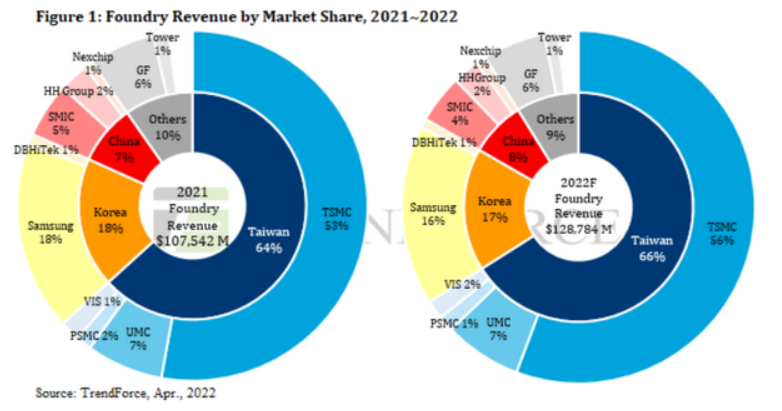
In some ways, we have a rock covering the well of Taiwanese chip production. On the surface, one company has a monopoly on the manufacturing of one of the key pieces of equipment needed to fabricate the most advanced chip technology. ASML, a Dutch company, makes an extreme ultraviolet lithography machine that costs $150M to purchase and needs to be transported to a customer in three fully-loaded 747 planes. These machines require components from over 800 suppliers located all over the world. For a sense of the scale of this supply network, consider that Apple has over 180 suppliers across all of its products. If ASML’s network of suppliers from around the world and the corresponding trade relationships don’t work, there’s no advanced semiconductor to speak of.
There is another way in which we have a rock covering the well. A tension lies between the leading developed markets who have expressed their concern with China’s efforts to exercise its claim on Taiwan. A host of companies, countries, and international organizations have a vested interest in ensuring there aren’t disruptions to the flow of semiconductors and other goods through that part of the world. This massive, delicate game of positioning is taking place, putting a rock on Taiwan, keeping it independent, at least for now.
The analogy doesn’t fully hold for an important reason. The US has led an effort to box China out from accessing advanced chip technology from Taiwan. The core reasoning behind this is to prevent China from gaining the technology it could use in applications spanning the military and surveillance, with all powered by artificial intelligence. Export controls and sanctions on companies like Huawei have blocked China from gaining access to this technology and inhibiting the deployment of its own technology globally.
What are our options?
It seems we have three options in front of us: war, sustained tension, or a release valve in the form of new technology. In a war scenario, we see the global powers go at it over Taiwan’s status as a state. The result would be an enormous amount of destruction. A huge toll on human life and the economies of these countries. There would then be some sort of reset. This is the bad outcome we should work and pray against. Sustained tension brings continued threats and jockeying. It’s hard to imagine how this continues as the US and other countries actively see to choke off China’s access to Taiwan’s technology. Conflict of some sort is likely to emerge from this. The third option is new technology emerges, relieving the pressure cooking in the Taiwan strait as more options emerge for generating the computing power the world needs.
The word abundance comes to mind, figuring out a way to have technology that leverage new materials and techniques to fabricate the technology we expect for this digital world, and developing that technology with the mindset that there is enough for everyone. Unfortunately, conflict is in us, and global society is not currently structured for abundance. We are in a contest to determine or redetermine the global world order, with China and the US as the two poles. Even with the emergence of new technologies, we will figure out a way to try and box each other out, lay claim to these new technologies, and find our way to conflict. James 4:1-5 comes to mind:
What causes quarrels and what causes fights among you? Is it not this, that your passions are at war within you?
Holding up hope in sober times
We are in exponentially complex times where the interplay between technology, trade, and geopolitics exposes the challenge we face in maintaining peace while building the future. My hope is that we find ways to trust one another and collaborate. The reality is much more sobering , as we see nations compete for control, resources, and power. As we continue to reach new technological heights, it is vital that we figure out how to cultivate trust among nations and individuals. We should push ourselves to tap into an abundant mindset, where collaboration and shared resources replace the fixed pie mentality that leads to conflict. That is how we navigate times as complex as the current.
 Kwame Som-Pimpong