
The more I read and study Africa’s history, the more I realize I don’t know. Part of that feels overwhelming. More of it is encouraging. The little I’ve scratched shows so much richness, and there is so much more to uncover.
The more I talk with Black folks in Africa and the diaspora, the more I see how little most of us were given. We know a lot of ancient and biblical history from our sacred texts and a lot of Western history from school. We know a bit of African history, mostly from the slave trade and colonial rule forward, with a little before.
I sketched it as a chart, “the african consciousness.”
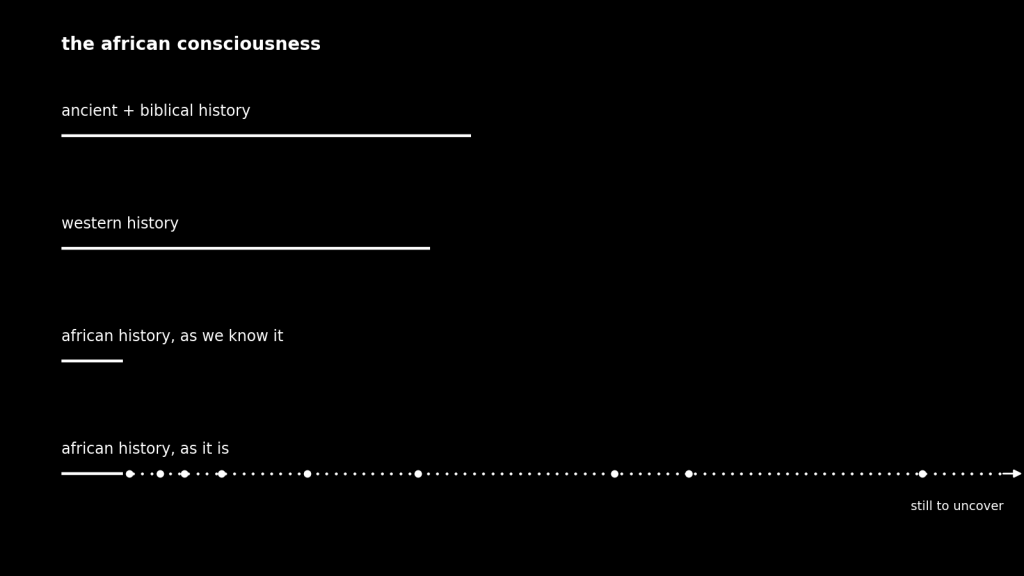
The top lines are illustrative. Only the bottom timeline is to scale: the solid stub is roughly the last 500 years, Kemet goes back about 5,000, Nabta Playa about 7,000, and the human story in Africa about 300,000. At that scale the dotted line runs hundreds of screens past the edge.
A review of five US high school world history textbooks found 57 to 62 percent of the content was about Europe. In a 2022 Pew survey, only 23 percent of Black Americans who know some Black history said they learned most of it in K-12 school. 43 percent said family and friends.
I believe the implications of this gap are social, political, and economic.


Leave a Reply